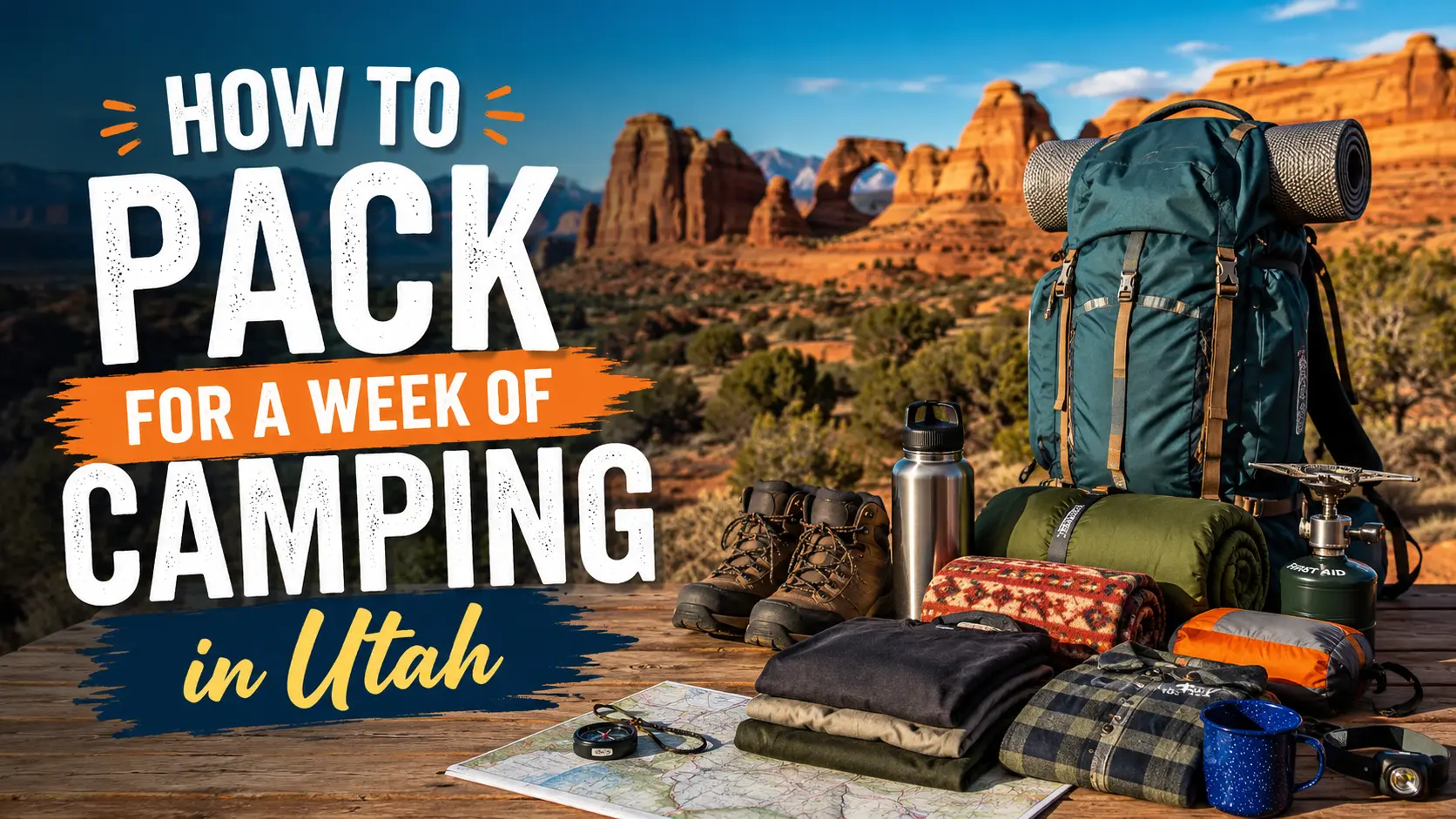
How to Pack for a Week of Camping in Utah 2026
How to Pack for a Week of Camping in Utah. One minute you’re shivering under a starry sky in Bryce Canyon at 30°F, and the next, you’re sweating through your shirt hiking The Narrows in Zion at 85°F. If you are heading to the Mighty Five (Zion, Bryce, Capitol Reef, Arches, Canyonlands) or the remote stretches of the Escalante, knowing how to pack for a week of camping in Utah is the difference between a spiritual awakening and a miserable flight home.
I’ve spent countless nights on the red dirt of this state. You don’t need a massive RV, but you do need a smart system. Here is my exact, battle tested gear guide for a week off grid in the Beehive State.
Why Utah Demands a Unique Packing Strategy
Most states have one season. Utah has four often in a single day.
The high desert air is thin. Without humidity to trap heat, the moment the sun dips behind a mesa, the temperature plummets. You need layers that can handle a scorching midday hike and a freezing 3 AM bathroom run. Plus, water is scarcer here than a cheap hotel near Moab in April. Your packing list needs to solve for survival, not just comfort.
Best times to use this packing list: April–May and September–October. Summer (June–Aug) is dangerously hot for camping unless you have a shade shelter. Winter (Nov–Feb) requires cold weather upgrades.
The Golden Rule: How to Pack for a Week of Camping in Utah
Before we get into the lists, memorize this. Cotton holds moisture. When you sweat in Utah’s dry air, that sweat evaporates too fast if you’re in cotton, leading to chilling. Worse, if you get wet in a slot canyon, cotton stays wet for hours. You want merino wool or synthetic fabrics.
Part 1: The Shelter & Sleep System (Your Desert Fortress)
You aren’t camping in a lush forest. You are camping on sandstone, dust, and cryptobiotic soil. Here is how to survive the night.
Tents & Ground Protection
- Double Wall Tent: The wind in places like Canyonlands can snap cheap poles. Bring a freestanding tent with a full coverage rainfly. You likely won’t get rain, but the fly helps with morning dew and wind.
- Footprint (Groundsheet): Mandatory. The Utah ground is sharp. A $10 tarp saves a $300 tent.
- Sand Stakes (MSR Groundhog or similar): The standard thin wire stakes will pull right out of the sandy soil in Moab. Bring 6–8 heavy duty stakes.
Sleeping Bags & Pads
- Temperature Rating: Look for a bag rated 20°F to 30°F. You can unzip it if it’s warm, but you cannot add insulation if you froze.
- Insulated Sleeping Pad (R-Value 4+): The ground acts as a heat sink. You need an insulated pad (like a Therm a Rest XTherm). An uninsulated air mattress will freeze your back.
Pro Tip: Bring a lightweight sleeping bag liner (silk or fleece). It adds 10° of warmth and keeps your bag clean from the red dust that gets everywhere.
Part 2: The Layer System (Your 24-Hour Wardrobe)
You will wear the same three shirts all week. Embrace it. Here is the exact capsule wardrobe for 7 days.
The Base Layer (What touches your skin)
- 2 Merino Wool T-Shirts (150gsm): They resist odor for days. I wear one, pack one.
- 1 Long Sleeve Merino Crew: For chilly mornings or sun protection.
- 3 Pairs of Merino Wool Hiking Socks (Darn Tough or Smartwool): Rotate them. Wash one in a Ziploc with Dr. Bronner’s soap if needed.
- Hiking Underwear (ExOfficio or Saxx): 3 pairs. Quick dry only. No cotton.
The Mid Layer (Insulation)
- 1 Synthetic or Down Puffy Jacket (Patagonia Nano Puff or similar): This is your emergency warmth. Packs into its own pocket. You will wear this every single night.
- 1 Fleece Pullover (Grid fleece is best): For active walking in the cold morning.
The Outer Layer (The Shield)
- 1 Rain/Wind Shell (Gore-Tex or similar): Even if the forecast says 0% rain, slot canyons flood, and afternoon monsoons hit in August. A wind shell stops the chilling effect of 30mph gusts in Factory Butte.
The Bottoms
- 1 Pair of Hiking Pants (Convertible zip offs are great): I prefer lightweight, stretchy fabric (like Prana Stretch Zion).
- 1 Pair of Hiking Shorts: For the hot afternoons in Arches.
- 2 Pairs of Leggings or Thermal Bottoms: To sleep in or layer under pants for cold mornings.
Part 3: The Utah “Red Rock” Footwear
The slickrock is sticky, but the gravel is sharp. The sand is deep, but the water crossings are wet.
- Hiking Boots (Mid Height): You want ankle support for carrying water weight over uneven terrain. Do not break in new boots in Utah. Wear broken-in boots.
- Water Shoes or Old Trail Runners: For The Narrows in Zion or Kanarra Creek. Submersion in 50°F water ruins leather boots.
- Camp Sandals (Crocs or Tevas): Trust me. After a 12 mile hike, your boots will feel like torture devices. Slip these on to walk to the vault toilet.
Part 4: The “Life Support” Kit (Water & Food)
Utah is a dehydration trap. Your sweat evaporates so fast you don’t realize you are losing fluids.
Water Management (The Non Negotiable)
- Capacity: 1 Gallon per person/per day. That is 7 gallons for a week. You cannot rely on backcountry sources.
- Primary Jug: 5-7 Gallon Reliance Aqua Tainer. Cheap, durable, fits in the car.
- Day Pack Bladder (3L Camelbak): For hikes longer than 2 miles.
- Backup Bottles: 2 x 1L Nalgene bottles.
- Filter System (Sawyer Squeeze or Katadyn BeFree): Even if you don’t think you need it, the Green River or Pine Creek might be flowing. A filter saves you carrying 10lbs of water on a long day hike.
Food Strategy (No Refrigeration Required)
You are in bear country (black bears in the La Sals and Uintas), but more importantly, raven country. Those birds will unzip a tent for a granola bar.
- Bear Canister or Ursack: Required in some areas (like Zion backcountry). At minimum, use an odor proof bag and hang it.
- Meal Plan:
- Breakfast: Oatmeal packets + instant coffee + protein powder.
- Lunch: Tortillas + peanut butter + honey + salami sticks (no refrigeration needed).
- Dinner: Freeze dried meals (Mountain House) or Knorr rice sides + tuna pouches.
- The Jetboil or MSR PocketRocket: One small stove. Bring two small fuel canisters. One is usually enough, but wind kills fuel efficiency.
Part 5: Navigation & Safety (The Search & Rescue Avoidance Kit)
Cell service is zero in Capitol Reef and spotty at best in Moab. You are your own rescue.
- Downloaded Offline Maps (Gaia GPS or OnX): Do this before you leave home.
- Physical Map & Compass: For the Needles District of Canyonlands. Know how to use them.
- Garmin inReach (or similar PLB): If you are going deep into the Dirty Devil or Hole in the Rock road, rent one. It saves lives when a car breaks down 50 miles from pavement.
- Headlamp (Black Diamond or Petzl): Bring two. And spare AAA batteries. The sun sets fast behind the mesas.
Part 6: The “Dirt Bag” Hygiene Kit (Leave No Trace)
You won’t have a shower. Here is how to not smell like a wildebeest by day 4.
- Biodegradable Soap (Dr. Bronner’s): Use 200 feet away from any water source.
- Wet Wipes (Dude Wipes or Unscented Baby Wipes): Your best friend. Pack them out in a Ziploc.
- Hand Sanitizer: Use before every meal. Giardia is real.
- Microfiber Towel: Dries in 10 minutes.
- Trowel (Deuce of Spades): If there is no vault toilet, you dig a 6-inch cat hole. No rocks, no flowers. Bury your waste.
Part 7: The Hidden Gems Packing List
Since you are on Hidden Trip USA, you aren’t going to the crowded trailheads at 9 AM. You are going to Goblin Valley or Cedar Mesa. Bring these extras:
- Red Light Headlamp Mode: Keeps your night vision for watching the Milky Way from Dead Horse Point.
- Dust Mask (Bandana): The dirt roads to places like The Burr Trail are silty. A 4×4 convoy will leave you in a brown cloud.
- Trash Bags (Heavy Duty): Leave no trace. But also, if you rip a tire on Schneider Hill, a trash bag is a makeshift tarp or rain jacket.
Also Read : 10 Best Hidden Gem Beaches in Southern California
The “Mom, I’m Safe” CTA
Before you zip your bag, take a photo of your packing setup. Text your family your itinerary which campsite, which trailhead, and when you check in next. The rangers at Hans Flat (Canyonlands) will thank you.
Frequently Asked Questions (FAQs)
Can I camp for a week in Utah without a 4×4 vehicle?
Yes, but you will be limited. You can easily camp for a week in established campgrounds (Watchman in Zion, Devils Garden in Arches) with a sedan. To reach hidden spots (like Cathedral Valley in Capitol Reef), you need high clearance and 4×4. Check road conditions at the visitor center first.
What is the absolute worst thing to pack for Utah camping?
Denim jeans. If they get wet (river crossing or sweat), they take 12+ hours to dry in the dry air and will chafe you raw. Leave the Levi’s at home.
How do I keep my food cold without a fridge?
Don’t bring ice dependent food. Use shelf stable items (pouches of chicken, hard cheese like aged cheddar, shelf stable tofu). If you must have a cooler, use block ice (lasts longer than cubes) and a high end rotomolded cooler (Yeti/RTIC). Keep it in the shade.
Do I really need a sleeping bag rated for 20°F in July?
In July at lower elevations (Moab 5,000ft), a 40°F bag is fine. But if you camp at Bryce Canyon (8,000-9,000ft) in July, it can drop to 35°F at night. A 20°F bag is the safest “one bag fits all” for Utah.
How do I pack out toilet paper?
Use a double Ziploc system (one inside the other). Add a little baking soda to the outer bag to kill the smell. Pack it in a dry bag inside your trash kit. Or better, use a backcountry bidet (a bottle cap attachment) and skip the TP mess.
What shoes should I wear for The Narrows in Zion?
Rent the special canebrake water boots and neoprene socks from an outfitter in Springdale. Do not use your hiking boots. Do not use sandals (you will break a toe on submerged boulders).
Is it safe to drink water from Utah creeks even with a filter?
Generally yes, but be cautious downstream of grazing areas (cows = giardia). A standard Sawyer Squeeze or Katadyn filter removes bacteria and protozoa. Chemical treatment (Aquamira) is a good backup. Do not drink from the Colorado River directly without a high end filter rated for silt.
How many gallons of water should I pack in my car for 7 days?
Seven gallons per person minimum for drinking, cooking, and washing. Add another 2 gallons for emergencies. That is roughly 75 lbs of water. Distribute the weight evenly in your vehicle.
Can I wash my hair in a Utah campsite?
Technically yes, but only with biodegradable soap at least 200 feet from any water source (streams, potholes, seeps). Use a spray bottle with water and a tiny drop of Dr. Bronner’s. Rinse sparingly. Most people just use a buff or hat for the week.
What is the one luxury item you recommend for a week-long trip?
A pillow. Not a stuff sack full of clothes. A real camping pillow (like Nemo Fillo). After 6 nights on a sleeping pad, your neck will thank you. Second place: a Helinox Chair Zero. Sitting on a log is romantic for one night, hellish for six.
Conclusion
Packing for Utah isn’t about bringing everything you own. It is about managing three variables: water, temperature swings, and self rescue. If you follow this guide on How to Pack for a Week of Camping in Utah, you will sleep warm, hike strong, and have energy left to watch the sunrise hit the Wingate sandstone.
Now, get that gear in the trunk, fill up your water jugs, and drive toward the desert. The arches are waiting.