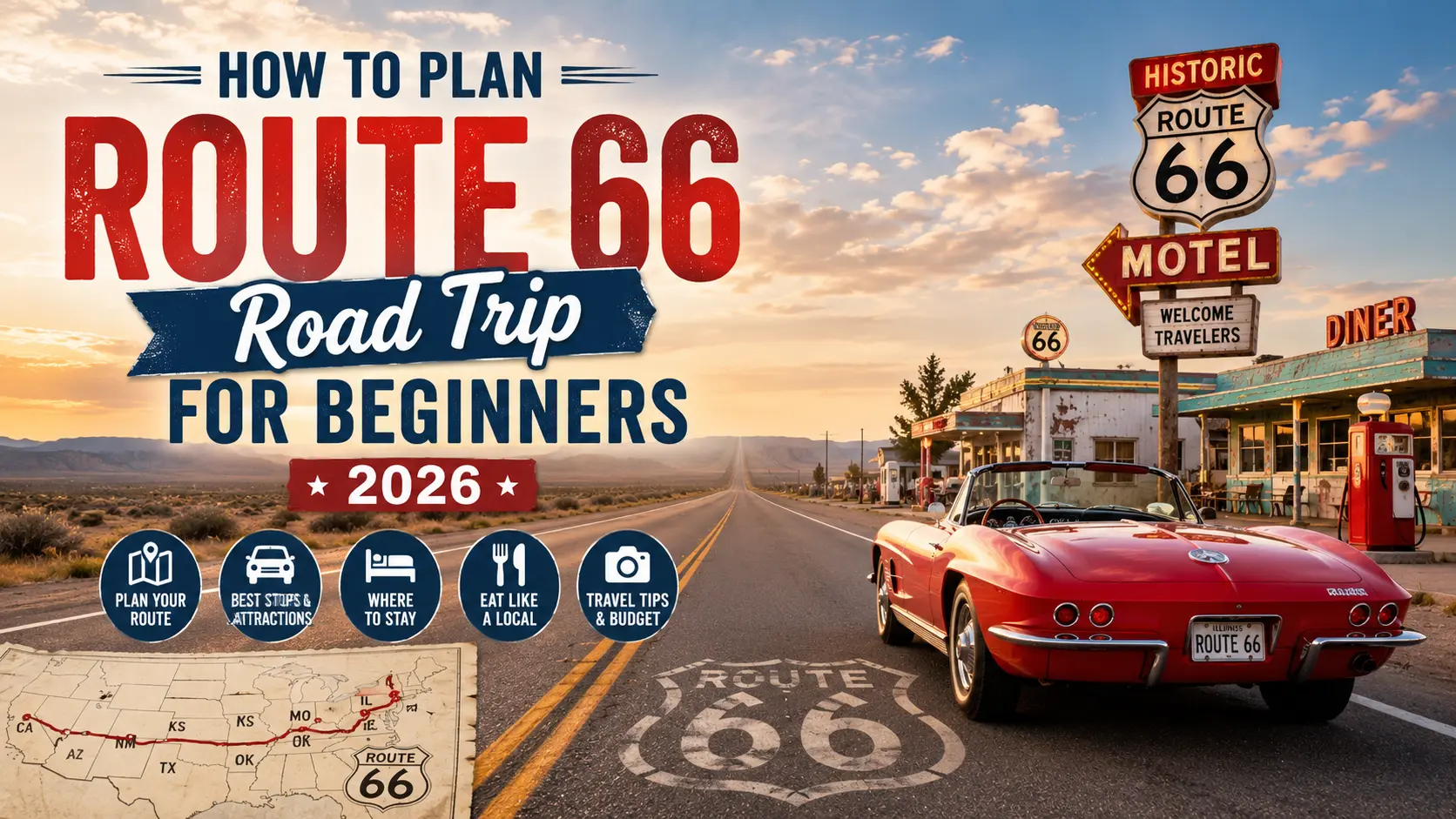
How to Plan Route 66 Road Trip for Beginners 2026
How to Plan Route 66 Road Trip for Beginners. You’ve seen it in movies. You’ve heard the song on repeat. The idea of rolling down a dusty two lane blacktop with the windows down and a milkshake in your hand feels like freedom.
But let’s be real. Planning the Mother Road is intimidating.
I remember staring at a map of Route 66 thinking, “Where do I even start?” Unlike an interstate where you just drive straight, Route 66 is a ghost. It fragments, changes names, and hides behind overpasses.
If you are a first timer, you need a game plan. You need to know what to skip, what to see, and how to stay off the boring highways.
This guide on How to Plan Route 66 Road Trip for Beginners will save you hours of frustration. We are going to cover the perfect itinerary, the best time to drive, where to sleep in vintage motels, and the hidden gems that most tourists miss.
Grab a coffee. Let’s hit the road.
Why Route 66 Still Matters (And Why You Should Drive It Now)
Before we dive into logistics, let’s talk about the magic.
Route 66 isn’t just asphalt. It is the spine of 20th century America. Built in 1926, it connected Chicago to Santa Monica. It carried Dust Bowl migrants to California and families on their first “vacation.”
Today, 85% of the original road is still drivable. But it is disappearing. Some sections are now gravel. Historic bridges collapse yearly. Driving it now is like visiting a museum before it closes.
For beginners, the appeal is simple:
- No huge RVs required. You can do this in a rental sedan.
- It’s cheap. Many attractions are free or cost $5.
- You control the pace. There is no tour bus schedule.
The road teaches you patience. You will drive through cornfields in Illinois, red rocks in Arizona, and neon signs in New Mexico.
The Best Time to Drive Route 66 for Beginners
Timing is everything. If you pick the wrong month, you will be miserable.
The Goldilocks Window: May, September, and early October
- May: Wildflowers in Arizona. Mild temps in Texas. Before the summer crowd hits.
- September: Summer heat breaks. Kids are back in school. Motels are cheaper.
- October: Cool mornings. Perfect for walking historic districts. Avoid late October in Illinois (rain).
Months to avoid (as a beginner):
- July & August: The desert will try to kill you. 110°F in Needles, California. Your car AC will struggle.
- December & January: Snow closes the high altitude sections in New Mexico and Arizona. Also, many small-town diners close for the season.
Pro tip: If you only have summer vacation, start in Santa Monica (west) and drive east. The coast is cooler, and you work your way into the heat slowly.
How Many Days Do You Really Need?
This is the 1 question from beginners.
The “Tourist Trap” answer: 7 days. (Too rushed. You will hate it.)
The realistic answer: 10 to 14 days.
The dream answer: 3 weeks.
Let me break it down.
- Chicago to St. Louis (2 days): You need time for the historic sites and the traffic.
- St. Louis to Oklahoma City (2 days): The Ozarks are curvy. Don’t speed here.
- Oklahoma City to Albuquerque (2 days): This is where the desert starts. You will stop for every photo.
- Albuquerque to Flagstaff (2 days): Petrified Forest, Painted Desert, meteor crater.
- Flagstaff to Santa Monica (3 days): Oatman, the Mojave, and LA traffic.
For beginners, I strongly suggest 14 days. You will not feel rushed. You can stop for the random “World’s Largest Rocking Chair” without feeling guilty.
How to Plan Route 66 Road Trip for Beginners
Let’s build your plan from scratch.
Choose Your Direction (East to West vs. West to East)
- East to West (Chicago to LA): The classic way. You follow the sunset. You end at the Pacific Ocean. Psychologically, this feels like “completing” the journey.
- West to East (LA to Chicago): Easier for navigation because the sun is behind you in the morning. Also, you avoid LA traffic on day one.
My advice for beginners: Go East to West. The landmarks are signposted better in this direction. Plus, ending at the Santa Monica Pier feels like a victory lap.
Rent the Right Car (Don’t Be a Hero)
You do not need a classic 1960s muscle car. They break down.
Best rental for Route 66:
- Mid-size SUV (Honda CR-V, Toyota RAV4). Why? You will hit gravel roads in Arizona (Oatman) and rutted pavement in Illinois. An SUV handles this without killing your back.
- Gas tank: Aim for 400+ miles range. Gas stations close at 8 PM in rural Texas.
- Avoid: Low-profile tires (they pop on potholes) and convertibles (the desert sun will fry you).
Hidden tip: Join the free loyalty program at Enterprise or Hertz. They often upgrade you to an SUV at no cost if you ask politely.
Paper Maps vs. GPS – You Need Both
Your phone will lose signal. A lot.
- Buy the “EZ66 Guide” by Jerry McClanahan. This is the bible. It has turn by turn instructions that GPS doesn’t show.
- Download offline Google Maps for each state.
- Use the “Route 66 Navigation” app (free, but donate). It pings when you veer off the modern interstate.
Do not rely on your car’s built-in GPS. It will try to put you on I-40 every single time. You want the frontage roads.
The Perfect 14 Day Route 66 Itinerary for Beginners
Here is the exact route I took. Save this.
Days 1-3: Illinois & Missouri (The Birth of the Road)
Day 1: Chicago to Joliet (50 miles)
- Start at Lou Mitchell’s (breakfast). They give donuts to travelers.
- See the Route 66 Begin Sign on Adams Street.
- Drive the original brick road in Joliet.
- Sleep: The Historic Route 66 Motel in Gardner. Cheap. Clean. Neon sign works.
Day 2: Joliet to Springfield (150 miles)
- Stop at The Ariston Cafe in Litchfield. Oldest continuously operating cafe on 66.
- See the “Soulsby Service Station” in Mount Olive. It looks exactly like 1926.
- In Springfield: Lincoln sites + The Cozy Dog Drive In (inventor of the corn dog).
- Hidden gem: Henry’s Rabbit Ranch. A weird, wonderful place with VW rabbits pretending to be cows.
Day 3: Springfield to St. Louis (100 miles)
- Cross the Old Chain of Rocks Bridge (walk it – it’s stunning).
- In St. Louis: Skip the Arch (too touristy). Go to Ted Drewes Frozen Custard instead. Get a “concrete” (it’s so thick they hand it to you upside down).
Days 4-6: Kansas, Oklahoma & Texas (The Flatlands of Nostalgia)
Day 4: St. Louis to Carthage, MO (250 miles)
- Stop at The Wagon Wheel Motel in Cuba, MO (oldest motel on 66).
- See the Munger Moss Motel sign in Lebanon.
- Detour to Galena, Kansas (just 13 miles). Why? This is where the real “Tow Mater” from Cars is. A rusted 1951 boom truck named “Tow Tater.”
Day 5: Carthage to Oklahoma City (200 miles)
- The Blue Whale in Catoosa. Perfect photo op.
- POPS in Arcadia. A 66 foot tall soda bottle. They sell 700 kinds of soda.
- Oklahoma City National Memorial. Quiet. Powerful. Worth the tears.
Day 6: OKC to Shamrock, Texas (150 miles)
- The Tower Station and U-Drop Inn in Shamrock. The inspiration for Ramone’s body shop in Cars.
- Pro tip: Eat at The Big Texan in Amarillo. Do the 72-oz steak challenge if you hate your stomach. Otherwise, just get the fried okra.
Days 7-10: New Mexico & Arizona (The Postcard Section)
Day 7: Shamrock to Santa Fe (detour, 200 miles)
- You leave 66 briefly to go to Santa Fe. Worth it.
- Stay at El Rey Motel (retro with kiva fireplaces).
- Eat green chile cheeseburgers at The Shed.
Day 8: Santa Fe to Gallup (200 miles)
- Back on 66 via Albuquerque. Drive the “66 Diner” and see the KiMo Theatre.
- Stop at El Rancho Hotel in Gallup. Every movie star from the 1940s slept here. Ask for the “John Wayne” room.
Day 9: Gallup to Holbrook (150 miles)
- Petrified Forest National Park. Seriously underrated. The Painted Desert looks like a Mars postcard.
- The Wigwam Motel in Holbrook. Sleep in a concrete teepee. No AC, but that’s the experience.
Day 10: Holbrook to Flagstaff (100 miles)
- Two Guns, Arizona. A ghost town with a killer view. Haunted. Do not go at night.
- Meteor Crater. $25 entry. Worth it once.
- In Flagstaff: Eat at Diablo Burger (local lamb burger).
H3: Days 11-14: California (The Grand Finale)
Day 11: Flagstaff to Oatman (180 miles)
- Sitgreaves Pass. A winding mountain road that will test your nerves. But the view at the top?
- Oatman, AZ. Wild burros walk the streets. They will stick their heads in your car for a carrot. Do not feed them (illegal), but they don’t know that.
- Sleep: Oatman Hotel – supposedly haunted by a gambler.
Day 12: Oatman to Amboy to Barstow (150 miles)
- Roy’s Motel & Cafe in Amboy. The most photographed gas station on earth.
- The Bottle Tree Ranch in Oro Grande. A folk art forest of glass bottles.
- Elmer’s Bottle Tree Ranch (two different ones – see both).
Day 13: Barstow to Santa Monica (250 miles)
- The original McDonald’s Museum in San Bernardino. Yes, Ray Kroc built this.
- The Santa Monica Pier. Find the “End of the Trail” sign.
- Celebration dinner: The Albright on the pier. Fish and chips with a Pacific sunset.
Day 14: Buffer day. You will need it. Something will go wrong (flat tire, closed road, or you just want to stay in Oatman longer). Build this day in.
Also check :10 Best Dynamic AI Travel Planner for USA Trip Options
How Much Does a Route 66 Road Trip Cost for Beginners?
Let’s talk money. I drove this on a budget of $125/day for two people. You can do it cheaper.
Daily breakdown (per person, mid range):
- Gas: $30 (assuming 25 MPG, 200 miles/day)
- Motel: $60 (split a $120 room)
- Food: $35 (breakfast diner, lunch sandwich, dinner sit down)
- Attractions: $10 (mostly small museums)
- Total: $135/day
Ways to save:
- Sleep in KOA cabins ($50/night) instead of motels.
- Pack a cooler. Grocery stores in small towns are 40% cheaper.
- Buy a National Parks Pass ($80) if you visit Petrified Forest, Grand Canyon (detour), or Joshua Tree.
Expensive mistakes to avoid:
- Buying souvenirs at gift shops (same stuff at Walmart for 1/3 price).
- Eating at the “historic” diners every meal (they are expensive. Do one per day).
10 Hidden Gems on Route 66 (Most Beginners Miss)
These are not in the typical guidebooks.
- The Gay Parita Sinclair Station (Paris Springs, MO). A restored 1920s station where the owner, Gary, tells stories for free. Look for the “Mobilgas” sign.
- The Devils Elbow Bridge (Missouri). A single lane, blind curve bridge over the Big Piney River. Honk before you cross.
- The Catoosa Whale (OK). Yes, you know the whale. But climb inside it. There is a rusty spiral slide.
- Sand Hills Curiosity Shop (Erick, OK). Run by 80 year old Harley and Annabelle. They will sing you a song for $1.
- The Leaning Tower of Texas (Groom, TX). Not Pisa. A 200 foot tall water tower built to fall over. It never did.
- The Tee Pee Curios (Tucumcari, NM). A tepee shaped like a gift shop. Buy a rubber rattlesnake.
- The Blue Swallow Motel (Tucumcari, NM). Book 6 months in advance. Every room has a garage attached. You park your car inside.
- Jack Rabbit Trading Post (Joseph City, AZ). Sit on the giant fiberglass rabbit. The sign says “Here it is.”
- The Hackberry General Store (Hackberry, AZ). A junkyard of old cars and gas pumps. Best free photo spot.
- The Madonna of the Trail (Upland, CA). A weird 12 foot statue of a pioneer woman holding a baby and a rifle. Very odd. Very Route 66.
What Beginners Forget to Pack (Essential List)
You remember sunscreen. You forget these five things.
- Paper towels & Windex. Your windshield will be a cemetery of bugs from Texas to New Mexico. Gas station squeegees are always broken.
- A physical road atlas. When your phone dies in the Mojave Desert, you will panic. The $10 Rand McNally saves you.
- Spare phone charger & battery pack. Not just a cable. A full 20,000 mAh pack.
- Cash (small bills). Several “honor system” farm stands in Illinois and Missouri take cash only. Also, toll roads near Chicago.
- A pillow. Motel pillows are the size of a postage stamp and filled with sadness.
Critical Safety Tips for Beginner Route 66 Drivers
This is not a joke. The road is mostly safe, but mistakes happen.
- Fill up at half a tank. Between Kingman, AZ and Needles, CA, there is 120 miles with zero gas stations. I mean zero.
- Do not drive at night. Besides the wildlife (deer, coyotes, javelinas), the pavement markings on original 66 are faded. You will drive off a cliff in Arizona.
- Check your spare tire. Most rental cars have a “donut” spare. That won’t survive 20 miles of gravel. Ask the rental desk for a full-size spare.
- Watch for “Road Closed” signs. Locals sometimes remove them as a joke. If a sign says closed, believe it. I learned this the hard way in New Mexico.
- Tell someone your daily route. Cell service drops for hours in the Texas Panhandle. Send your ETA to a friend before you leave each morning.
Where to Find the Best Route 66 Food (By State)
- Illinois: Horseshoe sandwich (open face burger with fries and cheese sauce) at D’arcy’s Pint in Springfield.
- Missouri: Gooey butter cake at Park Avenue Coffee in St. Louis.
- Kansas (short detour): Fried chicken at Chicken Mary’s in Pittsburg.
- Oklahoma: Onion burger at Sid’s Diner in El Reno.
- Texas: Chicken-fried steak at The Midpoint Cafe in Adrian (the exact midpoint of Route 66).
- New Mexico: Carne adovada (pork in red chile) at The Range Cafe in Bernalillo.
- Arizona: Navajo taco (fry bread with beans, meat, cheese) at The Historic Navajo in Holbrook.
- California: Date shake at The Wheel Inn in Cabazon (next to the giant dinosaurs).
Frequently Asked Questions (FAQs)
Is Route 66 safe for a solo female traveler?
Yes, with normal precautions. Small town America on 66 is actually safer than big cities. Stay in motels with well lit parking lots (Blue Swallow, Wagon Wheel). Avoid walking alone in Albuquerque after 10 PM. Thousands of solo women drive it yearly.
Can I drive Route 66 in a Tesla or electric car?
Yes, but it’s difficult. You need the CCS adapter. Chargers exist in Tulsa, OK, Amarillo, TX, and Flagstaff, AZ. However, the 120-mile stretch between Kingman and Needles has no chargers. You will need a portable Level 2 charger and an RV park hookup.
How much of the original Route 66 is still drivable?
About 85%. The missing 15% is either under I-40, on private land, or collapsed bridges. The EZ66 guide shows you the detours. You never have to get on the interstate for more than 10 miles.
Do I need a 4×4 vehicle?
No. A sedan can do 99% of the road. The only tricky part is the 8 mile gravel section east of Oatman, AZ. Go slow (15 MPH) and you’re fine. A 4×4 is overkill.
What is the most skipped but best stop on Route 66?
The Petrified Forest National Park. Most people drive past because it costs $25. But the Painted Desert and the Crystal Forest trail are breathtaking. Go at sunset. You will have the place to yourself.
How early should I book motels?
For the famous ones (Blue Swallow, Wigwam, El Rancho), book 6 months ahead for May-October. For generic chains (Motel 6, Super 8), you can book same day. Avoid booking through third-party apps (Booking.com etc.) in small towns they overbook. Call the motel directly.
What is the hardest day of driving for a beginner?
Day 11: Flagstaff to Oatman. You have mountain curves (Sitgreaves Pass), potential snow (even in May), and wild burros in the road. Start at 7 AM. Finish by 4 PM. Do not do this section in the dark.
Is Route 66 well marked?
In Illinois and Missouri, yes (brown “Historic Route 66” signs). In Texas and New Mexico, no. You will lose the road. That is why you need the paper map. GPS will betray you.
Can I bring my dog?
Yes. Most mom and pop motels allow dogs for a $10-20 fee. The Wigwam Motel does NOT allow dogs. Neither does the Oatman Hotel. Always call ahead. The Chain of Rocks Bridge (IL) is dog friendly.
What happens if my car breaks down in the middle of nowhere?
Stay with the car. Do not walk for help. Call your rental’s roadside assistance. If you have no signal, wait. Another traveler will come by within 30 minutes on 66 (unlike an interstate). The locals have a tow truck driver on speed dial. Offer them $40 for the call.
Conclusion
Planning the Mother Road feels overwhelming. But here is the secret: You don’t have to plan every mile.
The best moments on Route 66 are the wrong turns. The “Closed” signs that lead to a better road. The old mechanic who waves you into his garage just to show you his 1932 Ford.
You now know How to Plan Route 66 Road Trip for Beginners. You have the itinerary, the budget, and the hidden gems.
All that is left is to turn the key.
Your first step tonight: Go to Amazon and buy the “EZ66 Guide” (used copies are $10). Then, on your calendar, pick a start date. Even if it is 6 months away. Commitment is everything.
Now I want to hear from you: Are you planning a solo trip, a family adventure, or a buddies’ cruise? Drop a comment below. And if this guide saved you time, share it with someone who needs to get off the interstate.