
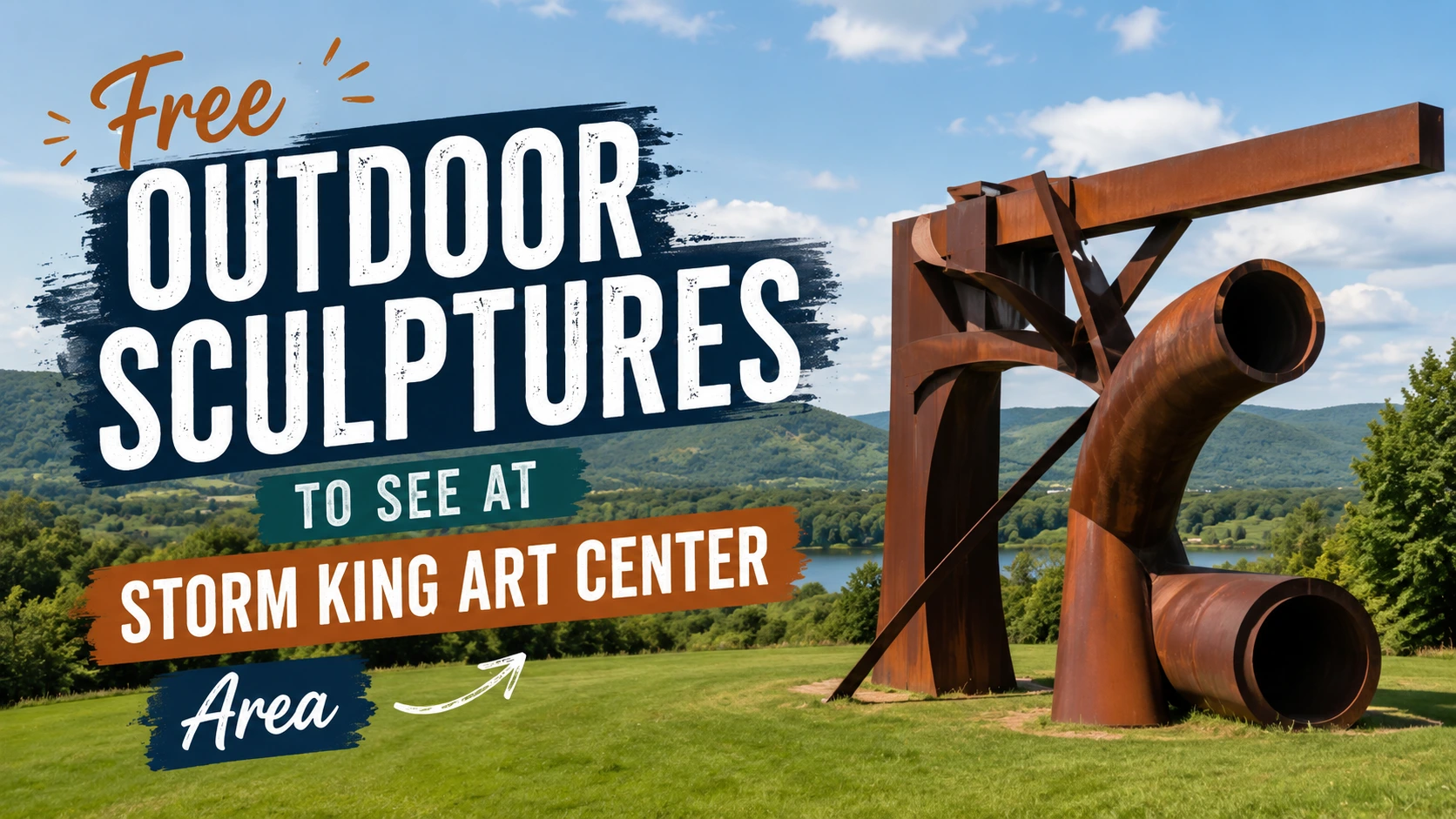
Free Outdoor Sculptures Near Storm King Art Center 2026

Free Outdoor Sculptures Near Storm King Art Center. There’s a moment when you’re standing in a vast meadow in New York’s Hudson Valley, surrounded by rolling hills and sky, and you spot a 50 foot tall steel sculpture rising from the grass like it’s always been there . That’s when Storm King Art Center gets you .
Located about an hour north of New York City this 500 acre outdoor museum is one of the largest collections of contemporary outdoor sculpture in the United States . With over 250 works scattered across the landscape , it’s the kind of place where art and nature don’t just coexist they elevate each other .
What makes Storm King truly special isn’t just the size of its collection but how the Free Outdoor Sculptures Near Storm King Art Center area interact with the changing seasons , light and terrain . Walking through the grounds feels less like visiting a museum and more like stumbling into a secret world where giant artworks have taken root in the countryside . Let me take you through everything you need to know for an unforgettable visit.
What Makes Storm King Art Center So Special?
A Brief History of This Hudson Valley Gem
Storm King Art Center opened its doors in 1960, founded by Ralph E. Ogden and H. Peter Stern, who were business partners at a local factory that produced metal fasteners . Originally a 180-acre property showcasing works by Hudson River School artists, everything changed in 1967 when the center purchased 13 sculptures by the American Abstract Expressionist artist David Smith . This marked the moment the museum expanded beyond its building and into the landscape itself. Free Outdoor Sculptures Near Storm King Art Center.
Today, Storm King Art Center spans nearly 500 acres, with more than 150 artists represented across the grounds . The collection reads like a who’s-who of modern and contemporary art: Alexander Calder, Richard Serra, Maya Lin, Louise Bourgeois and Andy Goldsworthy, to name just a few . Free Outdoor Sculptures Near Storm King Art Center.
Free Outdoor Sculptures Near Storm King Art Center
The magic of Storm King lies in how each sculpture is placed to interact with its environment. Some pieces anchor themselves to the earth, creating a sense of permanence and weight. Others appear to float or balance impossibly, defying gravity and expectation .
Walking the grounds, you’ll notice how the free outdoor sculptures to see at Storm King Art Center area change with the weather and time of day. Bright sunshine makes colorful pieces pop and creates dramatic shadows. Overcast days give everything a moody, contemplative quality. Rain transforms the steel, making it glisten and darken .
Best Seasons to Visit
Fall is when Storm King truly shows off. The changing leaves create a backdrop so stunning it almost competes with the art. Mid-October is spectacular, with the surrounding mountains ablaze with red and gold .
Spring brings fresh green growth that makes the whole property feel renewed and hopeful. Sculptures seem to wake up along with the landscape .
Summer turns everything lush and full, with tall grasses swaying and wildflowers adding splashes of color. Just be prepared for heat mid-July to mid-August can be muggy and the sculptures lack shade .
Winter strips everything down to essentials , revealing the bones of the landscape and the pure forms of the sculptures. Snow transforms the property into something otherworldly. The center closes during winter but typically reopens in April .
Must See Free Outdoor Sculptures at Storm King
While the center hosts over 250 works, these sculptures are the absolute highlights you shouldn’t miss.
Maya Lin’s Storm King Wavefield
This massive installation from the creator of the Vietnam Veterans Memorial is arguably the crown jewel of Storm King . Made up of seven 400 foot long hills across 11 acres of space, Wavefield brings to mind undulating ocean waves made of grass . You can climb and descend the hills , changing your line of vision and perception of the piece as you interact with it.
Pro tip: The Wavefield is mesmerizing and disorienting in the best possible way. Walk through it, lie down in the grass, and just stare at the sky for a while. It’s completely allowed . Free Outdoor Sculptures Near Storm King Art Center.
Alexander Calder’s The Arch
One of the first pieces you’ll see when you walk onto the grounds, this 50 foot tall steel sculpture is one of five works on site by Calder . Completed just a year before his death , The Arch flows and bends at monumental scale, blooming into the air .
Pro tip: Walk around it completely to see how the shape changes from every angle. Calder was a master of movement, and even his stationary works feel like they’re in motion.
Andy Goldsworthy’s Storm King Wall
Stretching half a mile from Storm King’s western boundary, this fieldstone wall appears to dip into and re-emerge from a pond . Built in part from the remnants of an old stone wall that Goldsworthy found in the nearby woods, the stones were shaped to fit each other with no binding agents used to hold the wall together .
Pro tip: Walk along the wall at your own pace. The terrain can be uneven in places, so watch your footing. The changing seasons alter light and vegetation around the structure, creating different visual experiences each time you visit .
Mark di Suvero’s Pyramidian
This 65-foot-tall sculpture dominates the South Fields, visible from a distance with its beams converging in a skyward point . The beam in the middle was originally a bench on the ground when the piece was installed in 1987 it was hoisted up and suspended with cables a decade later, giving the sculpture the feel of a building under perpetual construction .
Pro tip: Visit in late afternoon when the setting sun creates dramatic shadows through the steel beams.
Menashe Kadishman’s Suspended
A popular photo spot, this sculpture appears to float and balance in mid-air despite the massive size and apparent weight of its weathered steel construction . It’s one of Storm King’s more alluring and beguiling pieces. Free Outdoor Sculptures Near Storm King Art Center.
Pro tip: Try to figure out how it stays up. You won’t be able to see any visible evidence of the engineering holding the piece in place .
Richard Serra’s Schunnemunk Fork
This site specific commission consists of various steel ridges that seemingly poke out of the ground . The title references nearby Schunnemunk Mountain, and the metal plates, which are partially buried transform as you walk around them.
Pro tip: Get up close and touch the steel. You’re allowed to feel the texture and rusted surface.
Ursula von Rydingsvard’s Luba
This cedar-wood sculpture resembles a petrified tree coming apart in sections . The piece was cut freehand with a saw, stacked, and bound with glue, with cast bronze and graphite providing a modern component to this otherwise natural piece.
Pro tip: Notice the texture up close. The wood grain and saw marks tell the story of how it was made.
Isamu Noguchi’s Momo Taro
Consisting of a boulder split in two with a hollow space in between, this sculpture was inspired by the Japanese folk tale of Momotaro, or the Peach Boy . It brings to mind an egg cracked in two and lies within Noguchi’s aesthetic of rounded and solid designs that feel light and open. Free Outdoor Sculptures Near Storm King Art Center.
Pro tip: Look through the hollow space to frame the landscape beyond.
Zhang Huan’s Three Legged Buddha
This massive copper and steel sculpture stands 28 feet high and weighs over 12 tons . It depicts the lower half of a massive, three legged figure, with one foot resting on a human head—a self-portrait of Zhang himself appearing to either emerge from or sink into the earth. Incense can be burned inside the structure, with smoke wafting through openings in the Buddha’s toes, nostrils, and eyes .
Pro tip: Take photos with people standing at the base to get a sense of the scale visitors appear as small as ants .
Chakaia Booker’s A Moment in Time
Located in the Meadows, this sculpture is made from recycled rubber tires transformed into intricate shapes and textures . Walk around and through it to notice details you wouldn’t see in a photo.
Pro tip: Use your sense of smell the rubber has a distinct presence that adds to the experience
Martin Puryear’s Lookout
This brick structure allows visitors to walk inside and stand on a central stone circle . Look up and around you the experience of being inside the artwork is entirely different from seeing it from outside.
Pro tip: Compare this sculpture with other brick structures you’ve experienced. How is it similar? How is it different?
Dennis Oppenheim’s Architectural Cactus 6
Located in the North Woods, this sculpture combines multiple materials and textures . Count how many different materials you can find in it.
Pro tip: Challenge yourself to describe the various parts of this sculpture using different words. What title would you give it?
Rashid Johnson’s Stacked Heads
This piece includes plants used in the sculpture that compare to the plants in the surrounding landscape . Johnson has said, “I always thought it was interesting to make something that people had to take care of.”
Pro tip: Walk around the work from multiple angles and distances. What do you notice from close up that you might not see from far away?
Planning Your Visit to Storm King Art Center
Getting There
By Car: Storm King is about 1.5 hours from New York City. The address for parking is 20 Old Pleasant Hill Rd, New Windsor, NY 12553 . Parking is free during operating hours. Electric vehicle chargers are available through SWTCH .
By Train: Take Metro North Railroad from Grand Central to Beacon Station, which is about 30 minutes from Storm King by car . You can also take NJ Transit from Penn Station or Secaucus Junction to Salisbury Mills Cornwall, about 10 minutes from the center .
By Bus: Coach USA offers daily bus service from Port Authority Bus Terminal/Manhattan directly to Storm King Art Center .
Tickets and Admission
Timed entry tickets are required and must be reserved in advance . Tickets are released in two week blocks and become available on Wednesdays at 12:00 p.m. .
Admission starts at around $25, including on site parking . Kids under 5 are free. Members can visit for free without a reservation, though reservations are still required for the driving tour or shuttle from Beacon train station .
Hours of Operation
Storm King Art Center is typically open Wednesday to Monday from 10:00 a.m. to 5:30 p.m. . The center closes for the winter season and reopens in April .
Getting Around the Grounds
- The property is vast 500 acres with varied terrain including rolling meadows, hills, wooded areas, paved paths, gravel paths and mown lawn .
- Walking: Wear comfortable shoes. You’ll be covering serious mileage, and terrain can be uneven. The friendly docents posted around the sculptures can point you toward the best walking routes .
- Free Tram: The tram runs every 30 minutes if you need a break from walking .
- Bike Rentals: Bikes are available for on site rental only on a first come, first served basis. Helmets are required and encouraged bring your own if possible. Bikes are suitable for individuals 4’7″–6’2″. Personal bikes are not permitted .
- Digital Guide: The Bloomberg Connects app features information about the collection, audio and video commentary by artists and staff, suggested walking routes and activities for kids and families .
Practical Tips for a Perfect Visit
What to Bring
- Comfortable Walking Shoes: Non negotiable. You’ll be walking on grass, gravel paths, and occasionally uneven terrain. Leave the cute shoes at home your feet will thank you .
- Water: The grounds have limited spots to refill, and you’ll be spending hours outside. Bring a refillable bottle.
- Snacks/Picnic: The Outdoor Cafe serves grab and go options during the season, but it’s not always open. Picnics are encouraged and allowed many visitors make a day of it .
- Sunscreen: There’s limited shade across the open meadows.
- Camera: You’ll want to capture these incredible sculptures, though photos rarely do them justice.
What to Know Before You Go
- Allow at least 3 hours for your visit. This isn’t a place you rush through . It rewards slow exploration and the willingness to sit with a piece for a while.
- No touch policy applies to most sculptures, though some are climbable ask the docents which ones kids are allowed to interact with .
- Ball playing and recreational sports are not permitted on the grounds .
- Service animals are welcome. Read Storm King’s visitor policies on the website for full details .
- The indoor galleries offer a nice break from the elements. They house smaller works and rotating exhibitions. The Museum Building and Museum Store are closed for the season but reopen in spring .
Other Places to Visit in the Area
Storm King Art Center is just one highlight of the Hudson Valley. Consider making a weekend of it.
Dia: Beacon
Located a few minutes north and across the Hudson River, Dia : Beacon offers large scale site specific sculptures similar to Storm King’s . It’s a perfect complement for an arts themed weekend .
Brotherhood Winery
America’s oldest winery is just a short drive away. Stop by for a tasting and live music on weekends .
Shawangunk Wine Trail
Storm King could be a pin on the Shawangunk Wine Trail’s map. Palaia Winery is nearby with live music on weekends .
Also Check : Best Scenic Overlooks Along the Mohawk Trail in Massachusetts 2026
Cornwall and New Windsor
The nearby towns offer charming shops, restaurants, and accommodations for an extended visit.
The Experience: What It’s Really Like
Visiting Storm King Art Center is unlike any museum experience. The relationship between the sculptures and their environment is endlessly fascinating to observe . Some pieces seem to grow out of the landscape, as if they’ve always been there. Others create stark contrasts, with their industrial materials and geometric forms standing in deliberate opposition to organic curves and textures.
Some sculptures frame views, directing your attention to specific aspects of the landscape. Others become focal points themselves, drawing your eye and holding it captive . Kids love Storm King because they can run around, explore, and make discoveries on their own. The sculptures are big and bold enough to capture young imaginations without requiring a lot of explanation. Watching children interact with these massive sculptures is genuinely entertaining they ask the kinds of questions that cut right to the heart of what art is and does .
There’s no pressure to be quiet or overly careful. Beyond the basic rule of not climbing on the art, visitors are free to experience the place in their own way. That sense of freedom is part of Storm King’s enduring charm.
Seasonal Considerations
- Spring: Fresh green growth emerges and the sculptures seem to wake up along with the landscape .
- Summer: Lush and full, with tall grasses and wildflowers. The sculptures bask in long days and warm sunshine . The dog days of summer can be muggy and mosquitoes are plentiful bring bug spray .
- Fall: The absolute best time to visit. The changing leaves create an unforgettable backdrop .
- Winter: Stripping everything down reveals the bones of the landscape and the pure forms of the sculptures . The center closes during this season but the snow covered sculptures create otherworldly views if you can visit.
Final Thoughts
Storm King Art Center is more than just a sculpture park it’s a place where art and nature collaborate to create something transcendent. The free outdoor sculptures to see at Storm King Art Center area aren’t just displayed in the landscape; they’re in conversation with it.
Whether you’re an art lover, a nature enthusiast or just looking for a unique day trip from New York City, Storm King delivers an experience you won’t forget. The scale is humbling. The beauty is breathtaking. And the memories you’ll make wandering through those rolling hills will stay with you long after you’ve left.
So pack comfortable shoes, bring a picnic and prepare to be amazed. This is one hidden gem that deserves all the attention it gets.
Frequently Asked Questions (FAQs)
What are the best free outdoor sculptures to see at Storm King Art Center area?
The absolute must sees include Maya Lin’s Wavefield , Alexander Calder’s The Arch, Andy Goldsworthy’s Storm King Wall, Mark di Suvero’s Pyramidian and Menashe Kadishman’s Suspended . You can also see works by Richard Serra, Isamu Noguchi and Zhang Huan. There are over 250 sculptures across the 500 acre property .
How much time should I plan for a visit to Storm King Art Center?
Plan at least 3 hours for your visit. Many visitors spend a full day exploring the grounds, having a picnic, and taking in the artwork. The property is vast, and rushing through would mean missing the experience of discovering how sculptures interact with their surroundings .
Is Storm King Art Center open year round?
Storm King is typically open from April through early December. It closes for the winter season and reopens in April. Check the official website for specific opening dates and hours .
Can I picnic at Storm King Art Center?
Yes! Picnicking is encouraged. Many visitors bring their own food and drinks and make a day of it. The Outdoor Cafe serves grab and go options during the season when open. Just remember to carry in, carry out all trash should make it into bins .
What should I wear to Storm King Art Center?
Comfortable walking shoes are non negotiable. The terrain includes grass, gravel paths , hills and meadows. Dress for the weather and bring layers Hudson Valley temperatures can change throughout the day. Sunscreen is essential in warmer months .
Can I bring my own bike to Storm King Art Center?
No, personal bikes are not permitted on the grounds. However, Storm King offers bike rentals on a first come, first served basis. Helmets are required and encouraged you’re encouraged to bring your own helmet. Bikes are suitable for individuals 4’7″–6’2″ .
How do I get to Storm King Art Center from New York City?
The best way is by car via the Palisades Interstate Parkway North, about 1.5 hours. You can also take Metro-North Railroad from Grand Central to Beacon Station, then take the museum’s shuttle bus. Coach USA offers a bus service with a ticket package from Port Authority. NJ Transit trains go to Salisbury Mills Cornwall station .
Are there guided tours available?
Yes, Storm King offers docent-led Highlights Tours, self guided audio tours, and tram tours where the driver narrates the sites. You can also use the free digital guide on Bloomberg Connects for self guided exploration with audio commentary by artists and staff .
Is the terrain accessible for people with mobility challenges?
Storm King provides accessible amenities and services. The grounds include varied terrain with paved paths, gravel paths, and mown lawn. Bikes and trams are available for those who need assistance. Visitors with disabilities who cannot use Storm King’s bikes may bring their own adaptive bikes. Contact groups@stormkingartcenter.org for specific questions .
When is the best time of year to visit Storm King Art Center?
Fall is generally considered the best time, especially mid-October when the foliage is at its peak. The changing leaves transform how the sculptures look and feel. Spring and early summer are also beautiful. Summer can be hot and muggy, while winter has its own stark beauty but the center is closed during the cold months .