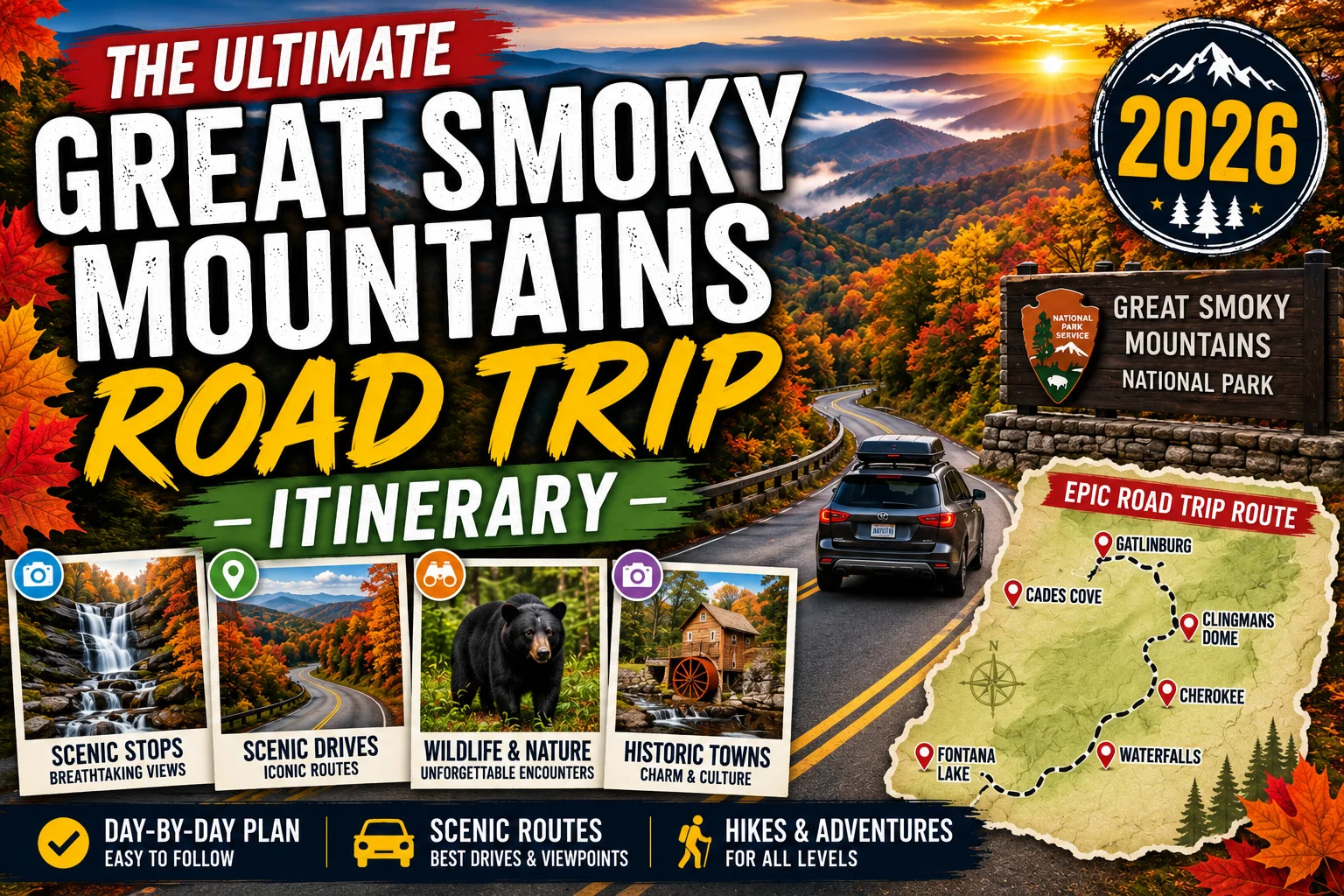
The Ultimate Great Smoky Mountains Road Trip Itinerary 2026
The Ultimate Great Smoky Mountains Road Trip Itinerary As soon as you cross the boundary of the Great Smoky Mountains National Park something happens. The temperature dips several degrees, the rest of the world fades away and you’re left in a land of infinitely rolling, blue hazed mountains that just keep on rolling out ahead of you. And as you already probably already knew the Great Smokies National Park is the most popular National Park in the entire country with over 12 million visitors last year!
Now here’s a secret though. It’s not just anyone who gets to experience the real beauty that the Smokies has to offer. Those 12 million visitors mostly all make stops at just a few viewpoints, snap a couple photos and then carry on. The real allure to my great smoky mountains road trip is found more down a secluded pull off or two, or deep into an unmarked trail in the midst of these timeless mountains, or even down one of the back roads just searching…for pretty much no reason at all.
Planning Your Smoky Mountain Adventure
Before we dive into the daily itineraries, let’s cover the essentials. A little planning goes a long way in making your road trip smooth and enjoyable.
Getting There and Getting Around
The Great Smoky Mountains straddle the Tennessee/North Carolina border, with the most popular gateway towns on each side being Gatlinburg, TN to the North and Cherokee, NC to the South. Most likely you’ll be flying into either McGhee Tyson (TYS) airport near Knoxville, TN or Asheville Regional (AVL) airport in North Carolina. Once you get here it’s advisable that you get a car just not a city cruiser, something that can handle unpaved terrain and offer ground clearance is your friend on these roads.
Newfound Gap Road (US 441) cuts through the interior of the park for 31 miles, connecting Gatlinburg to Cherokee, traversing through the most picturesque scenery but of course, the point of having a great smoky mountains road trip itinerary is to get off the main road and get to exploring.
When to Go for the Best Views
There’s something majestic about the Smokies in all seasons, but you’ll have a drastically different experience depending on which time of year you visit.
Fall (Mid September through Early November): The “in season” part of the park at this time for a reason. “These mountains are ablaze with red, orange and gold. The Foothills Parkway offers some of the most stunning vistas anywhere, as the vibrant color frame the mountain peaks.”
Spring (April through May): The park will burst with an array of wildflowers; dogwoods, rhododendrons and the flame azaleas paint the forest floor in bright colors while at high elevations, you may still spot animals that have emerged from the winter hibernation.
Summer (June through August): The warmth of these months makes it a perfect time to be on high elevation roads and taking those epic waterfall hikes. During the months of June to August, it’s hottest and the highest humidity level of the year.
Winter (December through February): The park reveals a whole new, peaceful, quiet splendor under a coat of snow on some higher elevations with leafless trees showing off their unobstructed mountain views. Check conditions before driving on roads such as the Clingmans Dome Road and the Roaring Fork Motor Nature Trail, as these close seasonally.
What You Need to Know Before You Go
While this is a free national park , you will need to purchase a parking tag for vehicles that stay for longer than 15 minutes. Park passes can be purchased daily, weekly, or annually online or at visitor centers. Also be aware that cell service in some parts of this park is scarce. Download your maps before you arrive and carry them with you.
The Classic Great Smoky Mountains Road Trip Itinerary
If you have limited time, this route is your best bet. It’s the perfect introduction to the park and hits all the must see highlights.
The Northern Gateway Gatlinburg to Newfound Gap
Morning: Sunrise at Kuwohi (Clingmans Dome)
Be out of bed before first light for the hour-long drive from Gatlinburg to Kuwohi (formerly Clingmans Dome). You drive up Clingmans Dome Road to the parking lot, and then it is a half mile paved, and strenuous, walk to the 6,643-foot observation tower, the high point of the park. The reward for your early wake-up call will be one of the most beautiful sunrise over a valley that you will ever see.
Mid Morning Explore the Alpine Zone
After taking in the views, head back down and stop at Newfound Gap Overlook. Sitting right on the Tennessee North Carolina border, this is where the Appalachian Trail crosses the park . President Franklin D. Roosevelt dedicated the park here in 1940. It’s a fantastic spot to stretch your legs and get a feel for the vastness of the Smokies.
Afternoon: A Hike to Remember
Take a hike Just a few miles south of Newfound Gap you can hop onto another of the park’s most popular trails -Alum Cave Trail. This fairly moderate hike travels 4.6 miles total (round trip) to the cave bluffs. You’ll duck under rock outcroppings such as arch rock, cross streams, and step out on a viewpoint called Inspiration point that boasts large, clear views of the park. The Alum Cave Bluffs are a colossal rock overhang great to stop for a breather and some food.
Late Afternoon: Scenic Overlooks
Driving north in your car along the park roads, take a side trip into the parking lot at the Morton Overlook. Many agree this has the best view at the park for an amazing sunset over a steep, “V” valley. At the Chimney Tops Overlook you are able to get a clear look of the unique ridgeline.
The Cades Cove Road Trip
Every Great Smoky Mountains road trip must include Cades Cove. Arguably the most iconic section of the national park, this 4-stop itinerary gives you a taste of why.
A Step Back in Time The Cades Cove Loop
The 11 Mile Loop
Spend the majority of your day in Cades Cove. The 11 mile loop drive Cades Cove Loop Road, one way , presents incredible opportunities to view park wildlife, especially the park’s famous white tailed deer and wild turkeys but be looking also for chances to see black bears . You can take this trip to see historic cabins, church congregations, the Grist Mill, all with a focus in the 1800s .
Note on the loop-driving time of day you might expect to do it for much of your vacation day because you will usually be backed up by automobiles around this popular site until it gets after 10:00 am .
You will find many bikers and walkers traversing the route when vehicles are eliminated from that loop day (which typically occurs on Wednesday during peak season) . The trek Abrams Falls from out within the loop driving route; you can hike (4.5 miles) there as well, seeing how many more different kinds of trees there may be then as when driving on the loop.
The Hidden Smokies Road Trip
For those who want to get off the beaten path and see a quieter side of the park, this is the itinerary for you.
Rivers, Roads Less Traveled, and Elk
Morning A Drive Along the River
Bypass the traffic of Newfound Gap Road and embark on this riverside journey instead. This winding road offers an more in depth, authentic journey into the Smoky Mountains and includes such delights as the small roadside waterfalls called The Sinks and Meigs Falls.
Mid Day Roaring Fork Motor Nature Trail
And here’s where things really get interesting: Roaring Fork Motor Nature Trail is a one lane, one way, 5.5 mile loop road open only during the summer. It’s a slow, peaceful amble down a well worn path into the woods, past old log homes (including the Noah “Bud” Ogle Place). For another nice, but short, hike, Grotto Falls trail is right there on the Motor Nature Trail. It’s 2.6 miles round trip to a cascade that you walk through.
Evening: Elk Spotting
End your day in the park at the Oconaluftee Visitor Center on the North Carolina side of Great Smoky Mountains National Park. Toward evening, particularly in the autumn season, this park spot offers one of the greatest odds of seeing elk . Don’t miss the adjacent Mountain Farm Museum, small open air museum displaying preservation 19th century structures revealing to guests what life resembled for residents.
Beyond the National Park Hidden Gems
Sometimes the best part of a great smoky mountains road trip itinerary is found just outside the park boundaries.
The Cherohala Skyway
Take an extra day for the Cherohala Skyway . This 43 mile road winds from the town of Tellico Plains, Tennessee to Robbinsville, NC. The “Smokies’ best kept secret,” as many call it, offers spectacular views into both the Cherokee and Nantahala National Forests, minus the traffic on the main park roads. The drive between the state border and the Santeetlah Overlook offers spectacular, wide ranging views .
The Foothills Parkway
Foothills Parkway Another lovely way to explore the Smokies, the Foothills Parkway has 19 different pull offs and is well known for its outstanding fall colors (particularly along the western part of the park, especially Pull Off #8). The eastern part, near Cosby, is much more remote and an ideal chance to avoid some of the crowds.
Tips for the Ultimate Smoky Mountain Road Trip
Here are some final tips to make your road trip unforgettable:
* Pack a cooler: With snacks and drinks readily available, you’ll have more time to explore and less time on the hunt for food.
* Fill your gas tank: Finding gas stations within the park can be very challenging, so fill up before you embark.
* Wildlife respect: Remember, these animals are in their home, so maintain a respectful distance from them all; especially when there are black bears near, as they are wild animals and should never be fed.
* Leave no trace: Pack out whatever you pack in to help us preserve the Smokies for years to come.
* Road condition checks: Before you set off, be sure to visit the NPS website for weather and seasonal road closures.
The Great Smoky Mountains is not only a destination, it’s an experience and one that you won’t soon forget.
Frequently Asked Questions FAQs
How many days do you need for a Great Smoky Mountains road trip?
Ideally, 3 to 4 days allows you to see the highlights like Newfound Gap Road, Cades Cove, and a few hidden gems. However, even a 2 day trip can provide a fantastic experience, especially if you use this great smoky mountains road trip itinerary as a guide.
What is the best scenic drive in the Great Smoky Mountains?
Newfound Gap Road is the classic, but for solitude and stunning views, many consider the Cherohala Skyway the best. The Cades Cove Loop is also incredibly popular for wildlife viewing .
Is the Great Smoky Mountains road trip free?
Entry to the national park is free. However, you are now required to purchase a parking tag for any vehicle parking for more than 15 minutes. You can buy daily, weekly, or annual passes .
What is the best time of year for a Smoky Mountains road trip?
Fall is the most popular for the vibrant foliage, but spring offers beautiful wildflowers. Summer has the warmest weather, and winter provides solitude and snow dusted mountain views .
Can you just drive through the Great Smoky Mountains?
Yes! Newfound Gap Road (US 441) is the main road that bisects the park, connecting Gatlinburg, TN, and Cherokee, NC. You can drive the entire 31 mile stretch without ever leaving your car .
Is Cades Cove worth the drive?
Absolutely. It’s one of the best places in the park to see wildlife, including black bears, deer, and turkeys. It also features beautifully preserved historic buildings. Just be prepared for slow moving traffic, especially during peak season .
Where can I see elk in the Smoky Mountains?
The Oconaluftee Visitor Center and the surrounding fields on the North Carolina side of the park are prime spots for elk viewing, particularly in the late afternoon and during the fall rutting season .