
How to Pack for a Desert Stargazing Night in Joshua Tree 2026
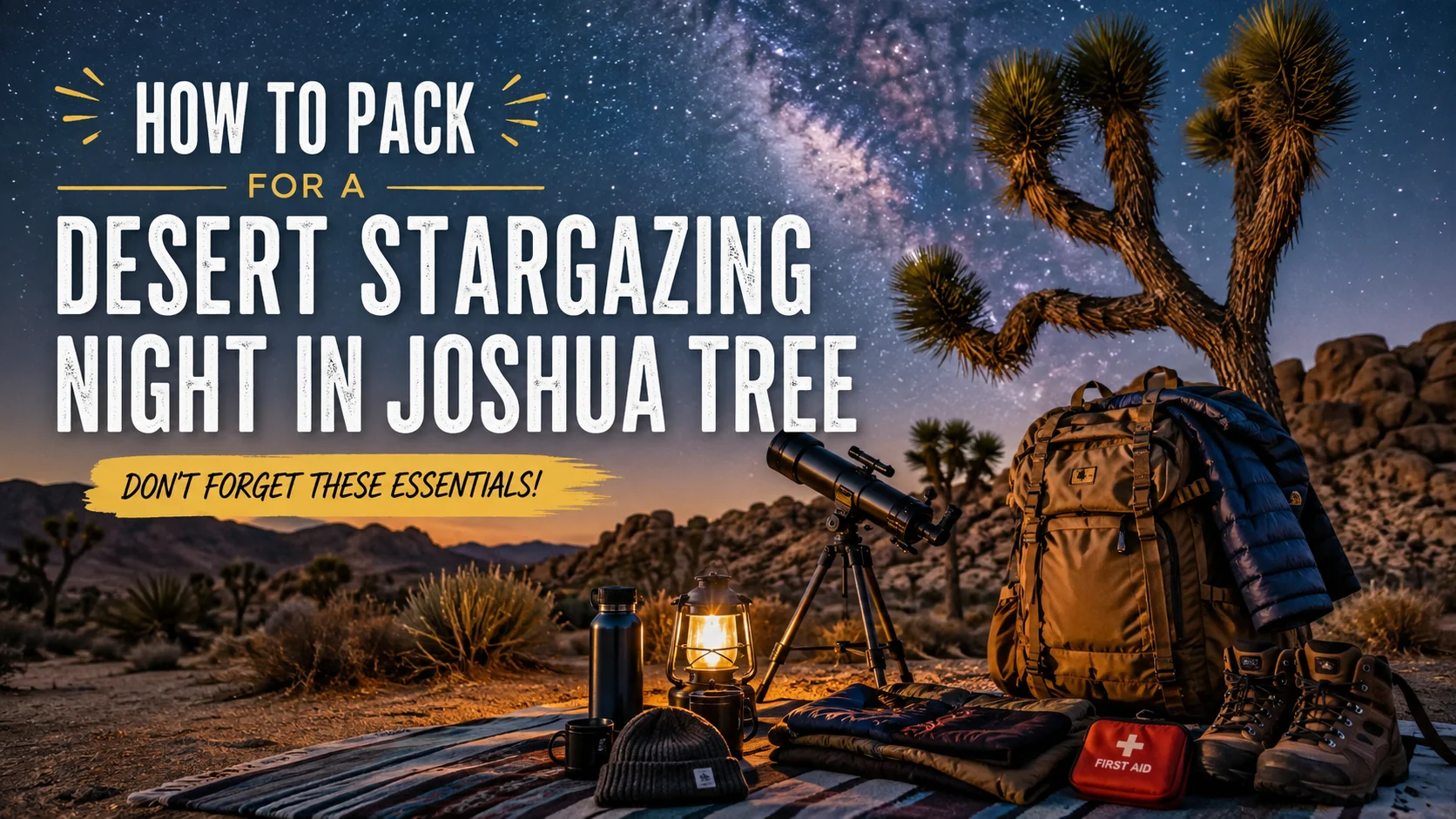
Desert Stargazing Night in Joshua Tree. There’s a moment just after sunset in Joshua Tree National Park when the sky transforms into something almost sacred . The silhouettes of the iconic Yucca brevifolia stretch across the horizon, the temperature begins to plummet and then the show begins. The Milky Way erupts overhead, and countless stars dot the sky in a way you simply cannot see anywhere near city lights.
But there’s a catch . Learning how to pack for a desert stargazing night in Joshua Tree is the difference between a magical , awe inspiring experience and a miserable and shivering night spent staring at your feet . The high desert is unpredictable and even the most seasoned adventurers can be caught off guard by the conditions. Desert Stargazing Night in Joshua Tree.
As someone who has spent countless nights under those spectacular skies, I’ve made every packing mistake in the book . I’ve shivered through a spring night when temperatures dropped into the 30s and struggled to see the Milky Way because I forgot a red light . Trust me this guide covers everything you need, from essential gear to optional luxuries, so your Joshua Tree stargazing trip is nothing short of unforgettable. Desert Stargazing Night in Joshua Tree.
Understanding Joshua Tree’s Night Climate: Prepare for the Unexpected
Before we dive into the packing list, let’s talk about what you’re actually up against. The high desert is notorious for dramatic temperature swings. That 90°F day you enjoyed? It can drop to 40°F or lower once the sun disappears behind those rugged rock formations . Desert Stargazing Night in Joshua Tree.
Winter nights (November to February) can dip below freezing sometimes hitting 30°F or even 20°F. Summer nights (June to September) are warmer but still require a jacket , as temperatures can drop 30-40 degrees from the daytime high . Spring and fall are the sweet spots pleasantly warm during the day and crisp at night.
The takeaway? You’ll be packing for two different seasons : the daytime conditions you’re driving in and the nighttime experience you’re seeking.
The Golden Rule: Red Light and Night Vision
Before you pack anything else, understand this : a single flash of white light can ruin your stargazing experience for up to 20–30 minutes . Your eyes take that long to fully adjust to low light conditions, allowing you to see the Milky Way in all its glory.
The solution is simple a red light headlamp is the most important item in your bag. Red light preserves night vision because your eye’s rod cells responsible for seeing in dim light are insensitive to red wavelengths . You’ll see clearly enough to navigate and set up your gear without ruining your or anyone else’s dark adaptation.
Alternative : If you can’t find a red headlamp , cover a regular flashlight with red cellophane, tape, or red construction paper. It’s a budget friendly hack that works surprisingly well .
Essential Gear: Your Desert Stargazing Night in Joshua Tree
Let’s get down to business . Here’s exactly what you need to pack for a comfortable and unforgettable stargazing experience :
1. Clothing and Warmth : Layer Like Your Comfort Depends on It
Desert nights are cold period . The NPS recommends bringing extra layers of warm clothing, even in summer . Here’s what works: Desert Stargazing Night in Joshua Tree.
- Base Layer : Thermal underwear (top and bottom) made of merino wool or synthetic material that wicks moisture
- Mid Layer : Fleece jacket or lightweight puffy jacket
- Outer Layer : Insulated parka or heavy jacket , especially for winter visits
- Bottom Layer : Insulated pants or jeans over your thermal base layer
- Accessories : Beanie, gloves and thick wool socks (your extremities get cold first)
- Footwear : Closed toe shoes or hiking boots no sandals
Pro tip : Wear your layers rather than packing them in a bag. You’ll likely be arriving during the day , so start with light clothing and add layers as the sun goes down . Avoid wearing clothing that lights up no flashing kids’ sneakers or glow in the dark gear .
2. Seating and Comfort: You’re Not Standing All Night
Looking up at the sky while standing is a recipe for a sore neck. The NPS explicitly recommends bringing lightweight folding chairs for each person in your group . Desert Stargazing Night in Joshua Tree.
Options:
- Reclining camping chair with a high back (allows you to lean back and look up comfortably)
- Sleeping pad with a pillow where you can lie flat and gaze upward
- Blanket on the ground (bring a tarp underneath to protect from moisture)
- Hammock (if you’re camping near trees but be careful not to damage Joshua Trees)
Some serious stargazers prefer a sleeping pad and sleeping bag combination , allowing them to lie flat for hours without discomfort . Desert Stargazing Night in Joshua Tree.
3. Food and Hydration: Yes, You Need Water at Night
The desert air is incredibly dry and you’ll dehydrate faster than you think even at night. The NPS recommends at least 1 gallon (4 liters) of water per person per day . For a stargazing session of 3-4 hours, bring at least one large bottle per person.
Food tips:
- Pack high protein snacks (nuts, jerky, cheese)
- Energy boosting snacks (granola bars , dried fruit)
- Hot drinks are game changers a thermos of coffee , tea or hot chocolate warms you from the inside out
- Avoid eating or drinking around other people’s telescopes (crumbs and spills can damage expensive equipment). Desert Stargazing Night in Joshua Tree.
Important : There’s no running water in most areas of the park, so you must plan ahead .
4. Navigation and Tools: Don’t Rely on Your Phone
Cell service in Joshua Tree is nearly non existent in most areas . You need backup navigation:
- Paper map of the park (available at visitor centers)
- Compass or GPS (download offline maps)
- Physical star chart (like a planisphere that doesn’t require batteries)
- Red-light headlamp (as discussed above)
5. Stargazing Aids : See More Stars
You can see plenty with the naked eye, but a few tools can dramatically enhance your experience:
- Star map apps like Stellarium or Sky Safari set to red screen mode
- Binoculars rated 7×50 or 10×50 these are affordable and reveal details in clusters, nebulae and galaxies that you’d miss otherwise
- Telescope for serious observers; even a 6″ Dobsonian fits in most cars and transforms the experience
- Planisphere (printed star chart) as a backup when batteries die
6. Power and Connectivity: Stay Charged
There are no electrical hookups in Joshua Tree’s campgrounds, so bring your own power source :
- Portable power bank for phones and cameras . Desert Stargazing Night in Joshua Tree.
- Car charger to keep devices running during long sessions. Desert Stargazing Night in Joshua Tree.
- Solar generator if you’re camping for multiple days (popular choice for serious adventurers)
7. Optional But Recommended
These items can elevate your stargazing experience:
- Camera + tripod for night photography (bring extra batteries and memory cards)
- Thermos with hot beverage coffee, tea, hot chocolate or soup
- Notebook/journal to document your observations
- Snacks (sandwiches , nuts , trail mix)
- Baby wipes for cleaning hands after snacks
- Wag bag (portable toilet) if you’re camping in remote backcountry areas
What NOT to Pack for Joshua Tree Stargazing
Avoid these items that can ruin the experience for you and others:
- White flashlights or bright white headlamps : they destroy night vision
- Bright phone screens not set to night/red mode : check the brightness
- Loud speakers : sound carries in the desert and stargazers appreciate the silence
- Open toed shoes : the terrain is rugged and cacti are everywhere
- Flashing shoes or clothing : preserve the dark environment
- Pets : service animals are allowed, but regular pets are not permitted in most stargazing areas due to safety and noise concerns
Best Locations for Stargazing in Joshua Tree
Now that you know what to bring where should you go? There are four designated stargazing areas:
- Quail Springs parking lot
- Hidden Valley parking lot
- Cap Rock parking lot
- Ryan Mountain parking lot
For the darkest skies , head to Pinto Basin which offers the least light pollution in the entire park. Any pullout along Pinto Basin Road works perfectly .
Timing is everything:
- Best time : 9 pm to 1 am on a moonless night offers the best combination of darkness, temperature and Milky Way position
- New Moon : The Milky Way appears brightest during the new moon phase
- May and June : Peak months for viewing the Milky Way arching over the eastern horizon just after dark
Also Check : Affordable Rustic Cabins Near Shenandoah National Park 2026
Photography Tips for Desert Night Sky
If you’re planning to capture the stars, here’s what you need to know:
Essential gear for night photography: Desert Stargazing Night in Joshua Tree.
- Digital camera with full manual controls, 30-second exposure capability, 3200–6400 ISO capability
- Wide and fast lens (f/2.8 14-24mm full frame equivalent)
- Sturdy tripod
- Extra batteries and memory cards
- Remote shutter release (optional but recommended)
Pro tip : Be cautious with light painting (illuminating foreground subjects during long exposures). While it creates dramatic images , always respect other stargazers and the dark environment . Photographers often use red lights during set up and only use additional lighting for brief moments.
The Night Sky Etiquette
Joshua Tree’s dark skies are a precious resource threatened by light pollution from nearby communities. Help preserve them: Desert Stargazing Night in Joshua Tree.
- Follow quiet hours (10 pm to 6 am) in campgrounds
- Limit noise sound carries far in the desert
- Don’t disturb wildlife nocturnal animals depend on the dark environment
- Pack out all trash Leave No Trace principles apply
- Keep your distance from other stargazers’ setups
Remember : You may need to wait 20-30 minutes after any white light exposure for your eyes to readjust. Be patient the wait is worth it .
Summary
Before heading out to Joshua Tree, check this list:
- Red light headlamp (essential for night vision)
- Warm layers (thermal base , fleece, insulated jacket)
- Beanie , gloves , thick socks (extremities get cold)
- Closed toe shoes (no sandals)
- Reclining chair or sleeping pad (neck comfort)
- Water (1 gallon per person per day minimum)
- Snacks and hot beverages (energy and warmth)
- Star map app and physical star chart (backup navigation)
- Binoculars or telescope (enhanced viewing)
- Paper map (cell service is unreliable)
Frequently Asked Questions (FAQs)
What should I wear for stargazing in Joshua Tree?
You need layers! Start with a thermal base layer , add a fleece and top with an insulated jacket. Don’t forget a beanie, gloves and thick wool socks. Wear closed toe shoes hiking boots are best. Even in summer, desert nights can get very cold.
How long does it take for eyes to adjust to darkness?
It takes 20–30 minutes for your eyes to fully adjust to dark conditions . A single flash of white light resets this process , so use only red lights during your session.
Can I use my phone for stargazing?
Yes, but you must put it in red screen mode. Regular screen brightness, even for a few seconds, ruins night vision . Better yet, put your phone away entirely and enjoy the moment .
What are the best months for stargazing in Joshua Tree?
The night sky is spectacular year round but May and June are considered the peak time for viewing the Milky Way, as it arches over the eastern horizon just after dark . A new moon phase offers the darkest skies.
Where are the best spots to stargaze in the park?
Designated areas include Quail Springs, Hidden Valley, Cap Rock and Ryan Mountain parking lots. For the darkest skies, head to Pinto Basin the farthest from light pollution .
Is it safe to stargaze alone in Joshua Tree?
Stargazing alone is generally safe if you’re in a designated area or near your vehicle. However, the NPS recommends staying within 20 feet of your vehicle if you’re in remote areas like Pinto Basin . Always carry a map, water and let someone know your plans.
Do I need binoculars to stargaze?
No, but they dramatically enhance your experience. Binoculars with 7×50 or 10×50 ratings are affordable and reveal details in star clusters, nebulae, and galaxies that your naked eye can’t see .
What’s the deal with red lights? Why can’t I use a regular flashlight?
Red light preserves night vision because your eye’s rod cells (responsible for low light vision) are insensitive to red wavelengths. Regular white light destroys your ability to see in the dark for 20–30 minutes . Every serious stargazer uses red lights.
What if I don’t have a red headlamp?
You can cover a regular flashlight with red cellophane, red tape or red construction paper . Many outdoor stores also sell cheap red headlamps.
Are there amenities like bathrooms or water at stargazing spots?
No! There is no running water in most areas of the park . You must bring all the water, food and other supplies you need. Plan ahead and pack out all trash.

One Comment