
What is the Best Month to Visit Sleeping Bear Dunes Michigan 2026?
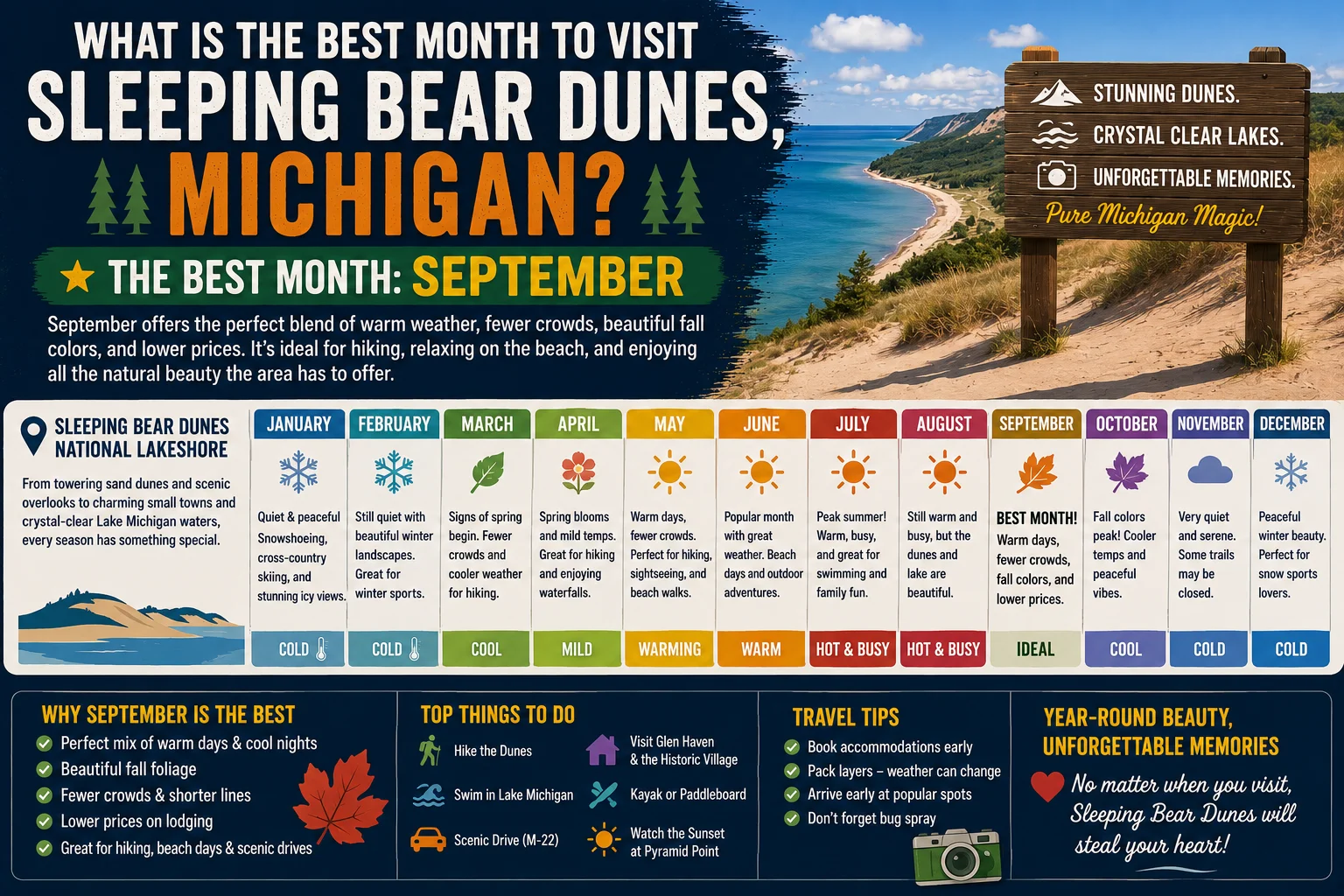
Month It is so fun to be planning an amazing trip to Sleeping Bear Dunes National Lakeshore Michigan! It is a really stunning part of Michigan with big dunes and beautiful water and trees. But sometimes what can seem really overwhelming with the Dunes, for visitors, can be: “what month is the best to visit Sleeping Bear Dunes Michigan?” Well let’s talk about it!
The short of it is, I don’t think there’s truly ONE best month. All of them have something really beautiful about them and can provide just what you are hoping for from your trip to Sleeping Bear Dunes Michigan! Are you looking for the swimming month, the fall colors month, the snow month?
Decoding the Seasons
To really know when is best to come, we really have to take into account the distinctive character of each month. The weather, crowd size and activities will be different in each one of the twelve months.
A Time for Renewal and Wildflowers
As the snow melts and the world awakens, spring is a beautiful time to experience the park in relative solitude.
April: Mud Season and Quieter Trails
April is a transitional month. Most of the snow will be gone, but you might find muddy areas on trails. Not a visually stunning month but if you want an off season, mud-on-your-boots experience and a bit of peace and quiet it’s definitely an option. Temperatures generally hover in the 40s-60sF (4-15C).
May: The Sweet Spot for Avoiding Crowds
The month of May is actually a really great month of the year as far as the “shoulder seasons” are concerned. The weather will generally get much nicer with temps getting up into the 60’s and 70’sF (15-22C). You will be there before the summer crowds get out here and the park will be nice and peaceful.
You will likely even catch the beginnings of Spring in the woods with many of the first flowers starting to come into bloom with that sweet Spring smell in the air.
If you are a hiker, or if you are wanting to come here to photograph the park without having to worry about all of the tourists of Summer, May is one of the best months for either activity.
Summer The Classic Peak Season
Sleeping Bear Dunes is most alive (and undoubtedly busiest) in summer, for those summer vacations swimming and sunbathing are key.
June: The Start of Summer Fun
In June, summer arrives in earnest and so does the tourist season. Temperatures usually run from the high 70s to the low 80s F (approximately 27C). The days are also the longest, which affords you extra hours of exploring.
What’s not ideal about the month is the Lake Michigan water temperature, which often only warms to the mid-60s F (about 16C).
So, if you’re OK with a cooling water temperature, June is a lovely time to go hiking to avoid the most oppressive summer heat.
July: The Hottest Month and Prime Beach Weather
If you’ve always dreamed of dipping into Lake Michigan’s iconic blue-green waters, July is your best bet. Temperatures hover in the swim-able 21-23C (70-73F) range, the air is warm and sunny (high of about 29C/84F) and you’re smack in the middle of summer’s action. This is also when the park is most crowded; expect to be shoulder-to-shoulder with fellow families.
Smart money: the lot at the famous Dune Climb can fill up by 10 AM on summer weekends so start your day earlier or visit the Dune Climb in the afternoon .
Prices for lodging will be their highest so book accordingly.
August: Slightly Quieter, Still Beautiful
August is squarely in high season and there’s every bit as good swimming and sunshine to be had in August as in July . It’s still incredibly popular, but perhaps just a hair less so than in July as some families will have started their holiday before the schools go back – you still get warm sea temperatures in this great month for beach going, though.
Fall A Spectacle of Color
For some of us, veteran visitors at that, the top honors go to the fall. Summer crowds disperse, air quality is great and the entire country erupts in glorious fire-like hues.
September: The Beginning of the Golden Season
We use a month known as “shoulder season,” called September, when we leave summer and enter fall. The weather in September is perfect for exploring; during the day, expect highs in the low 70s Fahrenheit (23C), but expect temperatures to drop in the evening as a telltale sign of fall weather approaching. The children are returning to school and the crowds begin to fade significantly, making it a quieter season to hit the trail. It is truly the sweet spot where weather is lovely and crowds are not!
October: The Best Month for Fall Foliage
As far as a photography or nature trip, my favorite month in Sleeping Bear Dunes is October . That’s the month that you’ll catch the stunning fall color of the park’s maple, birch and aspen, which typically peaks between the 5th and the 20th of the month, between the 5th of the month and the 20th. Seeing that brilliant fall color contrast against the rich blue waters of Lake Michigan can be quite breathtaking .
Swimming will be too cold with daytime highs of around 16° C (61° F), but for a scenic drive or walk or hike the experience can’t be beat .
Room rates also tend to drop considerably compared to those found in the summer .
Winter: A Snowy Wonderland
Sleeping Bear Dunes in winter time is for the daring ones. The landscape is hushed, covered by snow and a special kind of beauty comes alive. Snow normally lays here from the end of November till the end of March.
Please consider that services in winter times are scarce: ferry service to the islands stops and a lot of roads turns into tracks of snow and ice, whereas local weather patterns of lake-effect snowfalls could produce few meters of snow in only one day!
However, if you’re equipped, it’s a unique experience for snowshoeing and cross country skiing.
So, What is the Best Month for You?
Let’s cut to the chase and match the best months to your specific travel style.
The Ultimate Summer Experience: July & August
If the word “swimming”, “beach” and “lively, active vibe” gets you all in a tizzle, July and August are for you. In fact, this IS the ultimate summer Sleeping Bear Dunes experience. But prepare yourself: it’ll be crowded and pricier than a July day.
The “Best of Both Worlds” Shoulder Season: June & September
Other options include June and September. You’ll be blessed with good hiking and visiting weather and far less tourists. If your interested in climbing the dunes the temperatures will feel much more welcoming in June or September than they will be in July.
The Photographer’s Dream: October
When it comes to stunning scenery and eye popping fall colors, nothing beats October. Plus, smaller crowds and lower prices are the icing on the cake.
The Hidden Gem for Solitude Seekers: May
May’s got all the best things. Hiking birdwatching, the quiet of the park, and none of the insanity of the summertime.
Key Events to Plan Your Trip Around
Choose a month, and make sure you check for nearby local events: May through October: The season for ferry access to the Manitou Islands opens. Mid-July: The National Cherry Festival is held in the next door town of Traverse City. The party is huge, so get a room months in advance if you’re headed to the park for it. Early to mid October: Peak season for autumn color in the park and across the Leelanau Peninsula.
Practical Tips for Every Season
No matter when you visit, a good plan makes a great trip.
- Plan to Get There Early You won’t want to hit one of the popular sites (like the Dune Climb) at 1pm when all the parking spots are filled for summer visitors. Instead, aim to arrive in the morning before 9 AM or after 4 PM during the summer months (July and August).
- Wear Layers Lake Michigan’s weather is notoriously fickle. It can quickly change depending on cloud cover or the effect of the lake, and you may need them for cooling off in a summer breeze. You’ll regret visiting in the summertime with just your beach clothes on if the lake breezes pick up.
- Bring Lots of Water You may be thinking that walking on a dune is like walking on a beach. But if the weather is warm and humid you might be mistaken about how strenuous the climb is for the kids. Make sure to bring more water than you think you’ll need, especially during the summer.
- Consider Your Accommodations As mentioned earlier in this list, the summer and fall seasons (when people come to see the leaves change) are extremely popular at Sleeping Bear Dunes National Lakeshore. This means lodging is usually booked months ahead of time.
Conclusion
Ultimately, the choice of the best time to visit the Sleeping Bear Dunes in Michigan comes down to personal preferences. For the best weather and an active vibe, plan your visit from June to August. For a calmer time and breathtaking landscapes, September and October are magical. For winter adventures and a more isolated experience, visit during the snowy months.
I hope this guide has assisted you in planning the ideal time for your visit to this magical national lakeshore. Please feel free to share your own experiences and any questions you may have in the comments section below.
Click for More: Free Art Walks and Gallery Nights in Santa Fe New Mexico 2026
Frequently Asked Questions (FAQs)
What is the warmest month at Sleeping Bear Dunes?
July is typically the warmest month, with average high temperatures around 29°C (84°F) and water temperatures reaching 21 to 23°C (70 to 73°F), perfect for swimming .
When is fall foliage at its peak?
The fall colors usually peak between early and mid October, offering a stunning display of gold, orange, and red leaves .
Is Sleeping Bear Dunes open year-round?
es, the national lakeshore is always open. However, services, visitor centers, and ferry routes to the Manitou Islands are limited or closed during the winter months .
When are the crowds the worst?
The park is most crowded during July and August, especially on weekends and holidays. The Dune Climb parking lot can fill up very early in the morning .
When is the cheapest time to visit?
Accommodation and travel are significantly cheaper during the shoulder seasons of May June and September October, as well as during the winter months .
1.
2.
3.
Y
4.
5.
6. Can you swim in Lake Michigan at Sleeping Bear Dunes?
Yes, but the water is really only warm enough for most people from July through August. In June, the water is quite chilly, typically around 10-16°C (50-61°F) .
7. What should I pack for a summer visit?
Pack light clothing for warm days, but also bring a jacket or sweater for the cooler evenings. Don’t forget layers, sunscreen, a hat, and lots of water .
8. Is it worth visiting in winter?
Yes! For winter sports enthusiasts, the park transforms into a beautiful snowy landscape perfect for snowshoeing, cross-country skiing, and enjoying serene winter vistas .
9. What are the “shoulder seasons”?
The shoulder seasons are the periods between peak and off-peak seasons. At Sleeping Bear Dunes, these are May, June, September, and October. They offer a balance of decent weather and fewer crowds .
10. How long do you need at Sleeping Bear Dunes?
To really experience the park, plan for at least 2-3 days. This allows time to tackle the Dune Climb, explore the scenic Pierce Stocking Scenic Drive, visit the historic villages, and maybe take a ferry to one of the Manitou Islands.