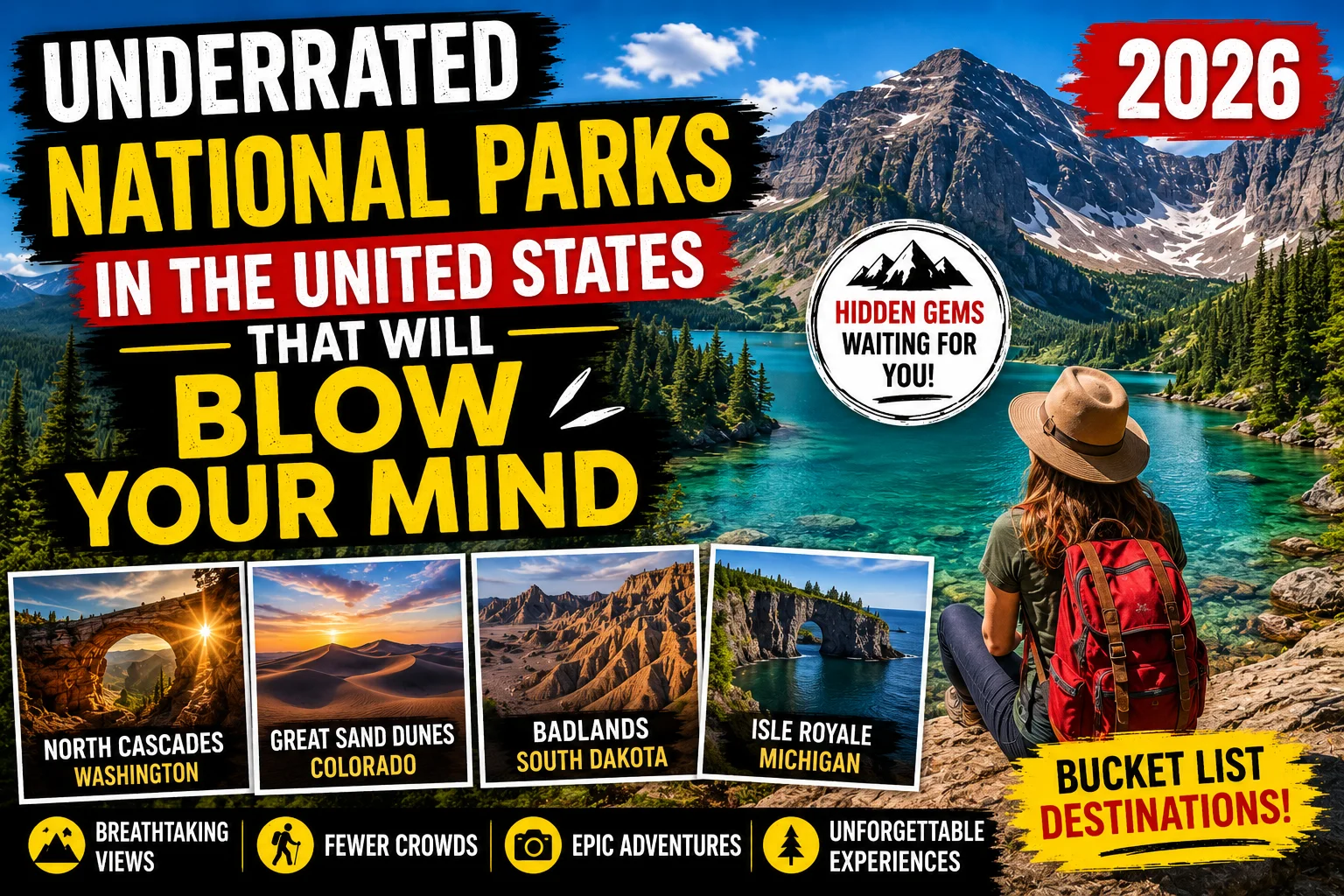
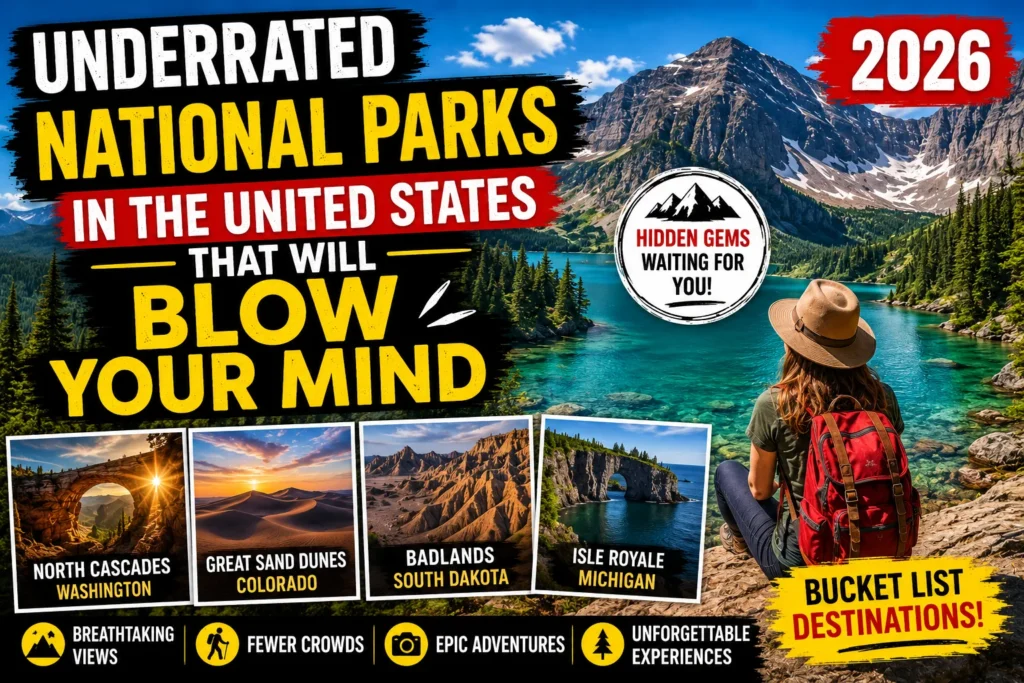
Underrated National Parks in the United States That Will Blow Your Mind 2026
National Let’s just be real. When most people envision a national park vacation , they picture you driving circles in Yellowstone waiting for parking, fighting for a space at the foot of a cliff in Zion or squeezing in to catch a glimpse of the Grand Canyon with a hundred of your new best friends . The obvious choices , like those I’ve just mentioned, are absolutely spectacular . But sometimes they seem more like theme parks with amazing scenery and hiking than they do a wilderness escape .
Here’s the thing most people don’t know : America’s Best Idea extends to a few lesser known national parks that just about give the “Big Ones” a run for their money . Here you get the same incredible landscapes and the same chance for epic adventure and total silence , without all the people . These parks give you a chance to truly breathe , hear your own thoughts avoid parking nightmares and maybe even feel like you’ve discovered something totally new.
In this article , I’ll share some of the United States’ most underrated national parks that are just begging for a place on your list . Get off the beaten path with me!
Why You Should Ditch the Big Names for These Underrated Gems
Look I understand . People are drawn to those iconic national parks for a reason , they’re incredible ! But something fundamental has changed in the way we visit them.
Over tourism can sometimes strip the very magic from a place , turning it from a tranquil escape into a chaotic stampede.
That’s where the beauty of visiting the underrated national parks in the United States really comes into play .
Why?
- It’s your path to solitude : Instead of rubbing shoulders with the masses , you might find yourself with an entire trail to yourself! This helps facilitate a stronger bond with the natural world.
- It is a more authentic adventure : To visit these places may require more planning like catching a ferry, hopping on a seaplane, or tackling a long drive to get there and that make the adventure itself a bit more challenging and more satisfying.
- It makes it easier to view wildlife: When fewer humans are trampling through a park, the wildlife feels a bit more relaxed and they’re more likely to venture out.
- It provides longer lasting memories: You will return from your trip with a collection of unforgettable experiences from places most people have never even heard of.
Interested?
Then let’s look at my list of the absolute best underrated national parks in the U.S. That I suggest you check out.
The Ultimate Guide to Underrated National Parks in the US
Channel Islands National Park California : An Island Escape Off the Coast of LA
Hop on a short ferry ride from shiny Los Angeles for an entirely other world . A remote archipelago of five islands dubbed “the Galapagos of California ,” Channel Islands National Park receives a mere 227,000 visitors per year (primarily because you have to take a boat or plane to get there) . Your wildlife interactions begin right at the dock-island foxes often walk by your side dolphins follow in your wake , whales surface to breach and sea stars cover the tide pools .
Lace up your boots and hike up to Inspiration Point on Anacapa Island and you’ll get that quintessential California coastal vibe .
- To get there: Ferry with Island Packers.
- Pro tip: It’s all foot travel here ; the islands do not have stores, so pack everything you’ll need!
- Best for: Kayakers, wildlife enthusiasts , those looking to leave the country (but stay at home).
Big Bend National Park Texas Where the Desert Meets the River
Remote is the word. Big Bend, tucked into a massive bend in the Rio Grande in southwest Texas , is one of the least-visited parks in the lower 48 , which makes it one of the most underrated National Parks in the US when it comes to night skies and desert solitude . Here the Chihuahua Desert the Chios Mountains and the Rio Grande meet, resulting in a stunning and diverse park .
You can hike the popular Window Trail , raft or kayak on the Rio Grande or soak in one of the park’s natural hot springs.
But the real star show doesn’t come out until dark . This International Dark Sky Park boasts some of the most awe inspiring starry skies you’ll ever witness.
Best time to visit : Any time of year, though spring and fall temperatures are the most agreeable.
Where to stay : Chinos Mountain Lodge is the only in park option.
For a truly wild glamping experience, look to nearby El Cosmico in Marfa.
Pro tip: Couple a trip to Big Bend with an overnight in quirky art haven Marfa, just 90 minutes away.
North Cascades National Park, Washington The American Alps
Just north of Seattle and called the “American Alps,” it’s no secret this place is for the serious adventurers among us. With over 300 glaciers more than any other national park in the lower 48 – and its maze of sharp, toothy ridges, you could have taken this photo on another continent.
Even though this is one of the closer parks to a major metro area (only 2 hours or so north of Seattle), it gets relatively little attention from tourists : only about 30,000 visitors pass through every year.
It’s remote: there’s no through road. It’s a tough, no frills, climb your own adventure sort of place. We took a raft out to the Diablo Lake, where you will swear you just walked onto the set of The Lord of the Rings.
Getting There: Take State Route 20 across the park (closed in winter months).
Insider Tip: Grab a kayak and spend a peaceful morning on the smooth surface of Fjord-like Ross Lake.
Best for : backpackers, mountaineers , & photographers
Isle Royale National Park, Michigan A Wilderness in Lake Superior
For anyone seeking peace and quiet , this is a dream come true . It’s the least visited park in the contiguous US and attracting just 27,759 visitors annually . It’s a rocky , wild island located on Lake Superior that you can only access by seaplane or ferry .
It’s a natural wonder that appeals to hikers and backpackers . The island features more than 165 miles of trails absolutely no motor vehicles and a surprising population of moose and wolves . If you’re hoping to escape the world as you know it , you can hike , kayak the untouched shoreline or even scuba dive through its famous shipwrecks.
Getting there : Fly via seaplane or take a ferry from Michigan or Minnesota.
Pro tip: Isle Royale National Park is only open mid April through Oct. 31.
Ideal For: Backpackers looking for a truly off grid getaway.
Great Basin National Park, Nevada Stars, Caves, and Ancient Trees
It’s not just Vegas. Head to the eastern part of the state and you’ll discover the stark beauty of Great Basin National Park. Here you’ll find the 13,063-foot Wheeler Peak, some of the oldest organisms on the planet in the form of bristlecone pines, and the impressive Lehman Caves.
Being so remote that it gets overlooked, the park’s primary distinction is its night sky . The absence of any large population centers to pollute the darkness make stargazing in the park a truly magical experience . Spend your days exploring the limestone caves and hiking to the summit of Wheeler Peak for a rewarding panorama of the desert landscape.
- Best season : Summer, for the best hiking conditions.
- Insider tip : Reservations for Lehman Cave tours, often conducted daily during peak season, should be made in advance.
- Great for : Star gazing, cave adventures, and outdoor explorers
Dry Tortugas National Park, Florida A Fortress in the Gulf
Just 70 miles west of Key West lies this collection of seven small islands in crystal clear waters so it makes sense that it’s called Dry Tortugas (Dry because there isno fresh water, and Tortugas Turtles due to all of them you’ll see there) is 99 percent water. Land’s only significant landmark is the 19th century Fort Jefferson, a behemoth of a fortress that never saw the completion of its extensive building.
Its remoteness keeps tour groups to a minimum . Days here are spent snorkeling amid the colorful coral reefs touring the history rich fort and keeping an eye out for the plethora of bird life that congregates on the islands . The best part ? Splurge on a night’s camping once the day trippers are gone , you can literally have the islands to yourself under an unbelievably starry sky .
- Getting there : The Yankee Freedom Ferry. Private seaplane tours also operate from Key West.
- Pro tip : If you’d like to camp , book ferry reservations (and island campsite!) far in advance.
- Go here if you : love history, want great snorkeling , like birds and want to sleep in a fort.
Voyageurs National Park, Minnesota A Water Wonderland
At this water-centric park just across the border in Canada, nearly 40 percent of the park is made up of water-a collection of linked lakes and rivers. It’s truly an angler and boater’s heaven.
Voyageurs is an official International Dark Sky Park, and it provides some of the best chances to see the northern lights in the lower 48. You can tour the park by houseboat, kayak, or canoe, camp on undeveloped islands, and navigate some of the same waterways the French-Canadian fur traders-the “voyageurs”-traveled.
Getting there: You can drive into the park, but to fully immerse yourself in the natural beauty of Voyageurs, you’ll need to hit the water.
Pro tip: Get on a houseboat for a glamping adventure on the water.
Who should go: Kayakers, canoeists, and anglers.
Congaree National Park, South Carolina A Swamp Cathedral
If you want to experience what the American Southeast looked like hundreds of years ago, take a trip to Congaree. This park safeguards the country’s most extensive remnant of old-growth bottomland hardwood forest. You can roam through elevated boardwalks surrounded by an ethereal “swamp cathedral” where old trees drip Spanish moss, and the sound of barred owls often echoes.
This park also offers a chance to see river otters and from late spring to early summer, one of the most amazing natural phenomena on earth: synchronous fireflies.
During synchronous firefly season, entire colonies flash in unison, a dazzling spectacle.
Best time to visit: Spring (to avoid the mosquitoes) and fall to take advantage of the pleasant weather.
Pro tip: Kayaking the Cedar Creek canoe trail provides an entirely different perspective.
Best for: Bird watchers, nature photographers and families.
Canyonlands National Park, Utah The Grand Canyon’s Quieter Cousin
Most people drone on about Arches and Zion, but Canyonlands, which also happens to be a Utah “Mighty 5,” is often overlooked-it’s actually the largest of the 5 parks, and it’s vast, with immense canyons cut by the Colorado and Green Rivers. Underappreciated due to being more of a place to stop between the popular two, it provides jaw-dropping panoramas and world-class raft trips with few crowds. You can catch fantastic views that will give the Grand Canyon a run for its money right from the viewpoints within Island in the Sky district, or try Jeep touring the White Rim Road, or even some canyoneering if you hit the Needles district.
Best time to visit: Spring and Fall.
Pro Tip: It is a short ride out of Moab and is a must add to your Arches trip. Good for: rafters, Jeep lovers and photographers.
Theodore Roosevelt National Park, North Dakota Cowboy Country
North Dakota’s Theodore Roosevelt National Park : If you can be somewhere on Earth and get a glimpse of the wild heart of the American West and simultaneously feel a connection with nature like few other places , Theodore Roosevelt National Park should be near the top of the list . Located in the Badlands of western North Dakota, this park was home to the 26th U.S . President during a formative time of his life when his conservation ethics developed . The park , which has had under 500,000 visitors per year recently , showcases a painted landscape of colorful canyons , prairie lands and resident bison .
- Best time to visit : From late spring through early fall.
- Pro tip : Take a drive down the Scenic Loop Road and look for wild horses and the park’s population of bison roaming the prairie lands.
- Best for : History fans, road trippers and those looking for an uncrowded Western experience.
Your Adventure Awaits at These Underrated National Parks
America the Beautiful features no fewer than 63 incredible national parks and yes those most iconic ones are famous for a good reason but there are hidden treasures waiting for those willing to veer from the usual route. Whether you’re craving a digital detox and some serious tranquility or looking to experience a deeper connection with the wilderness, these overlooked national parks in the U.S. Have a bit of magic to offer that their crowded counterparts can’t.
Ready to take a hike off the grid?
Do yourself a favor, ditch the crowds, the hassle, and long lines, pick out a destination from the below that whispers to you from afar, and get ready for a memory-making experience of the American wild that’s totally your own.
So which underrated national park on this list is the one for you? Or have you been to any of these on your travels? Tell us your favorites and your insider tips in the comments section!
Also Check : Best Small Mountain Towns in Colorado for Weekend Trips That Feel Like a Local Secret
Frequently Asked Qustions FAQs
What is the most underrated national park in the US?
Isle Royale National Park and North Cascades National Park are often cited as the most underrated. Isle Royale is the least visited in the contiguous US, while North Cascades offers incredible mountain scenery with a fraction of the crowds of other western parks.
What is the least visited national park in the US?
Gates of the Arctic National Park and Preserve in Alaska is the least visited, seeing just over 11,900 visitors in 2024. It is extremely remote and only accessible by bush plane.
Are there underrated national parks near Las Vegas?
Yes, Great Basin National Park is about a 4.5 hour drive from Las Vegas and offers fantastic stargazing, caves, and mountain scenery.
Which underrated national park is best for stargazing?
Great Basin National Park and Big Bend National Park are both International Dark Sky Parks, making them top-tier destinations for stargazing.
What is the best time to visit underrated national parks?
Generally, spring (April to May) and fall (September to October) are the best times to visit most national parks for comfortable temperatures and fewer crowds. However, always check the specific park’s website for seasonal closures.
Which underrated national park is best for avoiding crowds?
For a true anti crowd experience, visit Isle Royale National Park. Its remote location in Lake Superior keeps the numbers incredibly low, at fewer than 30,000 visitors a year.
What is the most beautiful underrated national park?
Beauty is subjective, but North Cascades National Park is nicknamed the “American Alps” for its jagged peaks and stunning glaciers, while Canyonlands offers sweeping, dramatic canyon views that rival the Grand Canyon.