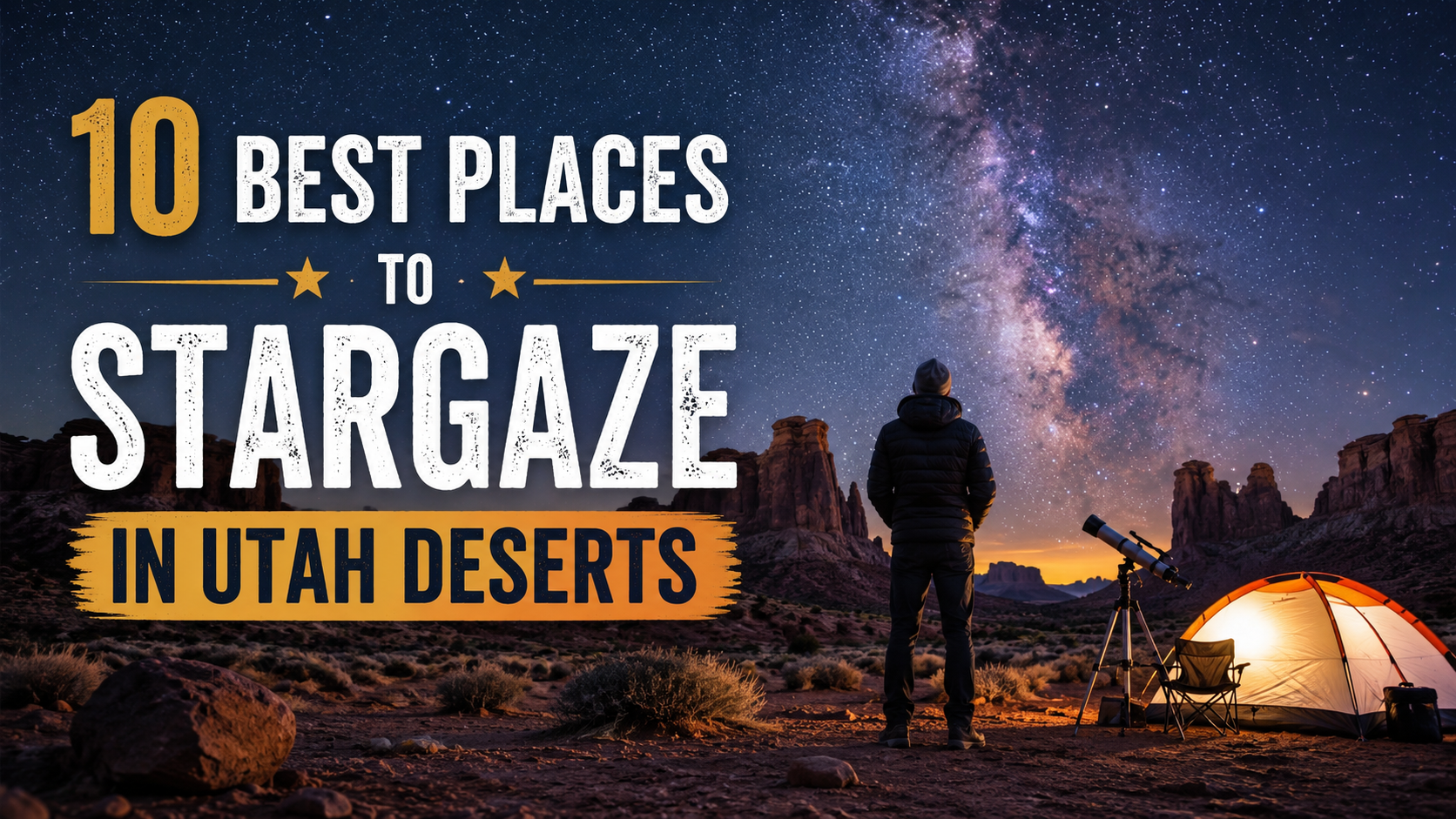
10 Best Places to Stargaze in Utah Deserts
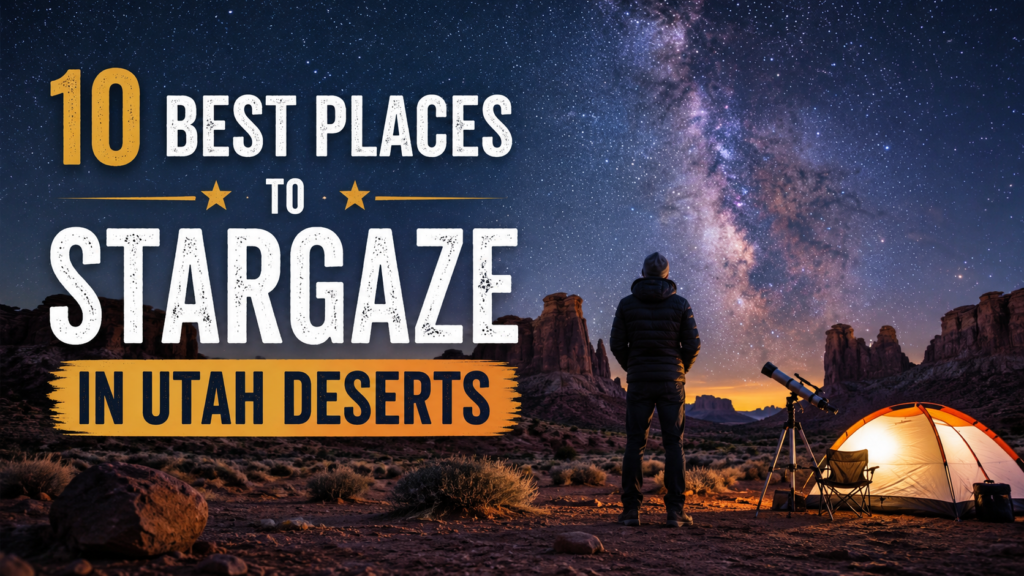
10 Best Places to Stargaze in Utah Deserts. You can’t get much closer to heaven than this hanging out under a dark desert night sky in Utah where the only interruption in the ink black velvet sky is a dazzling , shimmering universe so bright it feels as though you could just float up there and swim among it . Utah’s desert air is thin , crisp and totally dry.
That combination creates a clear really , really clear passage way to a vast night that has captured astronomers’ eyes for ages.
There are more officially Designated Dark Sky Places in Utah than in any other spot in the universe, and that is pretty compelling evidence that the state’s deserts make a world class Astro tourism destination. Gape at the iconic arches that the Milky Way looks like it’s trying to get through, check out the alien like hoodoo figures as they stand guard beneath the vast expanse of sky, the10 Best Places to Stargaze in Utah Deserts are truly out of this world. For telescope toting Astor photo Graphics and blanket laying stargazers alike, a night sky experience in the Beehive State will simply take your breath away. Journey with me through the very best stargazing in Utah.
I’ll give you tips and tricks so that you don’t just spend a night out looking at the sky; rather, you truly connect with it. Stargaze.
Why Utah’s Deserts Are Perfect for Stargazing
The Dark Sky Capital of the World
It’s no wonder that Utah is known worldwide as the “dark sky capital.” Between the 26 certified International Dark Sky Places sprinkled around the state, there’s plenty of wonder to go around, and a lot goes into making Utah the place for stars. The dry desert air helps immensely; humidity, or in this case, the presence of water particles, refracts light pollution as photons are reflected and scattered by water molecules. Stargaze.
In Utah’s dry air, however, scattering of light is minimal and the stars become almost unbelievably bright. Stargaze.
Another advantage is the state’s high altitude. At locations like Bryce Canyon, the stars seem closer, and in effect, are. While just a few thousand feet might not seem like much in relation to space, this is still enough less of an atmosphere in between you and the rest of the universe to diminish distortion and provide a clearer look into the furthest reaches of our galaxies.
A Commitment to Protecting the Night
In fact, Utah’s parks are working in fantastic ways to preserve dark skies. Take Snow Canyon State Park. All of the park’s lights have been changed out, resulting in a 100 percent dark-sky-friendly park. In fact, when you visit these parks, you’ll have access to some of the darkest skies in the continent where you may be able to see as many as 15,000 stars instead of 500 in an urban area.
The Best Places to Stargaze in Utah Deserts
1. Bryce Canyon National Park The Dark Ranger’s Playground
10 Bryce Canyon Perhaps you didn’t realize that Utah, high in the desert plateaus dotted with the otherworldly hoodoos that Bryce is known for, provides such a great platform for astronomy, thanks to clear air and Gold Tier Dark Sky status. Every year the park’s Astronomy Festival attracts stargazers from across the country, and ranger-guided night sky tours offer the perfect way to view the heavens, no matter your skill level. For a really exceptional astronomy experience, book an expedition with Keven “The Dark Ranger” Poe at the Dark Ranger Observatory, located just outside the park. 19 large telescopes can show you Saturn’s rings and nebulae light-years away.
Pro Tip : Head out on one of the guided stargazing programs in the park rangers know the sky .
2. Arches National Park Stars Through Stone
Picture this: the classic shape of Delicate Arch set against a blanket of millions of stars. Arches became an International Dark Sky Park in 2019 so you’ll see pitch black, starry skies above the more than 2,000 arches of the park. Double Arch is a popular spot for an amazing Milky Way view, and since Arches is right outside the adventure town of Moab, you can fill your day with activities and your night with world class views of the cosmos. In summer and park rangers offer dedicated tours on full moon nights and general stargazing experiences.
Insider Tip : Visit during a new moon for the darkest skies. The contrast between the glowing stars and the ancient sandstone arches is absolutely magical .
3. Goblin Valley State Park Otherworldly Views
Goblins and stargazing: You can almost convince yourself that you’ve gone to another planet at Goblin Valley State Park . The hoodoos here-often described as “goblins”-are in funny shapes like mushrooms, and the result is an otherworldly canvas for starry night skying. Because Goblin Valley is a certified Dark Sky Park, its nights have long been among the darkest in America. Designated in 2016, the park’s very dark skies help bring a brightly and clearly illustrated Milky Way, looking a lot like a celestial river stretching through the night.
What to Bring : A comfortable chair or blanket, warm layers (deserts get cold at night) and a red flashlight to preserve your night vision.
4. Canyonlands National Park Island in the Sky
The isolation of Canyonlands National Park also designated a Dark Sky Park in 2015 and keeps the night skies free of light pollution . The “Island in the Sky” section of the park boasts open vistas for observing the sunset flood the canyon walls with warm oranges and reds before filling with starry brilliance .
Because it’s pretty remote, there aren’t typically a lot of people around for viewing. In the evening, you can witness the full sweep of the Milky Way extending from one end of the sky to the other visible to the naked eye-after the last traces of sunlight fade from the canyons.
Pro Tip : Book a night at one of the backcountry campsites for an experience you’ll never forget . Just bring plenty of water and a reliable headlamp .
5. Natural Bridges National Monument The First Dark Sky Park
They’ve made history here! Natural Bridges National Monument was the world’s first International Dark Sky Park, the park also showcases three of the largest natural stone bridges on Earth that appear as spooky, ghostly shapes in the night sky. In summer you can take advantage of the park’s telescopes at ranger led stargazing programs. With the park’s Gold Tier status you’ll experience some of the darkest skies anywhere.
Why You Need To Go Ancient natural formations coupled with an unpolluted sky makes this place a must visit for any budding astronaut.
6. Kodachrome Basin State Park Photographer’s Paradise
Named for Kodak’s iconic Kodachrome film, the park is beautiful by day and spectacular by night as it is also a designated International Dark Sky Park and experiences a lot less visitors than the adjacent Bryce Canyon (under 180,000 a year vs Bryce’s two million). The park has 67 monolithic sandstone spires that serve as wonderful foreground subjects for night photographs. Camping overnight gives you the perfect opportunity to watch the Milky Way rise above these colorful rock formations. Stargaze.
Best Time to Visit : Spring and fall offer the most comfortable temperatures for night viewing and though the park remains open year round .
7. Snow Canyon State Park Urban Night Sky Gem
Our latest Dark Sky to join the Utah Dark Sky Family, Snow Canyon State Park received Urban Night Sky Place certification on December 2025. The park is a mere 10 miles away from the town of St. George, showcasing that you do not need to journey far into the backcountry to see some of the finest starry night skies imaginable.
In the park, staff replaced the park’s lights and retrofitted all lights to 100% dark sky compliant for neighboring towns to use as a benchmark. The park has over 38 miles of hiking trails that are punctuated by the red and white Navajo sandstone, making it very easy to access the dark skies without leaving behind convenient amenities.
Did You Know? Snow Canyon is one of the most visited state parks in Utah and welcoming over one million guests annually .
8. Dead Horse Point State Park Grand Canyon Vibes Without the Crowds
“Wow factor” that is often compared to that of the Grand Canyon , Dead Horse Point State Park features spectacular overlooks of the Colorado River flowing through canyon country . The park has been designated as an International Dark Sky Park since 2016 and offers phenomenal views of the night sky over the majestic overlooks .
Dead Horse Point State Park is located close to the town of Moab and is a wonderful place to add to any southeastern Utah itinerary . Don’t miss Dead Horse Point Overlook for one of the best sunset to night sky transition views around!
9. Antelope Island State Park Bison and Stars
Get the Antelope Island experience When the desire for an authentic stargazing visit strikes, head down to the Great Salt Lake’s Antelope Island , just 65km from Salt Lake City . Mountains down the center of this slender island keep it from getting light from the nearest city.
The island’s star parties are large, some featuring as many as 1,000 telescopes. While in the daytime you could cross paths with bisons blocking the road, after dark you might spot coyotes, bobcats or even fluorescing scorpions on a nighttime UV tour.
Unique Experience : Combine daytime wildlife viewing with nighttime stargazing for a full Utah adventure .
10. Goosenecks State Park River Meanders Under the Stars
A Dark Sky Park since March 2021 , Goosenecks State Park affords you a remarkable 1,000 foot view of the San Juan River . Small the park is a truly dramatic demonstration of entrenched river meanders in North America . Spend the night at the park’s campground under some of the darkest skies in the lower 48.
Best of all : The remote location guarantees minimal light pollution and maximum star visibility .
Essential Stargazing Tips for Utah Deserts
Timing Matters
Timing your visit to observe is tied to what you’re hoping to witness : The best time for observing the Milky Way , particularly to see the core , falls between late spring and early fall . It is recommended that one observe during a new moon in order to avoid light pollution.
Seasonal Recommendations :
- Spring & Fall : Comfortable temperatures and clear skies make these the ideal seasons
- Summer : Warm nights but watch for afternoon thunderstorms
- Winter : Cold but incredibly crisp air provides some of the clearest views
Packing Checklist
- Warm layers : Desert nights can be surprisingly cold, even in summer
- Red flashlight : White light destroys night vision
- Star map or app : Download Star Walk or Sky Safari before you go
- Comfortable chair or blanket : You’ll want to look up for extended periods
- Thermos with hot drink : Stay warm while you stargaze
Photography Tips
For those wanting to capture the night sky , bring a camera with manual settings , a sturdy tripod and a wide angle lens . The dry desert air and minimal light pollution in Utah’s Dark Sky Parks create ideal conditions for astrophotography .
Quick Tip : Use a remote shutter release or self timer to prevent camera shake during long exposures.
What to Expect : The Celestial Show
On a clear night in Utah’s deserts, you might see:
- The Milky Way : The galaxy appears as a luminous band of stars stretching across the sky
- The Andromeda Galaxy : 2.5 million light years away
- Jupiter and Saturn : Visible with the naked eye, spectacular through telescopes
- Constellations : Orion, USA Major , Cassiopeia and many more
- Meteor showers : Peak periods like the Perseus in August are particularly spectacular
Conclusion
Where to Stargaze in the Utah Deserts (10 Must be Visit Spots) Utah State Parks and beyond Best of Utah Adventures The best spots for stargazing in Utah’s deserts do much more than simply showcase gorgeous night skies they connect you to the cosmos in ways you just can’t replicate surrounded by city glow. Lying back to watch shooting stars zip across the sky at Goblin Valley, gazing up at the Milky Way forming above the natural arches of Arches National Park or attending an organized star party on Antelope Island ; these are the places to build memories for a lifetime in their sanctuaries of dark sky.
Book the dates now: Check out the moon phases and book the best campgrounds early so you can enjoy a truly stellar experience and let this stargazing guide transform the way you see the world.
Have you enjoyed the Utah’s dark skies? Share your favorite stargazing spot and memories below we’d love to hear! And share this article with any amateur astronomers you know planning a cosmic getaway.
Frequently Asked Questions (FAQs)
What’s the single best place to go for stargazing in Utah?
For its Gold Tier Dark Sky status, high elevation, and fantastic astronomy programs led by park rangers, most would vote Bryce Canyon National Park the best place to gaze at the stars.
What’s the best time of year for stargazing in Utah?
April, May, September and October are typically your best bet for a night under the stars in Utah due to mild temperatures and clear skies, but a clear winter night can also offer the crispest views.
Is a telescope needed to stargaze in Utah?
Nope! The deserts in Utah’s Dark Sky Parks boast visibility of the Milky Way and thousands of stars to the naked eye. During ranger programs, there are many opportunities to view the night sky through park provided telescopes.
Are there Dark Sky Parks near Moab?
Yes! Two International Dark Sky Parks, Canyonlands and Arches National Park, along with International Dark Sky Place Dead Horse Point State Park, are all just a short drive from Moab.
What’s the difference between a Dark Sky Park and a Dark Sky Place?
An International Dark Sky Park is an area with exceptional starry nights and preserved night sky quality, whereas International Dark Sky Place is a broader designation including parks, reserves, sanctuaries, communities, and urban night sky places.
Can I camp in Utah State Park campgrounds and stargaze overnight?
Many Utah State Parks offer campgrounds and opportunities to sleep out under the stars. Kodachrome Basin, for instance, features three campsites that are open year round. Book early as sites fill up!
How many International Dark Sky Places are there in Utah?
There are 26 certified International Dark Sky Places in Utah, more than anywhere else in the world.
What should I wear for night stargazing in the desert?
You’ll want to dress in layers. The temperature in the desert will drop considerably after sunset even during the summer months. Be sure to pack a warm jacket , gloves , hat and closed toed , insulating shoes.
Do I need a permit to stargaze in Utah National Parks?
General public access for stargazing does not require a permit, but if you are planning on staying overnight and going on an extended backpacking trip, a permit might be necessary. Be sure to always verify park policies and obtain any required permits prior to your visit.
Can I capture great astrophotography shots with just a phone?
You don’t need a camera worth thousands of dollars. Take good photos with a newer smartphone that features a good night mode camera.