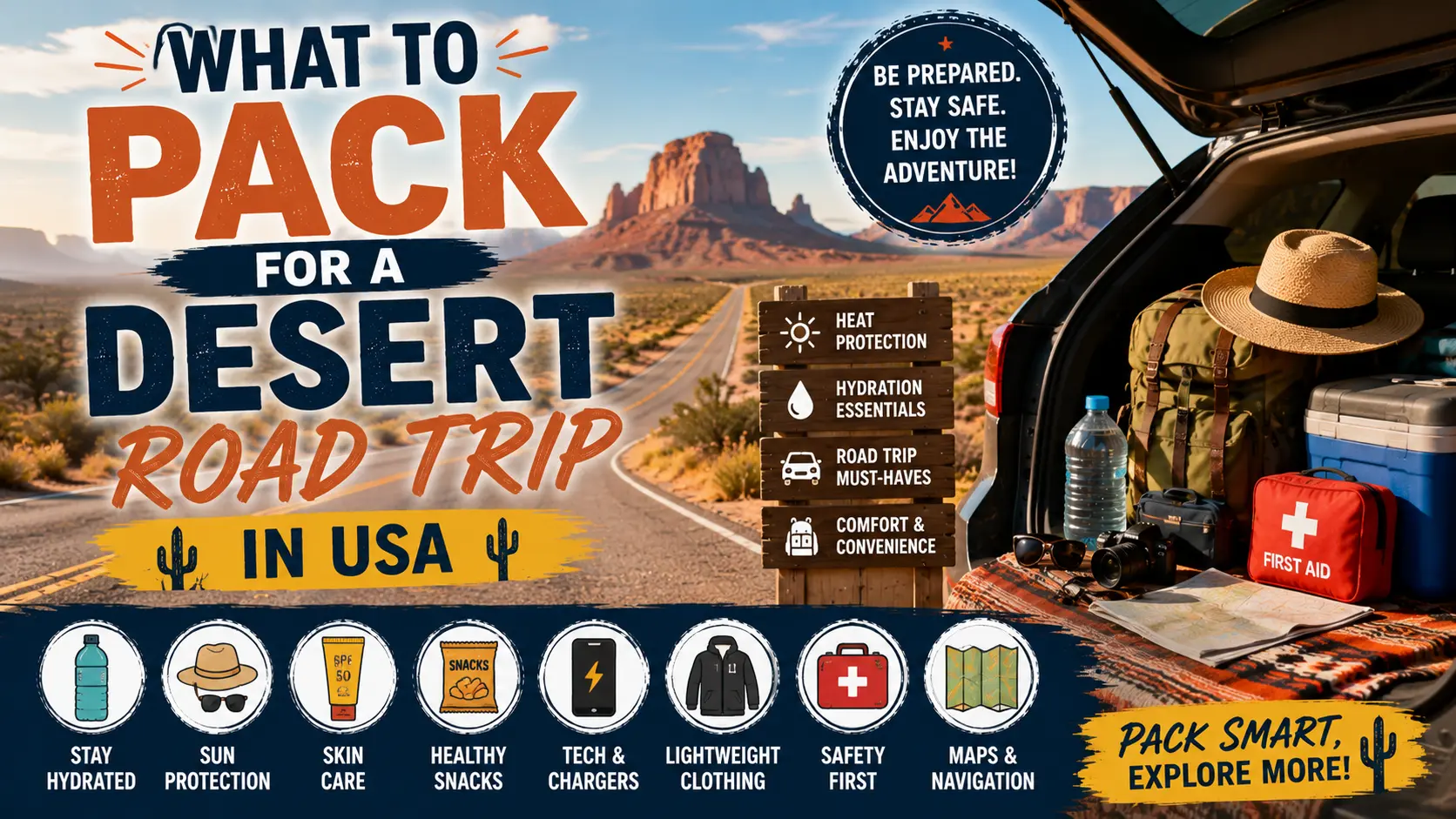
What to Pack for a Desert Road Trip in USA
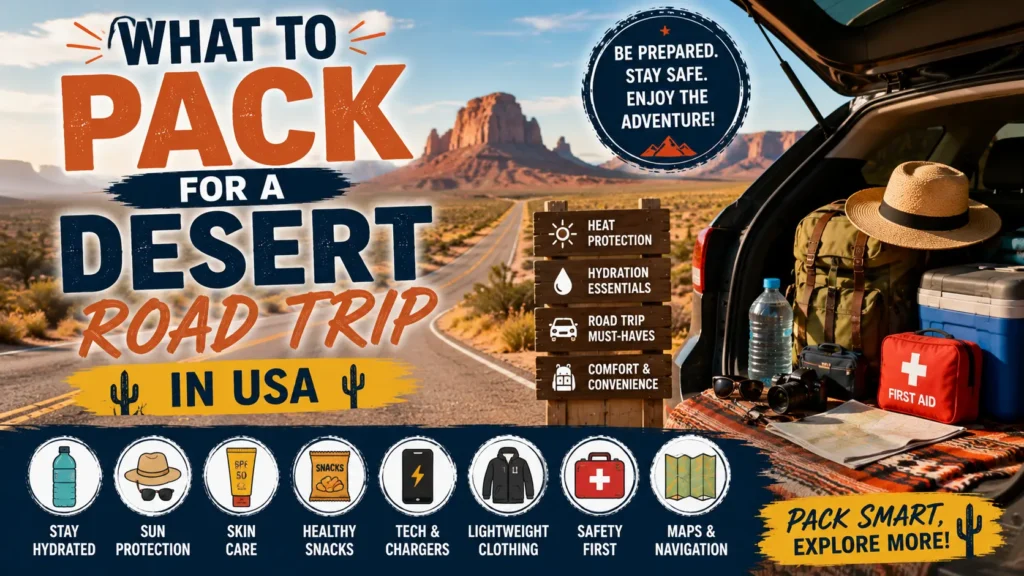
What to Pack for a Desert Road Trip in USA.The American desert is a trickster. One minute, you’re blasting the AC in 110°F heat, staring at a mirage on the asphalt. The next, you’re shivering in a 40°F night under a sky exploding with stars.
I’ve been stranded outside Joshua Tree at midnight (dead battery) and sunburned so badly in Moab that I looked like a lobster in hiking boots. Trust me: knowing What to Pack for a Desert Road Trip in USA separates a legendary adventure from a survival struggle.
You don’t need a million gadgets. You need the right gear. This guide covers exactly what goes into my trunk for routes like Utah’s Mighty 5, Arizona’s backroads, or Death Valley. Let’s pack smart so you can drive wild.
Why the Desert Demands a Different Packing List
The desert ecosystem is extreme. Humidity is often below 15%, which means you dehydrate without sweating. The sun is violent. Distances between gas stations can stretch over 100 miles.
Most first-timers overpack clothes but forget car survival essentials. I’ve learned that a desert road trip requires a “two zone” mentality: daytime hellfire and nighttime chill.
Key takeaway: Pack for the breakdown you aren’t planning to have.
The Golden Rule of Desert Layering (Don’t Skip This)
You cannot wear jeans in the desert. I said it. Denim traps sweat, chafes, and takes hours to dry.
Instead, focus on three layers:
- Base layer: Moisture-wicking synthetic or merino wool (no cotton!).
- Sun shirt: Loose, long sleeve with UPF 30+ rating.
- Insulation: A lightweight puffy jacket or fleece for evenings.
This system works from Sedona to Big Bend.
Clothing Essentials (What Actually Works)
Let’s get specific. Here is your desert packing checklist, broken down by category.
Tops & Bottoms
- 2 long sleeve sun shirts (light colors). Dark colors absorb heat. White, khaki, or light blue are your friends.
- 1 pair of hiking pants (convertible zipper legs are gold). Roll them into shorts when the mercury hits 100°F.
- 1 pair of bouldering or quick-dry shorts. Great for slot canyons or splashing in the Colorado River.
- 3 merino wool or synthetic T-shirts. Cotton kills in the desert (it holds sweat and causes hypothermia when the sun drops).
- Underwear: Anti-chafe, seamless boxers or briefs. Trust me on the chafing.
The Desert Footwear Rule
Don’t wear hiking boots in soft sand. You will hate life.
- Trail runners (low top). They drain water, dry fast, and grip slickrock. I use these for 90% of desert hikes (e.g., Grand Staircase Escalante).
- Chacos or Tevas (with toe strap). Perfect for river crossings at Havasu Falls or The Narrows (Zion).
- Desert boots (optional). Only if you expect cactus spines or heavy scree fields.
Critical Accessories
- Wide-brimmed hat (not a baseball cap). Baseball caps leave your ears and neck exposed. Get a “boonie” hat or a cowboy style straw hat.
- UV protection sunglasses (polarized). The glare off red rocks is blinding. Cheap gas station glasses cause eye strain.
- Bandana or Buff. Soak it in water and wrap it around your neck. It’s your personal swamp cooler.
The “Hidden Gems” Health Kit
You won’t find a CVS on the way to The Maze District or the Racetrack Playa. Build a small medical/tool kit:
- Electrolyte powder packs (Liquid IV or DripDrop). Water alone isn’t enough. You need sodium and potassium.
- Lip balm with SPF 30. Chapped lips in dry air crack and bleed within a day.
- Saline nasal spray. Dry air causes nosebleeds. This fixes it instantly.
- Tweezers (fine tip). For cactus spines and jumping cholla. A credit card also works to scrape off glochids.
- Gauze and medical tape. Not just for cuts you can tape a torn tent or a hose.
Car Gear for Remote USA Deserts
Forget the spare tire (well, don’t forget it, but upgrade). Driving Utah’s Hole in the Rock Road or Arizona’s Apache Trail requires extra preparation.
The Non Negotiable Survival Kit (Keep in Your Trunk)
- 5 gallons of water (separate from your drinking water). This is for your radiator, not your mouth.
- Jump starter power bank (e.g., NOCO or DBPOWER). You cannot rely on other cars. On a Tuesday in November, you may be the only car for 50 miles.
- Air compressor (plugs into 12V outlet). You need to air down tires for sand and air back up for highways. Flat tires happen hourly in sharp desert rock.
- Tow strap (no metal hooks). If you slide into a sandy wash, a kind truck driver can pull you out safely.
- Full-size spare tire. Many rental cars have donuts. Demand a full size spare, or buy a used one.
Navigation (Phones Fail)
The best hidden spots like Alabama Hills or Goblin Valley have zero cell service.
- Download offline Google Maps for the entire state.
- Gaia GPS or OnX Offroad (pay for premium for 1 month, download map layers).
- Paper map (Benchmark or National Geographic). When your phone overheats and shuts down (it will at 115°F), paper saves you.
Food & Hydration Strategy
You will eat more than usual. The dry air and heat spike your metabolism.
Daily water rule: 1 gallon per person, per day. Double it if you hike.
Foods that survive the heat:
- Tuna or chicken pouches (not cans pouches are lighter).
- Peanut butter & tortillas (bread molds in 2 hours).
- Trail mix without chocolate (it turns to goo).
- Instant coffee & no-stove cold brew bags.
- Apples and oranges (they don’t crush like berries).
Pro tip: Freeze a gallon jug of water. Use it as an ice block in your cooler. Drink it when it melts on day 3.
Camping vs. Motel vs. Vanlife Packing Differences
Not every desert road trip is the same. Adjust your loadout:
If you are tent camping:
- Sand stakes (regular stakes pull right out of soft ground).
- A tarp to put under your tent (sharp rocks destroy tent floors).
- Sleeping bag rated for 20°F. Deserts lie Utah in October can hit freezing.
If you are sleeping in the car (stealth camping):
- Reflective windshield cover (keeps it dark and cool).
- USB rechargeable fan (put it in a window crack).
- Mosquito netting for windows (Canyonlands has brutal gnats).
If you are motel-hopping (Route 66 or small towns):
- Only 2 outfits. Wash in the sink with Dr. Bronner’s soap.
- Earplugs. Small desert motels sit next to freight train tracks.
Exact Locations & Seasonal Packing Adjustments
Here is where most blogs get vague. Let’s get specific by destination and month.
Summer (June August) Death Valley & Lake Havasu
Never hike after 10 AM.
- Pack: Cooling towel, white long sleeves, instant ice packs.
- Leave: Hiking boots, dark clothing, chocolate.
- Hidden gem to visit: Rhyolite Ghost Town (Nevada) at sunset. It’s cooler and less crowded than Death Valley proper.
Spring & Fall (March – May, September – November) – Moab & Sedona
This is the perfect window.
- Pack: Layers for 50°F mornings to 85°F afternoons. Bring a beanie.
- Hidden gem: Valley of the Gods (Utah) instead of Monument Valley. It’s free, empty, and requires a high clearance vehicle.
- Warning: Spring brings wind. Bring dust proof goggles or wraparound sunglasses.
Winter (December – February) – Big Bend & Joshua Tree
The desert is actually pleasant.
- Pack: A down jacket, fleece lined pants, hand warmers.
- Hidden gem: Chiricahua National Monument (Arizona) . No crowds, frozen morning hoodoos.
- Road hazard: Black ice on high passes (e.g., Flagstaff to Page). Pack tire chains if snow is forecast.
The Overpacking Trap (What to Leave Home)
I’ve dragged useless junk across Nevada’s Extraterrestrial Highway. Learn from me.
- Leave the full size shampoo. It will burst at altitude. Use bar soap/shampoo bars.
- No heavy books. Bring a Kindle or audiobooks downloaded offline.
- No hiking boots with Gore-Tex (if summer). They trap sweat and cause blisters. Trail runners only.
- No jeans. I said it again.
- No aerosol sunscreen. It explodes in heat. Use lotion sticks or pump spray.
Also Check : How to Drive Through Death Valley National Park in Spring 2026
Your 5 Step Desert Packing Routine (Last 24 Hours)
Do this the night before you leave:
- Fill every water container. Line your cooler with frozen gallon jugs.
- Test your air compressor and jump starter. Ensure they hold a charge.
- Tell two people your route. Text them: “I am going to The Needles District. If you don’t hear from me by 8 PM Tuesday, call 911.”
- Take a photo of your car’s odometer and license plate. Save it to the cloud.
- Charge your headlamp. Desert nights are pitch black. Your phone light is a battery killer.
Real Talk Driving Dirt Roads Alone
The best hidden spots require risk. But risk isn’t stupidity.
If you drive a sedan, stay on graded dirt (e.g., Utah Route 12 overlooks). If you have a stock SUV, you can handle sandy washes if you air down to 18 PSI.
Never cross a flooded wash. “Stupid Motorist Law” exists in Arizona for a reason. Two feet of moving water floats a truck. Turn around.
And please, for the love of the desert, pack out your toilet paper. Bury human waste 6 inches deep, pack the TP in a Ziploc. The red rocks aren’t a bathroom.
The Final Checklist (Printable Version)
Copy this into your phone notes:
- 5 gallons emergency water
- Jump starter & air compressor
- Long sleeve sun shirts (2)
- Wide brim hat & polarized sunglasses
- Electrolytes & saline spray
- Paper map & downloaded GPS
- Headlamp & extra batteries
- First aid kit (tweezers, gauze, tape)
- Tow strap & full-size spare
- No cotton, no jeans, no aerosol cans
Frequently Asked Questions (FAQs)
What is the single most important item to pack for a desert road trip in the USA?
Water storage. Specifically, a dedicated 5-gallon jug for emergencies plus 1 gallon per person per day for drinking. Everything else is secondary to hydration.
Can I wear cotton if it’s a short drive?
No. Cotton holds sweat. When the sun sets, that damp cotton drops your core temperature dangerously. Even on short drives, a breakdown could leave you overnight.
How much water should I bring for a 3-day desert road trip?
At least 3 gallons per person (1 gallon/day) plus an extra 5 gallons in the trunk for your radiator or injuries. Double that if you hike or camp in summer.
Do I really need a full size spare tire?
Yes. “Donut” spares are only rated for 50 miles at low speed. In remote areas like The Loneliest Road in Nevada (US 50), the next tire shop is 200 miles away. A full-size spare is non negotiable.
What’s the best shoe for walking on slickrock (like in Moab)?
Trail runners with grippy rubber (e.g., Vibram Megagrip). Slickrock is like sandpaper it destroys soft hiking boot lugs. Trail runners grip better and dry instantly.
How do I keep my phone from overheating in the car?
Never leave it on the dashboard or center console. Put it in a cooler bag (not touching ice) or a ziplock bag wrapped in a damp cloth. Turn on battery saver mode and close background apps.
Is it safe to sleep in my car in the desert?
Yes, but crack two windows for ventilation (use mesh screens against bugs). Park on level, hard-packed ground, not soft sand. And never run the AC while sleeping carbon monoxide can seep into the cabin.
What hidden desert destination requires the most specialized packing?
The Racetrack Playa (Death Valley). You need a high clearance 4×4, two full size spares, an air compressor, and 10 gallons of water minimum. The 27 washboard road destroys tires and suspensions.
Can I rely on GPS in places like the Grand Staircase Escalante?
No. Download Gaia GPS with the “USFS Recreation” or “Public Lands” overlay. Cell service is zero for 100+ miles. Also carry the National Geographic Trails Illustrated map for that region.
What’s one item nobody thinks to pack for a desert road trip?
A small dustpan and brush. Sand gets everywhere inside your tent, your car carpet, your food. A $5 dustpan saves you from sleeping on gritty sand or scratching your rental car’s interior.
Conclusion
Packing for a desert road trip isn’t about buying expensive gear. It’s about respecting the silence, the heat, and the distance between gas stations.
When you have the right supplies especially water and navigation the American desert becomes a playground instead of a hazard. You’ll remember the sunrise over Canyonlands, the quiet hum of Saguaro National Park, and the surreal feeling of standing where no one else is for fifty miles.
Now it’s your turn.
What’s your most embarrassing desert packing fail? Forgot the sunscreen? Ran out of water three miles from the trailhead? Drop your story in the comments below. And if this guide saved your road trip, share it with a friend who’s planning their own Mojave or Great Basin adventure.
Drive safe. Stay hydrated. Leave no trace.