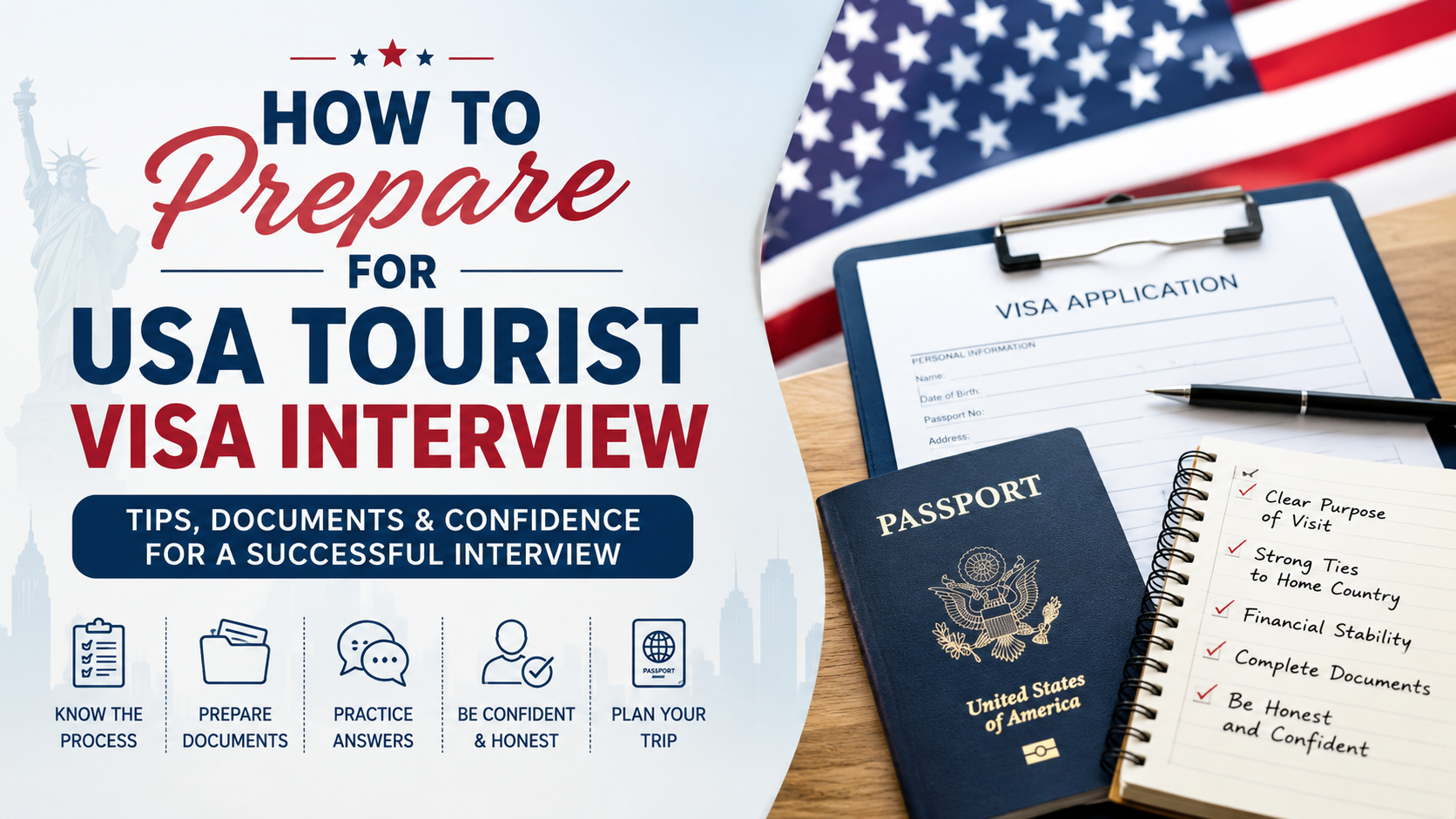
How to Prepare for USA Tourist Visa Interview 2026
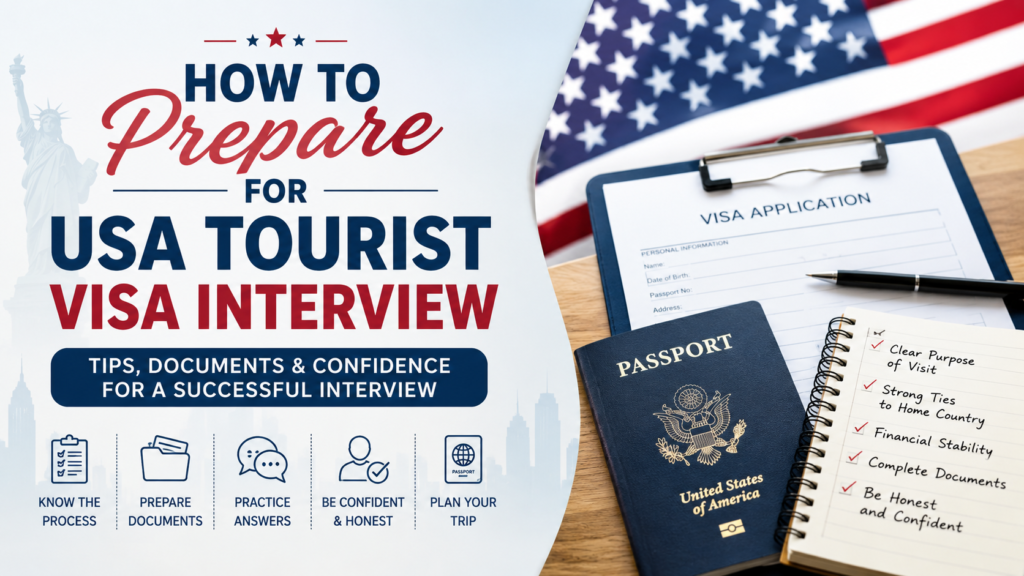
How to Prepare for USA Tourist Visa Interview. You’ve been dreaming of it for years. Road tripping down the Pacific Coast Highway. Watching the sunset over the Grand Canyon. Getting lost in the jazz streets of New Orleans. But before you can pack your hiking boots or charge your camera, there’s one nerve-wracking hurdle standing between you and that American adventure: the visa interview.
Don’t worry. I’ve helped dozens of travelers navigate this process, and today, I’m pulling back the curtain on How to Prepare for USA Tourist Visa Interview. like a pro. Think of me as your local guide not for a hidden trail in Utah, but for the consulate maze.
Let’s turn that anxiety into confidence. Here is your complete, no fluff playbook.
What Exactly Is the USA Tourist Visa (B2) Interview?
Before we dive into tactics, let’s get clear on what you’re facing. The B2 Tourist Visa is for leisure travel. The interview is a short conversation (usually 3–5 minutes) where a consular officer decides if you plan to return home after your trip.
They are not trying to trap you. They just want proof that your life in your home country is strong enough to pull you back.
Key takeaway: The officer assumes every applicant might overstay. Your job is to prove otherwise calmly, clearly, and confidently.
Why Most Travelers Fail (And How You Won’t)
Let’s be honest. Rejection happens. But in 90% of cases, it’s not because the traveler had bad intentions. It’s because they:
- Showed up unprepared or nervous.
- Gave vague answers (e.g., “I want to see everything”).
- Couldn’t prove strong ties to their home country.
- Applied for the wrong visa type.
You will avoid all of that. Follow this guide, and you’ll walk into that interview room like you own the place respectfully, of course.
Complete Your DS-160 Form Like a Detective
The DS-160 is the online nonimmigrant visa application. This is where most mistakes happen before you even book an interview. Treat it like a treasure map every answer must be precise.
Pro Tips for DS 160 Success:
- Save frequently. The session times out. Save the application number immediately.
- Be 100% honest. Even small lies (like a past visa denial) will surface later.
- List a specific U.S. address. Use a real hotel or an Airbnb booking. “I’ll figure it out later” is a red flag.
- Upload the correct photo. White background, no glasses, recent (within 6 months). The system rejects bad photos instantly.
Hidden Trip USA insider tip: After you submit, print the confirmation page with the barcode. You cannot enter the consulate without it. Keep two copies one in your bag, one in a separate folder.
Pay the Fee and Schedule Smartly
The visa fee is non refundable (around $185 for most countries, but check your local embassy). You pay it online. Then you schedule your interview at the U.S. embassy or consulate nearest you.
Best Time to Schedule an Interview:
- Morning slots (8–10 AM) are best. Officers are fresh, not tired or hangry.
- Avoid Mondays (backlog from weekend) and Fridays (rushed energy).
- Book at least 8–12 weeks before your planned trip. Wait times vary wildly by country.
Gather the “Golden Trio” of Documents
Here’s where most online guides overwhelm you with a 20 page checklist. Ignore the noise. You only need three rock solid categories. Officers rarely ask for extra papers, but if they do, you better have them.
Your Core Identity Documents:
- Valid passport (with at least 6 months validity beyond your planned stay)
- DS-160 confirmation page (barcode)
- Visa fee receipt
- Appointment confirmation letter
- One recent passport photo (even if you uploaded it)
Proof of Strong Ties to Home (Your Golden Ticket):
This is the most important. Show you have reasons to return. Examples:
- Employment letter (stating your role, salary, and approved leave)
- Pay stubs (last 3 months)
- Property deeds or rental lease
- Family ties (marriage certificate, children’s school records)
- Business registration if self employed
Ties to Your U.S. Trip (Itinerary Lite):
You don’t need every meal booked. But show you’ve thought this through:
- Round-trip flight itinerary (don’t buy tickets yet hold a reservation)
- Hotel bookings (refundable is fine)
- A rough day by day plan (e.g., “June 10-14: New York, June 14-18: Boston”)
- Bank statements (last 3 months proving you can fund this trip)
Bold truth: An officer might look at none of these papers. Or they might ask for all three. Be overprepared, then stay calm.
Master the “One Sentence Rule” for Every Answer
Here is the secret that changes everything. Most people ramble when nervous. You will not. You will answer every question in one clear, friendly sentence.
Example:
- Q: Why do you want to go to the USA?
- Weak answer: “Oh, I’ve always loved American movies, and my friend went last year, and I have two weeks off, so I thought why not?”
- Strong answer: “I plan to visit national parks in Utah for 12 days, and I have a return flight booked for June 22nd.”
See the difference? Short. Specific. Confident.
Common Questions & Your One Sentence Scripts:
| Question | Your Script |
|---|---|
| “What is the purpose of your trip?” | “Tourism. I’ll spend 10 days visiting museums in Washington, D.C., and hiking in Shenandoah Valley.” |
| “Have you traveled internationally before?” | “Yes, to Canada and Japan. I returned on time both trips.” (If no, say “Not yet, which is why this U.S. trip is important to me.”) |
| “What do you do for work?” | “I am a marketing manager at XYZ Company, where I have worked for 4 years. They approved my leave from July 5-20.” |
| “Do you have family in the U.S.?” | “No, I do not. I am traveling alone with a guided tour group.” |
Never lie. But also never offer extra information. Answer only what they ask.
Dress for Respect, Not a Wedding
You don’t need a three piece suit. But flip flops and a tank top send the wrong message. Aim for clean, conservative, comfortable.
- For everyone: Collared shirt, blouse, clean jeans or slacks, closed toe shoes.
- What to avoid: Hats, sunglasses, large jewelry, political slogans, strong perfume.
You want to look like a responsible professional who respects the process. Because you are.
The Night Before & Morning Of Your Calm Routine
Nerves are normal. But you can outsmart anxiety.
The night before:
- Place all documents in a single clear plastic folder (security will check).
- Memorize your one sentence answers (practice out loud in a mirror).
- Stop reading horror stories online. Seriously. Stop.
The morning of:
- Eat a light breakfast. Low blood sugar = shaky answers.
- Arrive 30 minutes early, not 2 hours. Standing around increases stress.
- Leave your phone, smartwatch, and large bags at home or in your car. Most consulates don’t allow electronics inside.
Inside the Interview Body Language Speaks First
You walk in. You hand over your passport. The officer looks at you. This first 10 seconds matter more than any document.
Do this:
- Smile naturally (not a forced grin).
- Make eye contact.
- Stand straight.
- Greet them with “Good morning, sir/ma’am. I’m here for my B2 visa appointment.”
Do not do this:
- Cross your arms.
- Look at your phone (it’s not allowed anyway).
- Whisper or act secretive.
- Interrupt the officer.
The interview is a conversation, not an interrogation. Treat it like you’re telling a friend about your dream road trip.
What Happens After the Interview? 3 Possible Outcomes
- Approved (90% of well prepared cases): They keep your passport and tell you when to pick it up (usually 5–10 business days). Congratulations. Start booking those hidden gems.
- Rejected (214(b) refusal): You get a white slip. This means they think you lack strong ties. You can reapply later with better proof. It’s not permanent.
- Administrative Processing: They need more time to verify something. This can take weeks. Don’t book non refundable travel until you have the visa in hand.
Hidden Trip USA note: A rejection is disappointing, not the end. I’ve seen travelers get approved on their second try simply by adding a job letter or property deed. Learn, adjust, try again.
Real Talk: What If You’re Self Employed or a Student?
These two groups get extra scrutiny. Here’s how to handle it.
For Self Employed Travelers:
- Bring business registration documents.
- Show tax returns (last 2 years).
- Explain who runs your business while you’re away. “My partner manages daily operations” is excellent.
For Students:
- Bring a letter from your university confirming enrollment and exam dates.
- Show your academic calendar (proof you must return for classes).
- Have a parent or sponsor’s bank statement + their letter of support.
Bold advice: Never say “I’ll look for a job in the U.S.” or “I might extend my stay.” Even as a joke. Officers don’t have a sense of humor about overstaying.
Also Read: Best Time to Visit USA for Hidden Gems & Epic
Most Common USA Tourist Visa Interview Mistakes
Let’s make sure you don’t become a statistic.
- Mistake: Booking a one way flight.
Fix: Always show a round trip itinerary. - Mistake: Saying “I have friends in the U.S.” without context.
Fix: “I have friends, but they will not support me financially. I am paying for everything.” - Mistake: Bringing loose papers in a shopping bag.
Fix: Use an organized, clear folder. Label sections with sticky notes. - Mistake: Answering “I don’t know” to any itinerary question.
Fix: Even a simple plan is better than none. “Three days in Los Angeles, then two days in San Diego.” - Mistake: Acting overconfident or rude.
Fix: Polite confidence wins. Not arrogance. - Mistake: Applying too early (more than 6 months before travel).
Fix: Apply 3–4 months ahead. Not earlier. - Mistake: Forgetting previous visa denials (even for other countries).
Fix: Disclose everything. They will see it in their system. - Mistake: Bringing a relative to the interview (unless they are also applying).
Fix: Go alone unless you are a minor or need a translator. - Mistake: Memorizing answers word for word.
Fix: Know your key facts, but speak naturally. - Mistake: Checking your phone in the waiting room.
Fix: Leave electronics outside. Bring a book or just sit quietly.
Your 7 Day Pre Interview Checklist
- Day 7: Review DS-160 for errors. Re print confirmation.
- Day 6: Gather all “Golden Trio” documents. Make one copy of each.
- Day 5: Practice one sentence answers with a friend for 10 minutes.
- Day 4: Book refundable hotel and hold a flight reservation.
- Day 3: Check consulate rules on electronics. Plan to leave items at home/hotel.
- Day 2: Charge nothing. Just relax. You are ready.
- Day 1: Lay out your outfit. Pack the clear document folder. Set two alarms.
What No One Tells You About Visa Interviews
Here’s the honest truth I share with all my readers: The officer already has a preliminary decision before you speak. They scan your DS-160 and passport. The interview is a quick confirmation.
That means if your DS-160 is weak, no amount of charm will save you. And if your DS-160 is strong, you just need to not mess up the verbal part.
So focus 70% of your energy on the DS-160. 30% on interview practice. That ratio works.
Final Word: Your American Hidden Trip Awaits
You’ve done the hard part. You researched. You prepared. You showed up. Now, picture this: standing at the edge of Horseshoe Bend in Arizona as the sun paints the canyon orange. Or biting into a lobster roll in a tiny Maine fishing village that isn’t on any tourist map.
That moment is real. And it starts with a 5-minute interview.
How to prepare for USA tourist visa interview is not about being perfect. It’s about being honest, organized, and calm. Do that, and you’re 95% of the way there.
Now go get that visa. Then come back to Hidden Trip USA I’ll show you the roads the tour buses never find.
Frequently Asked Questions (FAQs)
How long is the USA tourist visa interview?
Usually 3 to 5 minutes. Some are as short as 90 seconds. Don’t let the short time fool you every word counts.
Can I prepare for the USA tourist visa interview without a lawyer?
Absolutely. Most travelers do it themselves. Lawyers are only useful for complex cases (past denials, criminal records, overstays).
What if I don’t have a permanent job?
Show other strong ties: property, savings, family, or a business. Freelancers can show client contracts and tax returns.
Do I need to speak perfect English?
No. You can request an interpreter. But speaking basic English helps. If you struggle, practice simple key phrases.
How much bank balance is enough?
There is no set number. A good rule: $200–$300 USD per day of your trip, plus flight and hotel proof. More is safer.
Can my family come with me to the interview?
Only if they are also applying for a visa. Otherwise, wait outside. Consulates have limited seating.
What happens if I’m rejected? Can I reapply?
Yes, you can reapply immediately. But it’s better to wait 3–6 months and add new evidence (job change, property, more savings).
Do I need to show hotel bookings for every single night?
No. But show the first few nights and a logical plan. “I’ll drive Route 66 and book as I go” is fine if you have a rough route.
Is it true that older or married people get approved faster?
Statistically, yes, because they often have stronger ties (home, family, retirement). But young solo travelers get approved every day with good preparation.
How soon after approval can I travel to the USA?
As soon as you get your passport back with the visa stamp. Usually 1–2 weeks. You can enter the U.S. the next day if you wish.