
The Best Historical Monuments to Visit in Little Rock, Arkansas 2026
Little I get that it’s easy for Arkansas to slip through the cracks when planning Southern road trip itineraries. We’ve always had an itinerary, ever since 2014. However, if you have a love for all things history, or you’re the kind of person that enjoys a story that grips you, you will find Little Rock, Arkansas to be an absolute gold mine.
This city whispers tales of times past and the very terrain of the city itself tells stories ranging from mounds of Native American civilizations to significant monuments of the Civil Rights era.
Once you look for historical monuments to visit in Little Rock, Arkansas, you will soon discover this city is more than a stop along the highway. Let’s delve in and explore the historic spots to visit.
A Hollywood Fairytale in Arkansas
Let’s get this list going with one that feels like it just popped out of a fairy tale. Hidden in the T.R. Pugh Memorial Park of North Little Rock, you’ll discover the Old Mill, one of the most beautiful and photo-friendly destinations out there .
This isn’t just any old building, though.
It’s an accurate 1880s-style reproduction of a water-powered grist mill that was erected in the 1930s, and it’s best known as the only structure to survive from the beginning of the beloved film, Gone with the Wind . Walk through winding stone walkways as the water wheel softly splishes, and gape at the “wooden” architecture-though it’s actually a cunning use of concrete-for a trip into an enchanted land . The tranquil atmosphere makes this the ideal destination for a leisurely picnic, some introspection, or even snapping that enviable photograph to document your travels .
Pro-Tip: Be sure to hit up the Old Mill early on Sunday morning or on a weekday so you’ll have this dreamy place all to yourself, practically.
The Old State House Museum
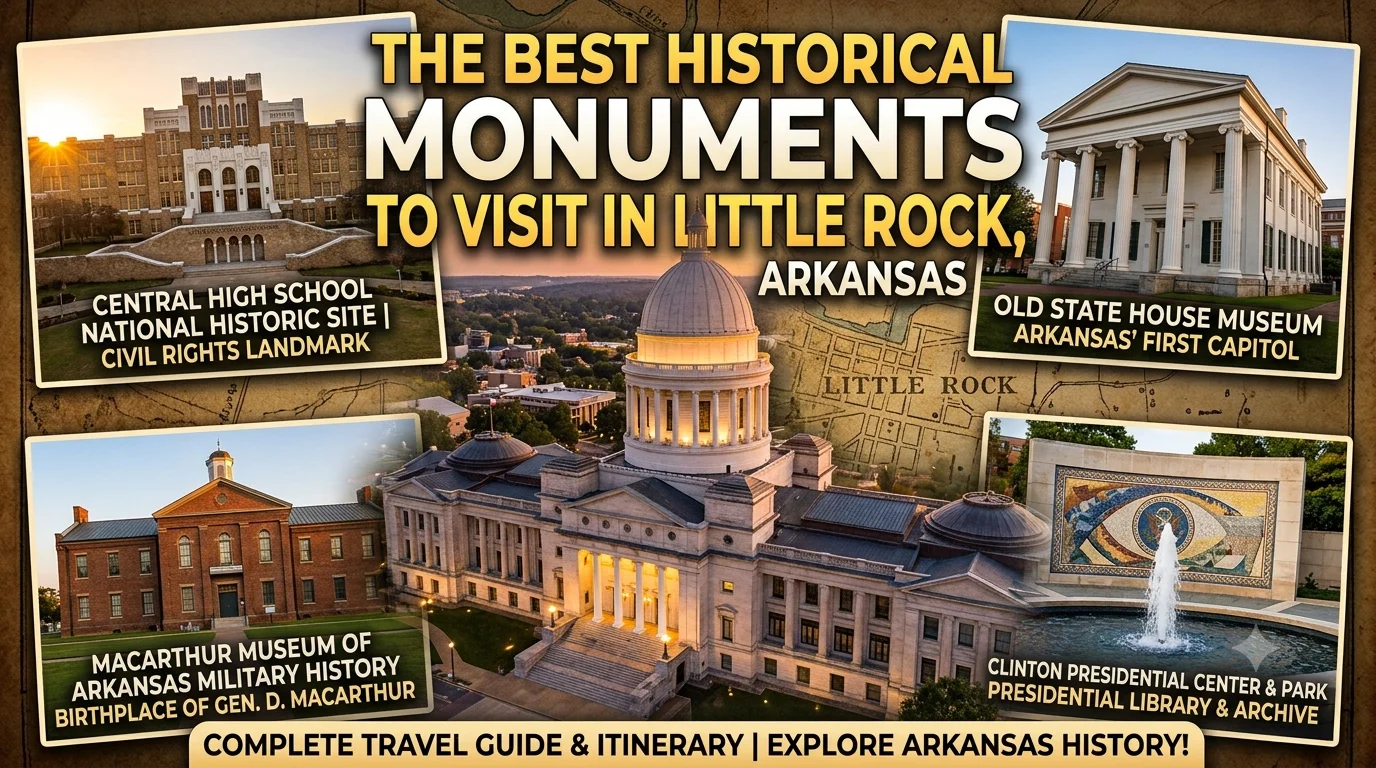
If these walls could speak wow! you can’t even imagine the dramas unfolded in the Old State House Museum. It is the oldest preserved state capitol in Arkansas, a gleaming white Greek Revival monument completed in 1833. From the territory to statehood and into the tumultuous Civil War, the house was the seat of government.
During legislative sessions, proceedings sometimes had a rather colorful, bloody edge.
For example, a legislator fatally stabbed another during an 1830s session, and at some point during the Civil War, Union soldiers made it their barracks. It is now an awesome free museum today, and its exhibits run the gamut Civil War battle flags, governors’ wives inaugural gowns, to name a few and Bill Clinton made an announcement for the presidency here and held his election night parties. Make sure you: Tour the 1836 and 1885 House of Representatives chambers for a real step back in time.
Little Rock Central High School National Historic Site
This is no mere school, but a monumental testament to America’s fight for civil rights. The Little Rock Central High School National Historic Site probably is the city’s most important monument. When nine African American students, now remembered as the Little Rock Nine, boldly integrated this all-white school in 1957, they braved the anger of a mob in scenes that the National Guard helped to diffuse and have become part of the national consciousness-a living response to the Supreme Court’s Brown v.
Board of Education decision.
A park now under the stewardship of the National Park Service (NPS), the 28 acre site is a still functioning four year public high school as well as an educational park that visitors, using the NPS visitors’ center as their starting point and a guided tour by a NPS ranger as the activity, find to be deeply moving. -Plan Ahead : Scheduled talks by park rangers take place throughout the day but you may need to schedule these in advance.
The “Westminster Abbey of Arkansas“
Experience a different type of history lesson at Mount Holly Cemetery in the Quapaw Quarter. This is no ordinary cemetery, established in 1843 as the burial ground for some of Arkansas’ most prominent figures such as senators, governors and authors. Referred to as the “Westminster Abbey of Arkansas”, this park like space is tended by volunteers at Pulaski County Master Gardeners and filled with stunning examples of funeral art-from Neo-Classical statues and Victorian and Art Deco tombstones.
Perhaps one of the most moving sites is Quatie Ross, wife of Cherokee Chief John Ross, whose husband re-interred his wife here after her death along the Trail of Tears.
Unforgettable Experience: Each October, local high schoolers dress in historical costumes and enact “Tales of the Crypt” monologues at the gravesites of history makers.
Honoring Native American Heritage
Long before this city began, the land was populated by the Caddo, Osage, and Quapaw Indians. For the real history of this region, take your bearings from these deep connections to the earth.
Plum Bayou Mounds Archeological State Park
Head down some trails and channel your inner 800 AD Plum Bayou person at this state park. The park boasts many Indian mounds and also serves as an active archaeological research facility.
La Petite Roche and the Quapaw Line
Little Rock is named after “La Petite Roche” (little rock), which served as an important landmark along the riverbank for the Quapaw tribe. The remnant of the rock has been protected in the city and can now be seen within the city center at the Quapaw Linemarkers located at the city’s La Petite Roche Plaza. Thesemarkersindicate where the Quapaw’s ancestral territory met settlement territory.
Sequoyah National Research Center
The Sequoyah National Research Center at the University of Arkansas at Little Rock preserves the writing and expression of North American Indians and contains interpretive exhibits, one of which focuses on Native American soldiers who have served in U.S. Wars .
MacArthur Park
History lovers should visit MacArthur Park. This is where Gen. Douglas MacArthur was born and the park features the MacArthur Museum of Arkansas Military History in the old Tower Building.
The museum discusses Arkansas’ military history beginning in the Civil War and continuing to present day wars.
The park is a pretty little area with nice walking trails, an attractive statue representing “sister cities,” and the interesting “Barrel Bridge” which makes a great photo opportunity.
The Clinton Presidential Library
A tour through the William J. Clinton Presidential Library and Museum is a must-do for anyone visiting Little Rock. This large riverfront museum is a shrine to the 42nd president and the most famous Arkansan (and probably, of the 20th and 21st centuries) ever born.
Like many presidential libraries, it’s a modern building, but still a powerful piece of history due to all the original documents, furniture and furnishings on display.
What visitors will most enjoy is getting to stand in a full-scale replica of the Oval Office – a close up like few ever experience.
The Manor on Stagecoach A Hidden Castle
Looking for something really unusual?
Then you have got to find The Manor on Stagecoach. Sitting on a street of houses, it seems like a stone fortress plunked right into central Arkansas straight from Europe.
Not a place where people live, it is now the focus of people driving up and down a very normal looking road and a hidden wonder of a place.
It goes to show, with a bit of history, a little bit of enchantment and some imagination you may find something truly unusual!
Final Thoughts on Little Rock’s History
From the ancient mounds of the Plum Bayou people to the important places of the Civil Rights movement, Little Rock is a city of history etched onto the landscape, and history is the story that must be heard. This is the kind of place that engages, inspires, and causes reflection. Here’s a look at the top historical monuments in Little Rock, Arkansas.
These monuments are not just old buildings, they’re a living part of history.
Pack your bags with your curiosity ready. Little Rock is waiting to share its stories with you! Share with a travel buddy or leave a comment below: what are you excited to explore first?
Click for More : How to Find the Center of the Universe Acoustic Anomaly in Tulsa 2026
Frequently Asked Questions (FAQs)
What is the most famous historical monument in Little Rock?
The Little Rock Central High School National Historic Site is arguably the most famous monument, serving as a pivotal site in the Civil Rights Movement. It’s a National Historic Site with a powerful story to tell .
Why is it called “Little Rock”?
The city is named after “La Petite Roche” (the little rock), a small rock formation on the Arkansas River that was a landmark for early explorers and Native Americans. You can see the remains of the rock at the La Petite Roche Plaza in Riverfront Park .
Is The Old Mill really from Gone with the Wind?
Yes! The Old Mill is the only remaining structure from the opening scenes of the classic 1939 film Gone with the Wind. It’s a beautiful and popular spot for photos and picnics .
Is the Old State House Museum free to enter?
Yes, the Old State House Museum offers free admission to all visitors, making it a fantastic and accessible historical stop in downtown Little Rock .
Where can I learn about Native American history in Little Rock?
You can visit the Plum Bayou Mounds Archeological State Park to see ancient mounds, explore the Sequoyah National Research Center at UA Little Rock, and see the Quapaw Line markers and La Petite Roche in Riverfront Park .