Best Hikes in Rocky Mountain National Park 2026
Park Best Hikes in Rocky Mountain National Park Picture yourself perched 12,000 feet up, surrounded by air that’s nearly crisp enough to crack, with an unending canvas of snow dusted mountain peaks and turquoise lakes below. This, my friends, is the essence of Rocky Mountain National Park a haven for trekkers the world over that hosts millions of people annually. Navigating 350+ miles of pathways, from verdant montane meadows to the otherworldly alpine tundra, a bit tricky for novices.
Fortunately, the struggle ends here.
Based on my own expeditions across many an RMNP landscape, I’m providing the definitive best hikes.
The Best Hikes in Rocky Mountain National Park for Every Adventurer
So, you’re ready to hit the trail. The key is picking the right one for your fitness level and ambitions. Some people come for the iconic lakes, others for the summit views, and some just want to escape the crowds. Here are my top picks, categorized to help you decide.
For the Family and Leisure Seeker
Not every hike in the Rockies needs to be an epic. These trails are perfect for families with young kids or anyone looking for a more relaxed experience without sacrificing the iconic scenery.
A Stroll with a View: Sprague Lake Loop
This is absolutely the ideal place to start at the park, as a short 0.7 mile boardwalk circles around a beautiful lake giving you pristine views of the Continental Divide, all while staying fairly level, perfect for strollers! Keep your eyes peeled as Sprague Lake is prime spot to view both beaver and moose if you’re lucky, but either way; the photos of the views will absolutely make up for it.
The Classic Family Hike Cub Lake Trail
A good, fun option for the older and more adventurous ones is to hike Cub Lake Trail. At 4.6 miles long and an out and back type trail, Cub Lake Trail gains a modest 540 feet over the distance. You’ll walk along the lake through nice meadows and trees and have a really great time. If you are here during fall, this hike in Rocky Mountain National Park is one of the best hikes to see the aspen turned into glorious gold!
For the Lake Chaser
If glistening alpine lakes are what you’re after, this section is for you. These trails offer some of the most breathtaking and photogenic scenery in the park.
A Short Walk to Iconic Beauty Nymph Lake
For a sweet taste of Bear Lake corridor’s main drags but less commitment on your time and energy, the short hike to Nymph Lake is the winner. This 1.1 mile round-trip, minimal-elevation gain trail begins from the Bear Lake Trailhead, giving you accessibility to one of the most visited areas in RMNP but with a little less… hype. It’s a little lake but packs in a punch of charm and in summer usually sports yellow pond lilies on the water.
The reflections on this lake are spectacular.
It’s also the jump point to more adventures to Emerald Lake and Dream Lake if you so feel so inclined.
The Quintessential Rocky Mountain Experience Sky Pond
You can get a feel for Rocky’s high country on this relatively “strenuous” loop from the popular Bierstadt lake trailhead. If time and energy are limited, and you want to hit one spectacular spot and some of the park’s showstoppers, Sky Pond might be number one.
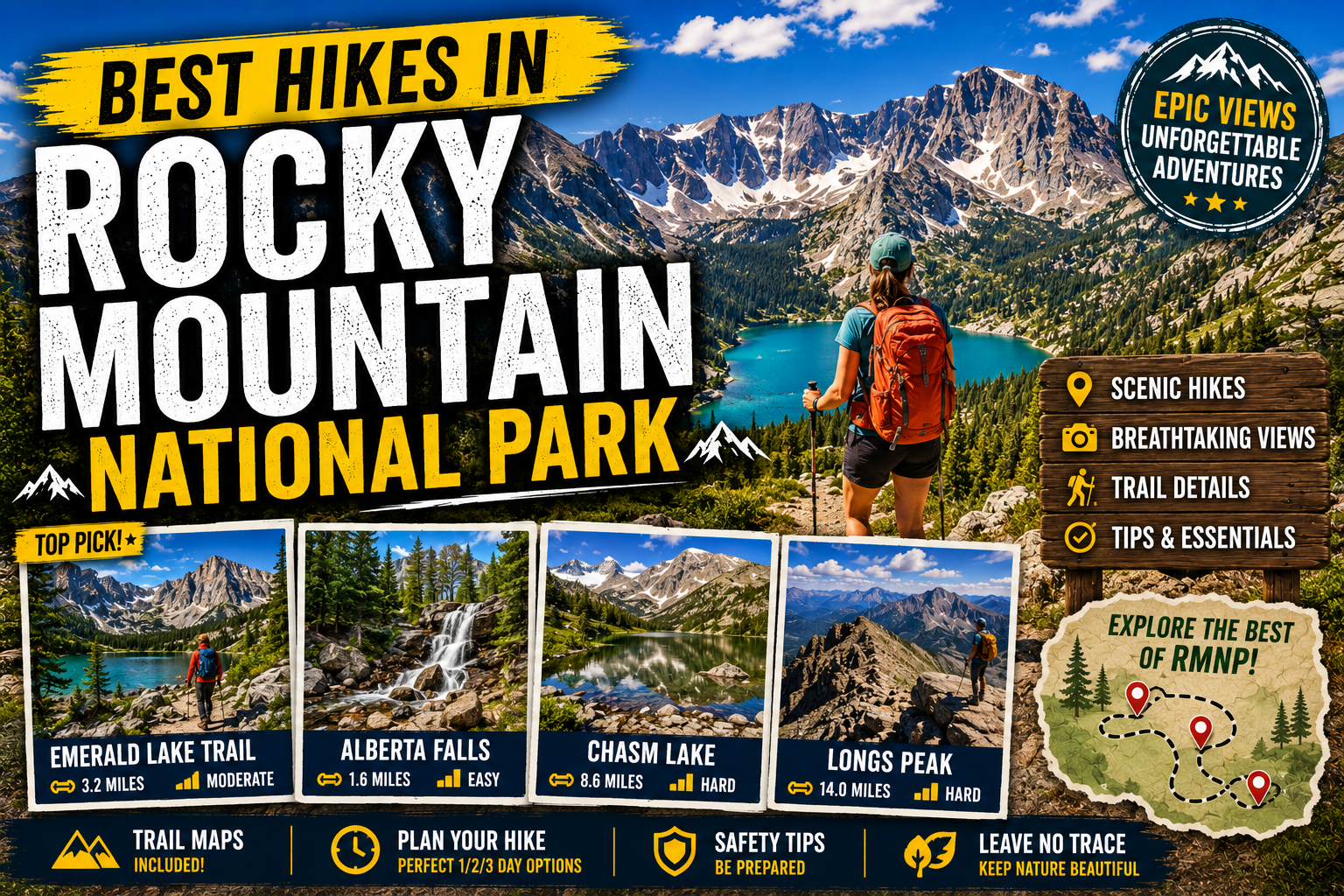
It’s 8.6 miles to Sky Pond, passing many park gems on the way such as Alberta Falls and you even scale through Timberline Falls, finally revealing your rewarding destination in the glacial bowl which has earned itself the name ‘Sky’. As Taylor Peak and Powell Peak dominate your views throughout this hike, you’re in for quite an impressive ride.
For the Off the Beaten Path Explorer
While the Bear Lake Corridor is stunning, it can get busy. If you’re looking for solitude and a more wild experience, the Wild Basin area is your sanctuary.
Solitude and Waterfalls Wild Basin’s Ouzel Falls
On the eastern side of Rocky Mountain National Park is the Wild Basin Trailhead which provides an entirely different park atmosphere. Ouzel Falls is an out and back hike totaling 5.4 miles which flows over Ouzel Falls after you see Copeland Falls and Calypso Falls. Wild Basin is more of a solitude side of Rocky Mountain National Park where less foot traffic results in some very relaxing and wild country experiences. The hiking isn’t incredibly difficult though, making it one of the top wildflowers hiking opportunities in RMNP in the spring.
For the Peak Bagger
Those with a “higher is better” mentality can expect the park’s highest payoff, even though they’re some of the most strenous and best trained routes available.
A Summit Without the Scramble Flattop Mountain
The mountain for when you’re itching for summit elevation without the precarious scrambling of Longs Peak, Flattop is for you. Flattop is an eight mile out and back trek that will have you earning 2,900 ft in altitude. Reaching its top will be rewarding you with endless views stretching to a bright blue Dream Lake and its well defined neighbor, Hallett Peak. It’s your walk up.
The Ultimate Colorado Challenge Longs Peak
The main prize, and at 14,255 feet, Longs Peak is the only ‘fourteener’ in the park and is as legendary as any, but this is one serious endeavor. A 15 mile roundtrip hike, it begins in the pre dawn hours (the earliest you want to hit the trail is 2 to 3 AM so you are out of the “storm line” that tends to begin in the early afternoon) with much of the upper reaches involving exposure and a bit of scrambling across the Keyhole.
An incredible achievement for anyone who is up to the challenge and experience. If you are up for a serious hike but not perhaps a true summit attempt then you can take this same trail a few miles and reach Chasm Lake where the views are superb but the exposure is minimal.
A Backpacker’s Dream Continental Divide Loop
For an extremely remote park experience, you really can’t beat the Continental Divide Loop. This is a 30 mile overnight backpacking trip along the Continental Divide National Scenic Trail. Get set for some of the best scenery in the park and zero people. The route takes in trails like Green Mountain, Tonahutu, North Inlet, etc., and takes you by, among other places, Granite Falls, Mount Patterso Overnight passes will be needed, available at Recreation.gov.
Hiking Essentials
Before you lace up your boots, a little prep goes a long way. Here’s what you need to know for a safe and smooth trip.
Navigating the Timed Entry System
This is important for your planning. To limit the number of people at the park during busy months, RMNP enforces a reservation system in which you’ll need timed entry permits. Timed entry passes range from those that grant you access to most of the park to those designated “Timed Entry+” that will get you into the ever popular Bear Lake Corridor as well.
All need to be purchased well in advance through Recreation.gov.
In general, backcountry/night permits, including those for staying in a campground in RMNP, should allow you in without purchasing a timed entry pass for the park itself, however, it is best to confirm the latest regulations and details on the NPS website.
The Shuttle System
Don’t let trailheads like Bear Lake go from 5am parking filled and on your drive out to them get the entire parking situation to be that huge headache you wish wasn’t possible while driving in the park, make sure to utilize the park’s totally free Shuttle which run from May-mid Oct out to Bear Lake Road Corridor to visit those trailheads. There is also the Hiker Shuttle operating out of the town of Estes to take you straight out to the park’s Park & Ride Transit Hub to make getting to anytrailheada piece of cake.
Weather Warnings and Layering Strategies
Weather changes in the mountains fast. Sunny mornings turn quickly into stormy afternoons; above treeline these summer thunderstorms are very dangerous. The general idea is that you head out to the high peaks early in the day and should have come down from any and all summits by the noon mark. Secondly, always be dressed in layers no matter the season; a packable insulator as well as an impervious to water outer shell are both worthwhile elements of your day pack, no one is safe from an inconvenient summertime snow at any altitude at any point of the year.
What’s the Best Time to Hike?
When Is The Best Time To Go Hiking Best time of year to hike Most hiking is done during summer and early fall (late June to late September). Most trails are accessible until the snow falls then as soon as most of it has fallen and is generally clear until it falls again. Snow may persist at high elevations until July though so factor this into your planning if you intend to tackle the higher routes.
Fall color is best when you visit from late September.
Expect winter conditions above 11,000 feet during spring/summer (April and May and some parts of June).
Wilderness Safety and Wildlife
Bear in mind that you are visiting the home of black bears, elk, moose, and others! Always keep at least 75 feet distance from all animals, carry bear food canisters if overnighting, and alert bears to your approach on the trail to prevent startling one. Visit the park’s trail conditions page for information on conditions along your trail of choice.
Click For More : Secret Spots in Acadia National Park to Escape the Crowds 2026
Conclusion
Rocky Mountain National Park is jam-packed with all kinds of beauty, and trust me, there is literally a trail for all the way from the tranquil circle around Sprague Lake to all out scrambling and climbing on Longs Peak; The Best Hikes in RMNP do Not disappoint! I’ll leave you with my ultimatetip for RMNP hiking that is to plan in advance, play in the wilderness respectfully and by no means get out there and go for a romp out there.
What is on YOUR hiking agenda?
Are there any these you have hiked already or are looking to do next?
Feel free to leave any answers below… And if anything in this hiking RMNP blog helped, please consider sharing!
Frequently Asked Questions (FAQs)
What is the easiest hike in Rocky Mountain National Park?
The Sprague Lake Loop and the Bear Lake Loop are excellent choices. They are flat, short, and offer stunning views, making them perfect for families or a quick walk.
Do I need a reservation to hike in Rocky Mountain National Park?
Yes, from late May to mid to October, you’ll need a timed entry reservation in addition to a park pass to enter the park between certain hours of the day.
What is the most scenic hike in RMNP?
That’s a tough one! The hike to Sky Pond is a top contender, taking you past Alberta Falls, the Lake of Glass, and a waterfall scramble. For pure alpine lake beauty, the Emerald Lake trail is hard to beat.
Can you hike in Rocky Mountain National Park without a car?
Yes! The park operates a free shuttle system along the Bear Lake Road Corridor and has a Hiker Shuttle from Estes Park, allowing you to access many of the best trails without a vehicle.
What is the hardest hike in Rocky Mountain National Park?
The Longs Peak hike is the park’s most challenging, a 15 mile trek with scrambling and over 5,000 feet of elevation gain. The Black Canyon Trail is another extremely difficult, less-crowded option for experienced hikers.
Are there any family friendly hikes in the park?
Absolutely. Beyond the Sprague Lake Loop, trails like the hike to Alberta Falls (1.6 miles) and the Cub Lake Trail are fantastic for families with older children and offer manageable distances and elevation gains.
What should I pack for a day hike in Rocky Mountain National Park?
Essentials include plenty of water, snacks, sun protection (hat, sunscreen, sunglasses), layered clothing, a rain jacket, a map, and sturdy hiking boots. Trekking poles are also highly recommended.
Can I see wildlife on the trails?
Yes! Elk, mule deer, bighorn sheep, and marmots are commonly seen. Moose and black bears also inhabit the park, though they are more elusive. Always view wildlife from a safe distance.