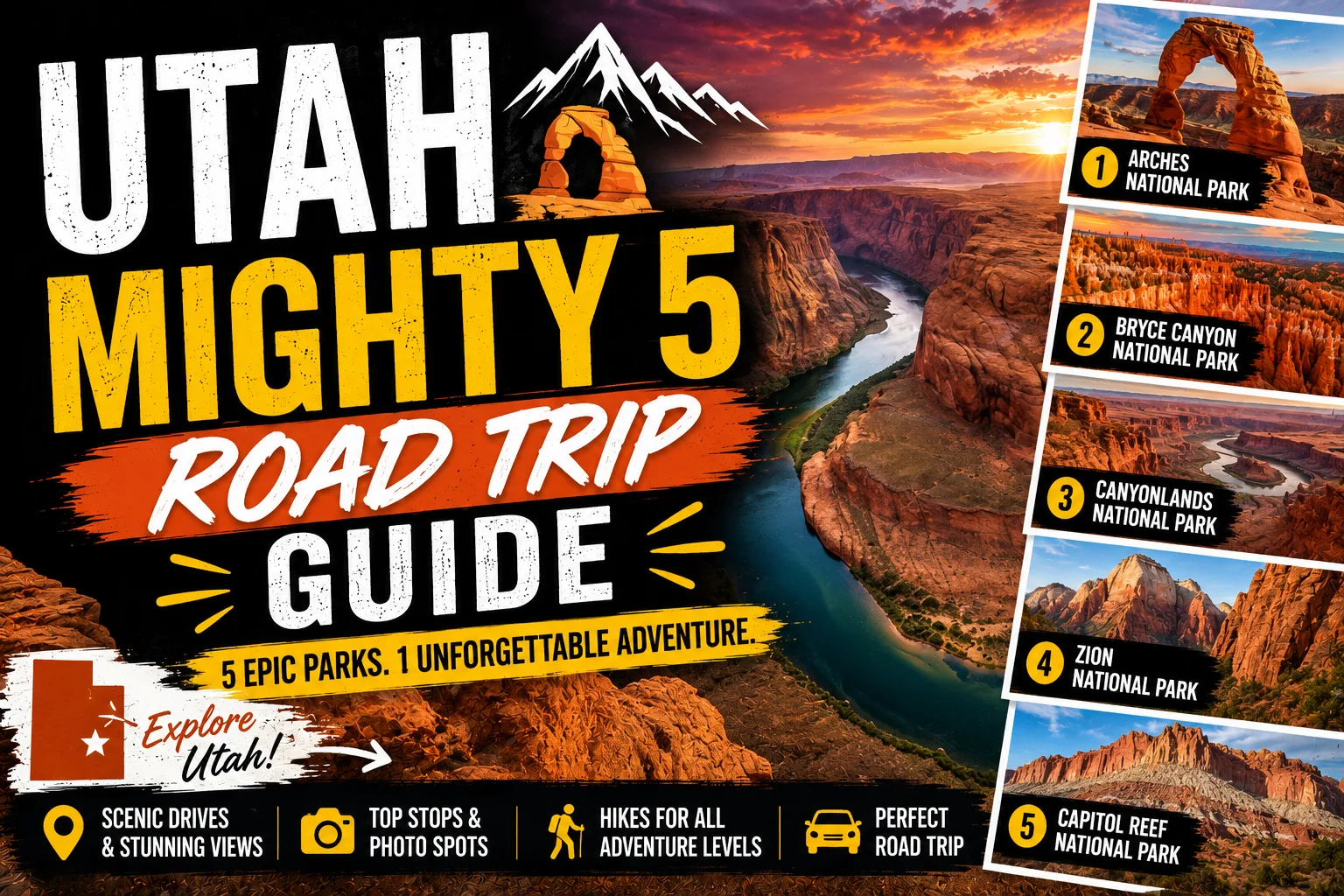
The Ultimate Utah Mighty 5 Road Trip Guide
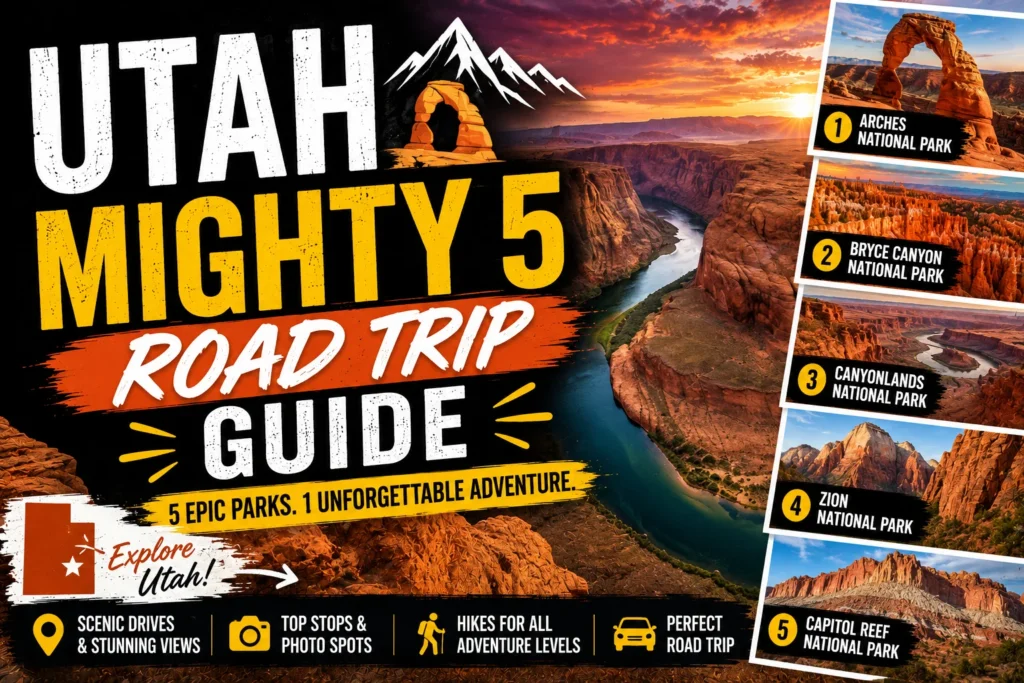
The Ultimate Utah Mighty 5 Road Trip Guide. The beginning of legendary You simply won’t encounter a place anywhere else on Earth with such density of geological marvels capable of rocking you to your core. One minute you could be striding across a vista of red sandstone (under a world-famous red rock arch, mind you), and the next you’ll be peering over a ledge of red sandstone, 1,000 feet or so above the mighty Colorado River.
But planning your own Mighty 5 Utah road trip itinerary might feel like a monumental task. With five massive parks, over a thousand miles of driving and countless little details – where do you even begin? Fear not, we’re here to help you organize and optimize your ultimate road trip with everything we know about the “Mighty 5”.
We’ve compiled over a thousand hours on the red rocks of Utah (and many road trips!) into an up-to-date (with 2026 plans) user friendly itinerary and planning guide. We’ll walk you through how to manage, organize and navigate this red rock paradise Whether you have 7 days, 10 days, or want to do the ‘whole thing’ this Mighty 5 Utah road trip guide is your planning blueprint.
Ready for your best trip through the American West?
Table of Contents
- Why This Trip Is For You: The Mighty 5 of Utah Best Time to Visit Your Mighty 5 Vacation Getting There and Where to Start the Awesome 8 Days! Your Mighty 5 of Utah Itinerary!
- What to Eat on The Mighty 5: How to Make Your Mighty 5 of UT a Photoshoot!. The Must See & Must Do at each!
- Save Your Money: How to do the Mighty 5 Budget Style What to pack! Mighty 5’s of Utah with a Baby/ toddler Mighty 5 of Utah Packing list, that’ll make you pack right Mighty 5 Top Tip Save for future trip
Why You Should Take This Trip
The Mighty 5 loop is less of a vacation and more of a trek millions of years back in time, through the history of geologic formations. Each park offers its own character and geologic phenomena, with Zion serving up a cathedral-like feel by virtue of the looming cliffs; Bryce Canyon, a strange land filled with spires called hoodoos; the relatively subdued, historically significant Capitol Reef; the vast and wild desert canyonlands of Canyonlands; and the final park and main event, the highest density of natural stone arches to be found anyw. A trip that puts together all the incredible scenery of the American Southwest, yet does not leave you feeling rushed. The parks can all be seen by traversing Scenic Byway 12-arguably the single most beautiful road in the US.
The Ultimate Utah Mighty 5 Road Trip Guide
Timing can make or break a Utah road trip. The shoulder seasons are your best bet.
Spring (April – May)
Arguably thebestseason Weather is pleasant , wild flowers begin popping open , and melt in Zion adds water flow to waterfalls . It is an wonderful, even with spring break crowds,time to be outside . The biggest drawback for is the some of the higher elevation roads might still be shut due to snow (such as near Brian Head, North of Zion) .
Fall (September – October)
The other perfect time is during fall. By the time autumn begins in late September, the summer temperatures have calmed down, and summer people have largely headed home on both sides of Labor Day, most definitely in Moab . The air feels good for you to breath and there is some amazing lighting out there that really suits a photographer’s needs.
Summer (June – August)
Look forward to heat Arches and Canyonlands temperatures can top 100F with alarming regularity. You have to go into slot canyons and get back out before 10 and go after 4pm just to survive, but hey, it is also peak-season time and the start of the monsoon season that includes flash floods to slot canyons.
Winter (December – March)
However, during the winter, when the snow is dusted on the red rocks it provides for quite an impressive contrast as well. Especially from on top of Bryce Canyon, around 8,000 feet elevation- it’s certainly magical but cold as can be. Some roads and buildings close when winter comes on, but it’s one of those times where the parks can be even easier to get around once shuttle systems are out of commission. Most will be able to drive themselves along the primary park road though, keep in mind the snow will make conditions much rougher though!
The Takeaway: For optimal weather, open accessibility, and a better crowd situation- plan your trip for late spring (around May) or early fall (September/October).
How to Get There and Where to Start
Your starting point depends on your preference for one-way rentals and flight costs.
Starting from the West (Las Vegas, NV)
This is often the top pick as Las Vegas is a couple of hours outside Zion National Park giving it its name and acting as the perfect entrance into this wonderful wonderland. From Las Vegas you’ll end up driving west to east as you head towards Moab (close to Arches) and will be driving as needed though starting and finishing on opposite sides means for longer drives and hence, best suited flying into Las Vegas then flying out of Salt Lake City.
Starting from the East (Salt Lake City, UT)
Alternatively, if you don’t want to pay one-way rental prices, you can spend one night in Salt Lake City and do a loop. Salt Lake City is within one-days drive of all 5 parks. You can start in SLC and head south to Moab first (Arches and Canyonlands) and then west towards Zion, or vice versa. Salt Lake City makes a good city to spend a day in and getting acclimated to the altitude before you start.
We Recommend First-timers. Drive From West to East (Las Vegas Zion Bryce Capitol Reef Canyonlands Arches Salt Lake City). This gets you on one straight line without any U-turns and gives you Arches National Park for the big finale.
The Ultimate 8-Day Itinerary: West to East
This is our curated 8-day itinerary designed for the first-timer. It’s a balance of driving, hiking, and soaking it all in.
Day 1: Arrive in Las Vegas – Drive to Zion
- Drive: 160 miles, 2.5 hours
- Stop: Go to your rental car company in Las Vegas to pick up your car. An SUV is beneficial here for comfort on this leg but a regular 2WD will do. Go to a grocery store and get plenty of snacks; gateway towns have small and inconvenient offerings.
- Evening: Drive toward your final destination, Springdale, the town right next to Zion.
- Check into your hotel, then get ready for an early rise.
Day 2: Zion National Park
- Itinerary Focus: The ‘must-do’ hikes.
- Morning: Wake early and head for the park entrance to get parking for the shuttle into Zion Canyon (this is non-negotiable during peak season).
- Main Hike: Pick the level of challenging hike you’re up for: Angels Landing will involve submitting the necessary application forms to get the permit that allows you the thrill of walking along the narrow spine with only chain handholds to accompany you; in contrast, The Narrows hike (a world-class, albeit less exposed, experience) involves walking the river bed between immense canyon walls.
- Evening: Grab a meal and a cold beer at the Zion Canyon Brew Pub.
Day 3: Drive to Bryce Canyon National Park
Drive- ~75 miles- 1.5 hours via the Zion-Mt. Carmel Tunnel. ( Scenic drive-) This quick drive is very scenic.
You’ll go through the historic Zion-Mt.
Carmel Tunnel (the country’s longest tunnel when completed in 1930) and drive on highway 89 then follow Scenic Byway 12. ( Afternoon-) Arrive at Bryce Canyon. When Zion was a surprise of its beauty on the other side of a tunnel, Bryce is a surprise only on the rim. The view into the enormous amphitheater of hoodoos is spectacular.
( Must-do-) Drive to Inspirational point & Rainbow point for great views.
If you want to walk among the hoodoos take the Navajo loop from sunset point.
Day 4: Drive to Capitol Reef National Park
Driving distance: 125 miles, ~2.5 hours. Your drive over the scenic, twisting and rolling hills will take you down the spine-tingling Hogsback, which looks like a ridge with dangerous drop-offs! This a truly one of the most remarkable in all of the Southwest.
It is a very worthwhile alternative than simply driving on 12 to Capitol Reef.
Stop: Consider adding a stop to view Calf Creek Falls or to hike through Escalante Petrified Forest State Park on your way to make more legs break.
Afternoon: Your arrival destination for your overnight stay is in Torrey which is just outside Capitol Reef National Park’s “entrance.” Upon your arrival make sure to venture into Capitol Reef National park to visit the impressive petroglyphs on display on the eastern side of the visitor’s center near Fruita.
Day 5: Capitol Reef National Park
Topic: history and hiking. Morning :Drive on scenic park road and stop at the Gifford Homestead in the historic town of Fruita to grab some homemade fresh fruit pie (you can’t skip these!).
Hike: Visit the classicnatural arch,Hickman Bridgeor hike throughCapitol Gorgeto view the state’s ancient rock writings as well as the Pioneer Register. Where early American pioneers etched their names in the rock.
Day 6: Drive to Moab (Canyonlands)
Drive: ~155 miles, 2.5 hrs
Route: Take highway 24 heading east that becomes the Capitol Reef Scenic Byway.
Detour: Check out Goblin Valley State Park, just past Capitol Reef, to walk among its strange “mushroom-like” rock formations if you have time.
Afternoon: Land in Moab, your home base for the next two parks.
Day 7: Canyonlands National Park – Island in the Sky
- The Lowdown: EPIC Views Our Take: The Island in the Sky district, located 40-minute from Moab, sits atop a huge mesa, overlooking the canyons formed by the Colorado and Green Rivers. Sunrise at Mesa Arch, perhaps the most photographed rock formation in all of Utah is absolutely a don’t miss, and then finish your morning at Grand View Point at the very end of the main road and the 360º views of Canyonlands will drop your jaw. Dead Horse Point State Park, two minutes down the road from the Canyonlands entrance, offers up a dramatically awesome alternative with 2000′ sheer drop offs above the Colorado River to a far more mellow sunset viewing.
Day 8: Arches National Park & Departure
- Theme: Arches, Arches, Arches
- Morning (Sunrise): Head out to Arches National Park early in the day to take in some sunrises. The park has close to 2,000 arches and is sure to inspire and stun photographers . If you’re feeling a little adventerous, try and make your trek to Delicate
- Arch the symbol on Utah plates: otherwise, try out the somewhat simple trails to the windows section and Double Arch. Departing: Enjoy one last morning trip out to the national park before taking the roughly 3.5 hour drive from Moab back up to the airport.
Hidden Gems Along the Way
Here are some under-the-radar places with views just as
- Epic as national parks: Dead Horse Point State Park: We touched upon it above, but to re-emphasize, from 2,000 feet, view of the Colorado River snaking below? Out of this world. Goblin Valley State Park: Walk amongst more than a thousand eerie, mushroom-like sandstone hoodoos totally feels like you landed on an alien planet.
- Kodachrome Basin State Park: This park which is relatively close to Bryce Canyon is abundant with stunning spires composed of multi-colored sandstone for a more peaceful hiking journey compared to the national parks.
- Snow Canyon State Park: This park, located to the west of Zion just past St. George, has stunning formations of striped red and white sandstone called Navajo Sandstone, plus several old lava flows.
Also Check: The Ultimate Guide to the Best Road Trips Through the Blue Ridge Mountains 2026
Essential 2026 Tips for the Road
Things change every year. Here’s what you need to know for 2026.
Timed Entry & Permits
Arches National Park – Great news – starting in 2026 Arches has removed the requirement of having a timed entry reservation and you can enter without purchasing a ticket in advance . Fiery Furnace – Reservations required for guided as well as self guided hiking tours in Arches Fiery Furnace area . Angels Landing – Hiking Angels Landing in Zion still require a permit and you will be going through a random, seasonal lottery system to apply for it. The Wave – A very ambitious side trip to Coyote Buttes North is one of the harder permits to receive, but it is still needed.
Money-Saving Pass
- America the Beautiful Pass This is an $80 annual membership that will pay entrance fees to any U.S national park. As every park costs $35 to enter your automobile, the pass will cost for itself after the third park you will explore with this pass.
Weather & Road Safety
Look at Weather: Dangerous floods may flood in slot canyons during monsoon season which lasts from the end of June through August. A minimal rainfall in another region can result in flooding.
Elevation:
The elevation in Bryce Canyon is considerable (8,000 to 9,000 feet). It will serve you well to drink many fluids, as well as have expectations of becoming winded, or out of air quickly when doing long climbs.
Sun is More Severe on Hikes Because You Are at higher elevation. Sun hat, as well as high-protection sun screen are a must.
Driving Tips
Refuel, Conserve, and plan well before traveling. The road from Moab into Capitol Reef has long distances between stops: keep an eye on your gas gauge! You definitely want to ensure that when traversing the stretch of betweenCapitol Reef and Moab that you leave your tank over half full as you could end up looking for an unlikely refueling opportunity.
Road limitations: the State of Utah now requires large vehicles, RV’s, and trucks, over 35 foot 9 inches, 7 foot 10 inches inwidth and 11 feet 4 inches in height to go use SR 9 through Zion as there now are restrictions on the Zion – Mount Carmel Highway starting 6/1/2026 for those large size vehicles.
Take that into consideration if booking with the possibility of traveling this road if a major rental agency is renting it out to you.
Frequently Asked Questions (FAQs)
Is there an optimal order to visit The Mighty Five?
If you’re traveling west, fromLas Vegas, it is common advice to visit The Mighty Five in this order: Zion, Bryce,Capitol Reef, Canyonlands, thenArches. If traveling from Salt Lake City, it is best to travel east to west order . This should set the correct route avoiding overlap and backtracking on the way.
How much time is needed for the Mighty 5 road trip?
Ideally plan on 7 days – 10 days . This includes your travelling time and time for each park. If you choose to relax on this trip and do more lengthy activities,plan 10 or 14 days with added breaks.
What will be the travelling miles if doing the full roadtrip?
You’re looking at roughly 1100 travelling mile (about 19 hours of travel time) to complete this trip.
Do I need a permit to enterArches National park in 2026?
Thankfully, after recent decision, 2026 is one less thing you’ll need to book. A timed entry permit has officially been cancelled for visiting Arches National Park so simply turn up and go!
Is a permit necessary for Angels Landing?
Yes, an Angels Landing trip requires a permit to pass Angels Landing, to access the chain assisted final leg of the route. The permit can be accessed via a weekly ballot system.
Would this be a good family road trip?
Yes! There’s a vast variety of hikes and viewpoints for every activity level so everyone will be accommodated, as well as a wide selection of amenities from cafes to a whole hotel located outside of all 5 National parks in the shape of gateway cities.
What’s the distinction between Canyonlands & Arches?
Although both share a vast, iconic desert style terrain, both parks serve contrasting purposes. Arches holds the distinction for having over2,000 natural sandstone arches to explore. This offers a closer up, more concentrated natural spectacle than Canyonlands. Canyonlands, however, is an enormouse expanse of terrain, carved by theColorado River in a deep and expansive desert landscape ,offering a whole spectrum of panoramic viewing spots.
Can we do this tour as an RV drive trip?
Of course you can! You have just to take in consideration size restrictions for any type of RV you can use. For your trip, up to June 2026. Any RV longer than 35’9 and any RV wider than 11’4, for example is ban from the Mt . Zion . Carmel High Way . The most recommended Rv campground includes 99 ‘ parking sites at ‘ watchman campsite ‘.
What products do I have to bring along on this tour?
Prepare to dress in many layers of clothes, as it’s quite cold in the heights and warmer near bottom . Bring a comfortable pair of hikers. 1 litre to 2 litre of water bottle should work well too. Sun protection is essential, so get sun protection factor and sunscreen. Lastly, try to download the google maps offline. It is best to also load google offline maps.
Conclusion
More than a road trip, a trek through Utah’s “Mighty 5” is a journey to some of the most awesome places on planet Earth, from Zion’s awe-inspiring bluffs, to Arches fiery red rock spires-every single mile of this trip holds a surprise. With this guidebook, and just a little forethought, you’ll have this expedition locked in.
Ready?
Pack your bags, get some gas, and the open road.
Utah’s Red Rock Country awaits.