Best Places to See Wild Bison in Yellowstone 2026
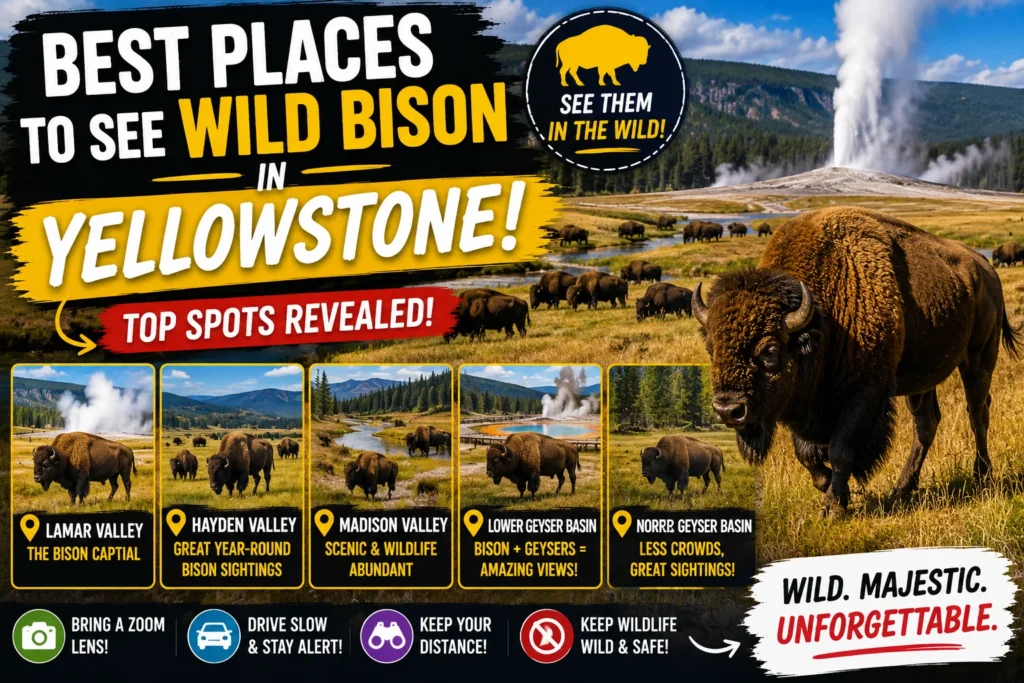
Places to See Wild Bison in Yellowstone The car in front of you slams on its brakes. You look up from your map. And there it is a massive, shaggy, dark brown wall of muscle standing in the middle of the road. A bison. Not in a zoo. Not behind a fence. Just… there. Wild. Unbothered. Ancient.
Your heart skips a beat. This is why you came to Yellowstone. Places to See Wild Bison in Yellowstone
Seeing wild bison in their natural habitat is one of the most thrilling wildlife experiences in North America. And Yellowstone is the only place in the lower 48 where bison have lived continuously since prehistoric times. These aren’t reintroduced animals. They are descendants of the herds that roamed here 10,000 years ago.
But here is the thing. Bison move with the seasons. They follow the grass. Knowing the best places to see wild bison in Yellowstone means knowing where they graze in spring, summer, and fall. Show up in the wrong spot, and you might see nothing but empty meadows. Places to See Wild Bison in Yellowstone
I have spent years tracking these gentle giants across the park. Let me show you exactly where to go, when to be there, and how to stay safe.
The Quick Answer Where to Find Bison in Yellowstone
Before we dive deep, here is the short version. Places to See Wild Bison in Yellowstone
| Season | Best Locations |
|---|---|
| Spring (April to May) | Hayden Valley, Lamar Valley, Mammoth Hot Springs (lower elevations) |
| Summer (June to August) | Lamar Valley (morning/evening), Hayden Valley (avoid midday heat) |
| Fall (September to October) | Hayden Valley (rut/mating season action), Lamar Valley |
| Winter (November to March) | Northern Range (from Gardiner to Cooke City only road open year-round) |
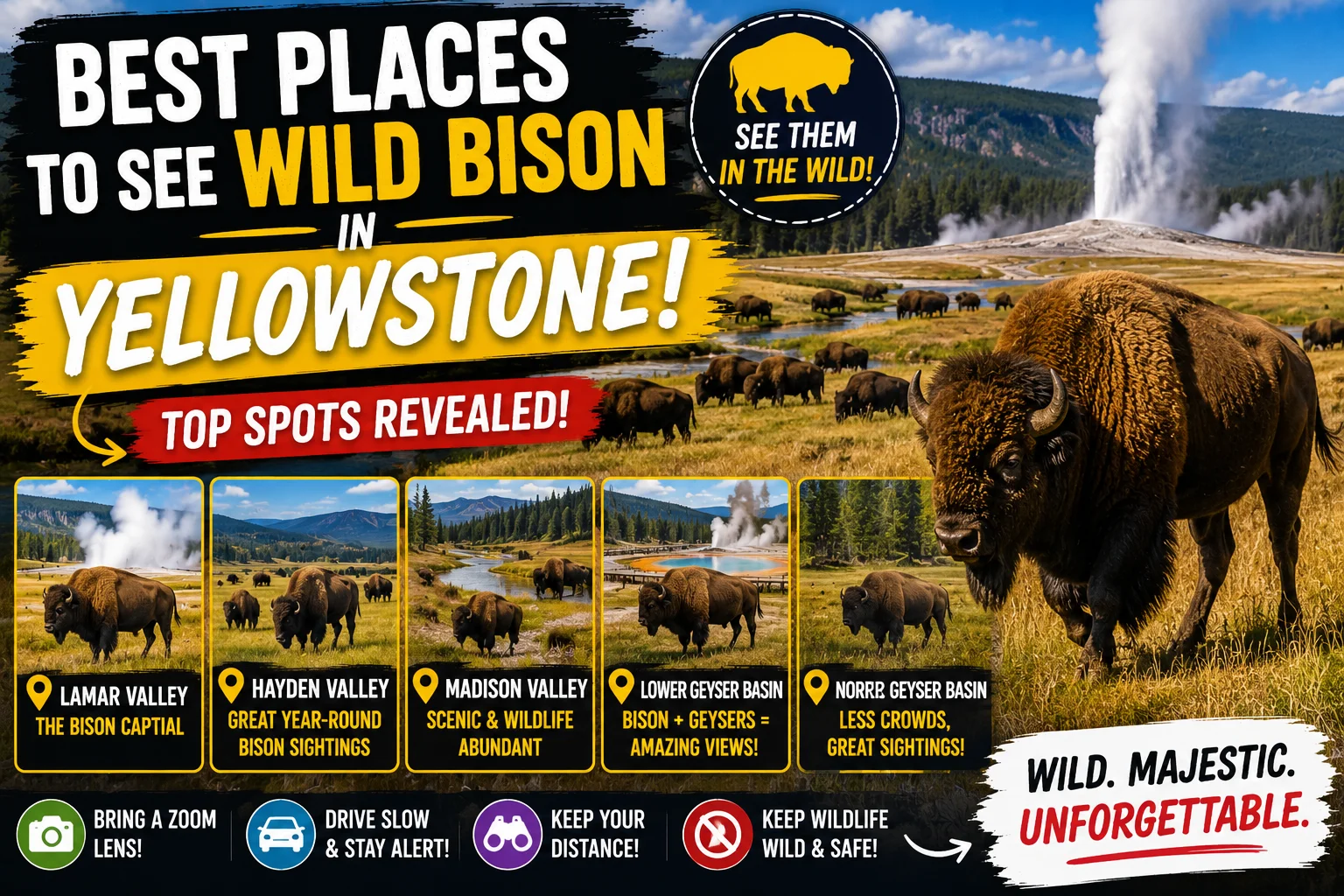
The single best spot overall: Lamar Valley (known as the “Serengeti of North America”).
The single best time: Sunrise (5:30 to 7:30 AM) or sunset (6 to 8 PM) in summer.
Now, let me walk you through each location.
Lamar Valley
Location: Northeast corner of Yellowstone, east of Tower Roosevelt
Best time to visit: Sunrise or sunset, May to October
Why it is #1: Largest, most consistent bison herds in the park
Lamar Valley is the crown jewel of bison viewing. Wide open meadows, a winding river, and mountains on all sides. The bison here gather in massive herds sometimes 1,000+ animals grazing, wallowing in dust, and crossing the road without a care in the world.
What makes Lamar special:
- The valley is wide and open, so you can see herds from a mile away
- Bison are here year round (though they move to lower elevations in winter)
- You also have excellent chances of seeing wolves, pronghorn, bighorn sheep, and grizzly bears
Best pull offs and viewpoints Places to See Wild Bison in Yellowstone
- Lamar River Bridge (park on the west side, walk to the bridge)
- Crystal Creek (short walk from the road to a raised viewing platform)
- Pebble Creek Campground area (quieter, fewer cars)
Pro tip: Bring binoculars (or a spotting scope if you have one). The bison are often a few hundred yards off the road. Binoculars turn a brown dot into a massive, breathing animal.
Getting there: From Tower-Roosevelt junction, drive east on the Northeast Entrance Road for 20 miles. The valley is between Tower and Cooke City.
Hayden Valley Places to See Wild Bison in Yellowstone
Location: Central Yellowstone, between Canyon Village and Lake Yellowstone
Best time to visit: Early morning (6 to 8 AM) or late afternoon (5 to 7 PM), June to September
Why it is famous: Bison traffic jams (literally)
Hayden Valley is the other great bison destination. In summer, hundreds of bison gather here to graze on the lush grasses. They often cross the road at the most inconvenient times which means you get to sit in your car and watch them walk past your window.
What makes Hayden special:
- The valley is narrow and flanked by hills, so bison are often close to the road
- The Yellowstone River winds through, creating a stunning backdrop
- Great birdwatching (sandhill cranes, pelicans, ducks)
Best pull offs and viewpoints:
- Hayden Valley Overlook (large parking area, short boardwalk)
- Alum Creek (small pull off, often has bison crossing the road)
- Mary Mountain Trailhead (good for bison at a distance)
The traffic reality: On summer afternoons, “bison jams” can back up traffic for miles. Be patient. Do not honk. Do not get out of your car. Just enjoy the show.
Pro tip: Go to Hayden Valley at sunrise. The light is golden, the crowds are absent, and the bison are most active. By 9 AM, the valley starts heating up, and the bison head to the trees.
Getting there: On the Grand Loop Road between Canyon Village and Lake Yellowstone (about 10 miles south of Canyon).
Mammoth Hot Springs to Gardiner Places to See Wild Bison in Yellowstone
Location: North entrance road (from Mammoth Hot Springs to the town of Gardiner, MT)
Best time to visit: Year-round, but especially winter (November to March)
Why it is unique: Only road open in winter, bison here 365 days a year
The northern range is the only part of Yellowstone that stays open to cars in winter. The bison here are hardy. They survive subzero temperatures, deep snow, and howling wind. In winter, they gather near the road (the wind sweeps the pavement clear, making it easier to walk). Places to See Wild Bison in Yellowstone
What makes this area special Places to See Wild Bison in Yellowstone
- Year round access (the only bison viewing in winter)
- Bison are often right next to the road (snow forces them to lower elevations)
- You can combine with a snowcoach tour into the interior
Best spots in winter Places to See Wild Bison in Yellowstone
- Around the Roosevelt Arch (entrance to Gardiner)
- The first 5 miles of the North Entrance Road (from Gardiner to Mammoth)
- Mammoth Hot Springs terraces (bison graze on the lawns)
Pro tip: Visit the Albright Visitor Center in Mammoth. The rangers post daily wildlife sighting reports on a whiteboard. They will tell you exactly where bison were seen that morning.
Getting there: Enter Yellowstone through the North Entrance (Gardiner, MT) or drive north from Mammoth Hot Springs. Places to See Wild Bison in Yellowstone
Click for more: How to Save Money on Disneyland Paris vs California
Tower Roosevelt Junction Places to See Wild Bison in Yellowstone
Location: Junction of the Northeast Entrance Road and Grand Loop Road
Best time to visit: May to June (calving season) or September to October (rut)
Why it is underrated: Fewer crowds, steep terrain for dramatic photos Places to See Wild Bison in Yellowstone
Tower-Roosevelt is not as famous as Lamar or Hayden. That is exactly why you should go here. The bison herds are smaller, but the landscape is dramatic — steep cliffs, the Yellowstone River cutting through a canyon, and wildlife everywhere. Places to See Wild Bison in Yellowstone
What makes Tower Roosevelt special Places to See Wild Bison in Yellowstone
- Calving grounds (baby bison are orange-red and impossibly cute)
- The Lamar River Trail starts here (good for hiking away from crowds)
- You can see bison from above (climb the hill near the junction for a panoramic view)
- Places to See Wild Bison in Yellowstone
Best pull offs:
- Tower Fall Overlook (short walk to a waterfall, bison often in the meadow)
- The junction itself (park at the general store, scan the hillsides)
Pro tip: In late May and early June, you will see “red dogs” the nickname for baby bison. They are bright orange red, clumsy, and always close to their mothers. Keep a very safe distance (mothers are protective).
Getting there: At the intersection of the Northeast Entrance Road (to Lamar) and the Grand Loop Road (to Canyon and Mammoth). Places to See Wild Bison in Yellowstone
Old Faithful Area Places to See Wild Bison in Yellowstone
Location: Upper Geyser Basin, near Old Faithful geyser
Best time to visit: Early morning (before the crowds arrive) or late evening (after they leave)
Why it surprises people: Bison love geothermal areas
Most people come to Old Faithful for geysers, not bison. But the thermal areas keep the ground warm, the snow melts earlier, and the grass grows greener. Bison know this. In spring and early summer, you will find small bachelor herds lounging near the boardwalks. Places to See Wild Bison in Yellowstone
What makes this area special Places to See Wild Bison in Yellowstone
- You can watch bison with steam rising behind them (incredible photos)
- The bison here are used to people (they wander right next to the boardwalks)
- Combine geysers + bison in one stop Places to See Wild Bison in Yellowstone
Best spots Places to See Wild Bison in Yellowstone
- The boardwalk between Old Faithful and Morning Glory Pool
- The meadows near the Old Faithful Inn
- The Firehole River drive (one-way road south of Old Faithful)
Safety note: Do not approach bison on the boardwalks. Give them 25 yards (75 feet). They can run 35 mph and are unpredictable despite their calm appearance.
Pro tip: Go to Old Faithful at sunrise. The bison are active, the geysers are steaming, and you will have the place almost to yourself. The first bus tours arrive around 9 AM.
Getting there: From the West Entrance (West Yellowstone, MT) or South Entrance (Grand Teton), follow signs to Old Faithful.
Madison River Valley Places to See Wild Bison in Yellowstone
Location: Between West Yellowstone entrance and Madison Junction
Best time to visit: April–June (green-up season)
Why it is overlooked: People drive through without stopping
The Madison River Valley is the first section of park you enter from the West Entrance. Most visitors speed through on their way to Old Faithful. That is a mistake. In spring, the valley turns emerald green, and the bison come to graze. Places to See Wild Bison in Yellowstone
What makes this area special Places to See Wild Bison in Yellowstone
- Elk and bison together (you often see mixed herds)
- The river attracts bison for drinking (good photo ops)
- Less crowded than Hayden or Lamar
- Places to See Wild Bison in Yellowstone
Best pull offs Places to See Wild Bison in Yellowstone
- Madison Picnic Area (park, walk toward the river)
- 7 Mile Bridge (small pull-off, bison in meadows to the south)
- The Gibbon River confluence (where Madison and Gibbon meet)
Pro tip: This is the best area for bison and birds. Watch for sandhill cranes, great blue herons, and bald eagles — all hunting in the same meadows as the bison.
Getting there: Drive east from West Yellowstone entrance for 14 miles. The valley is between the entrance and Madison Junction.
Pelican Valley
Location: East of Fishing Bridge, accessible via hiking trail
Best time to visit: June to September (trail snow-free)
Why it is for adventurers: No cars allowed, you have to hike
Pelican Valley is the wildest bison experience in Yellowstone. No cars. No roads. Just a 4.5-mile (one-way) trail through prime bison habitat. You will see herds in the distance, hear them grunting, and feel like you have stepped back in time. Places to See Wild Bison in Yellowstone
What makes Pelican Valley special Places to See Wild Bison in Yellowstone
- No vehicles (just you, your feet, and the bison)
- Bear activity is high (carry bear spray, make noise)
- The trail follows Pelican Creek through open meadows
The logistics Places to See Wild Bison in Yellowstone
- The trail starts at the Pelican Valley Trailhead (just east of Fishing Bridge)
- The first 2 miles are the best for bison (meadows open up)
- The trail continues another 2.5 miles to Pelican Creek (good for birding)
Safety is critical here: You are walking in bison and grizzly habitat. Stay on the trail. Make noise. Carry bear spray (know how to use it). Do not approach bison — give them 100+ yards.
Pro tip: Go with a ranger-led hike. The park offers guided walks in Pelican Valley several times per summer. Check the schedule at the Fishing Bridge Visitor Center.
Getting there: Park at the Pelican Valley Trailhead on the East Entrance Road (east of Fishing Bridge). The road is open summer only.
Bison Viewing Tips & Safety
Bison are not pets. They are not zoo animals. They are wild, powerful, and responsible for more injuries in Yellowstone than any other animal (including bears).
The rules are simple Places to See Wild Bison in Yellowstone
- Stay 25 yards (75 feet) away from bison. That is about two school bus lengths .
- Stay in your car if bison are near the road. Do not get out for a closer photo.
- If a bison approaches you (yes, they sometimes do), back away slowly. Do not run. Do not make sudden movements.
- Do not honk at bison blocking the road. They will move when they are ready.
- Keep dogs in the car (or better, leave them at home). Dogs stress bison and can trigger a charge.
The most dangerous time: The rut (mating season, July to August). Bulls are aggressive and unpredictable.
The second most dangerous time: Calving season (April to June). Cows are fiercely protective of their orange-red calves.
What to do if a bison charges:
- Run away (bison can run 35 mph for short distances faster than Usain Bolt)
- Put a large object between you and the bison (a tree, a car, a rock)
- Do not play dead (that is for bears, not bison)
Sample Bison focused Itinerary
Day 1 (Lamar Valley Focus)
- 5:30 AM: Drive to Lamar Valley from Roosevelt Lodge or Cooke City
- 6:00 to 9:00 AM: Bison viewing from Lamar River Bridge and Crystal Creek
- 9:00 AM: Breakfast at Roosevelt Lodge (basic but filling)
- 10:00 AM: Hike the 2 mile round trip trail to Lost Lake (bison often near the trail)
- 1:00 PM: Lunch picnic in Lamar Valley
- 5:00 to 8:00 PM: Evening bison viewing (golden hour light)
- Overnight: Roosevelt Lodge or Gardiner
Day 2 (Hayden Valley & Old Faithful)
- 6:00 AM: Drive to Hayden Valley (from Canyon Village)
- 6:30 to 9:00 AM: Bison viewing at Hayden Valley Overlook and Alum Creek
- 10:00 AM: Short hike: Mary Mountain Trail (first 1 mile, good for bison)
- 12:00 PM: Lunch at Canyon Village
- 2:00 PM: Drive to Old Faithful
- 4:00 PM: Explore Upper Geyser Basin boardwalks (bison near geothermal areas)
- 6:00 PM: Dinner at Old Faithful Inn
- 8:00 PM: Evening bison viewing near the Firehole River drive
- Overnight: Old Faithful Lodge or West Yellowstone
Day 3 (Northern Range & Departure)
- 7:00 AM: Drive north from Mammoth to Gardiner
- 8:00 to 10:00 AM: Bison viewing along the North Entrance Road
- 10:00 AM: Visit the Roosevelt Arch (photo op)
- 11:00 AM: Breakfast/brunch in Gardiner
- 12:00 PM: Depart through the North Entrance
Conclusion
Seeing a wild bison in Yellowstone is a privilege. These animals survived near-extinction (from 30 to 60 million to just 541 in 1889) and have made a remarkable comeback. In Yellowstone, they live as they have for thousands of years roaming free, following the grass, and raising their calves.
You can be part of that story. Wake up early. Drive to Lamar Valley. Sit quietly in your car. And watch. You might see a bull roll in a dust wallow. A calf nuzzle its mother. A herd cross the river in single file.
These are moments you cannot get anywhere else. Take them in. Take photos. But mostly, just be present. You are in the presence of the American wilderness.
Have you seen bison in Yellowstone? Drop your best sighting story in the comments. And if this guide helped, share it with a friend planning a park trip.
Frequently Asked Questions (FAQs)
What is the best time of day to see bison in Yellowstone?
Sunrise (5:30 7to :30 AM) and sunset (6 to 8 PM) are best. Bison are most active in cooler temperatures. Midday heat sends them to the trees.
Can I see bison in Yellowstone in winter?
Yes. The Northern Range (Mammoth to Gardiner) is open year-round. Bison gather near the road because snow is shallower.
Are bison dangerous?
Yes. Bison have injured more people in Yellowstone than any other animal. Stay 25 yards (75 feet) away. Do not approach them for selfies.
What is the difference between bison and buffalo?
Technically, “bison” is correct for North America. “Buffalo” refers to African Cape buffalo or Asian water buffalo. But everyone says “buffalo” anyway. Use whichever you prefer.
How many bison live in Yellowstone?
Approximately 5,000 to 6,000 bison in the park. They are divided into two main herds: the Northern Herd (Lamar Valley) and the Central Herd (Hayden Valley).
Q1:
A:
Q2:
A:
Q3:
A:
Q4:
A:
Q5:
A:
Q6: Can I see bison from my car?
A: Yes. Most bison viewing happens from pull-offs and along the road. Stay in your car if bison are near — it is safer and less stressful for the animals.
Q7: What is the best month to see bison?
A: September. The rut (mating season) is winding down, the bulls are still active, and the calves are big enough to be playful. Fall colors add to the experience.
Q8: Can I hike in bison territory?
A: Yes, but take precautions. Make noise, carry bear spray (works on bison too), give bison a wide berth, and do not hike in the dark.
Q9: What should I bring for bison viewing?
A: Binoculars or a spotting scope, a telephoto camera lens, sunscreen, water, snacks, a blanket (for chilly mornings), and patience.
Q10: Where should I stay for the best bison viewing?
A: Roosevelt Lodge (for Lamar Valley), Canyon Village (for Hayden Valley), or Gardiner (for Northern Range in winter). Book 6–12 months in advance.